
Introduction:
Timing is everything in trading. Entering too early or exiting too late can make the difference between profit and loss. One of the simplest and most effective methods to time trades is moving average trading.
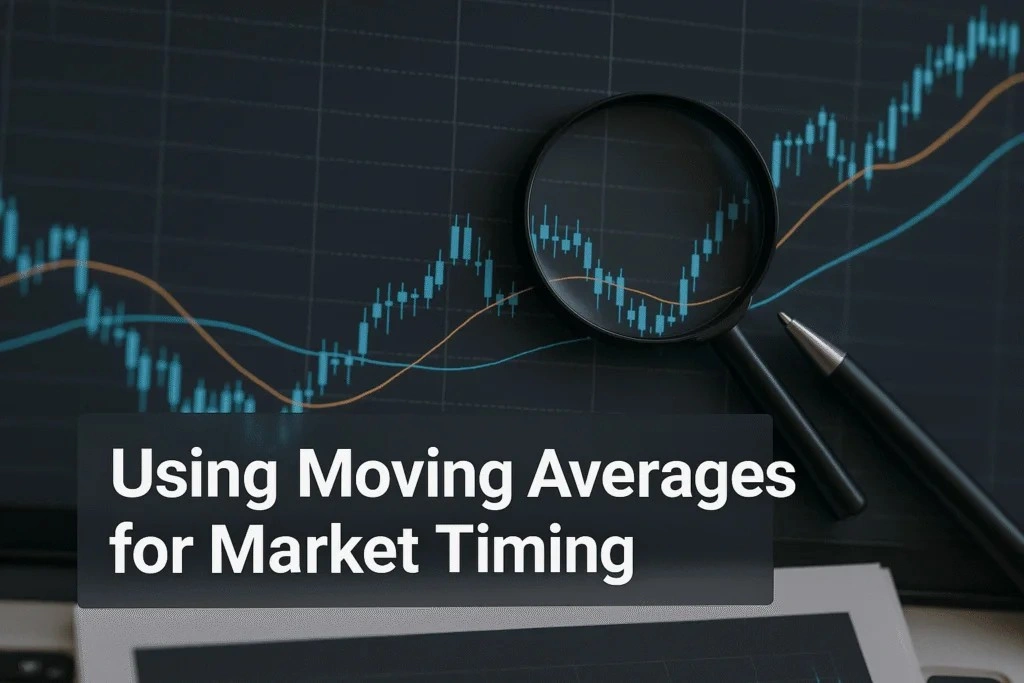
Moving averages are popular trend indicators used to smooth out price data and reveal the market’s true direction. When applied correctly, they help traders identify optimal entry and exit points.
This guide explains how to use moving averages to time the market with precision, covering both single and crossover strategy approaches without unnecessary complexity.
What Is a Moving Average in Trading?
A moving average (MA) is a line that shows the average price of an asset over a set number of periods. It updates as each new period closes, making the line “move.”
Traders use MAs to reduce price noise and highlight the dominant trend. Instead of reacting to every fluctuation, the moving average offers a smoother view of direction and potential reversals.
Types of Moving Averages
There are two main types used in moving average trading:
- Simple Moving Average (SMA):
Calculates the average price over a defined period (e.g., 20, 50, or 200 days).
Example: The 50-day SMA adds the last 50 closing prices and divides them by 50.
- Exponential Moving Average (EMA):
Gives more weight to recent prices, making it more responsive to new information.
Traders often prefer the EMA for shorter time frames or volatile markets.
Why Moving Averages Matter for Market Timing
The main goal of technical analysis is to find the trend and follow it. Moving averages make this process simpler by providing visual guidance on direction and momentum.
Here’s why they are essential:
- Clarify Trend Direction:
An upward-sloping MA signals a bullish trend, while a downward slope indicates bearishness.
- Act as Dynamic Support or Resistance:
Price often bounces off popular MAs like the 50-day or 200-day.
- Generate Entry and Exit Signals:
Crossover points or price interactions with the MA highlight potential trade opportunities.
This approach aligns with the core ideas discussed in our Comprehensive Guide to Forex Technical Analysis, where price action, chart analysis, and trend trading form the foundation of professional decision-making.
How to Use Moving Averages for Trade Entries
Identifying entries using moving averages involves observing the relationship between price and the MA line.
1. Price Above or Below the MA
- When price crosses above a key moving average, it signals potential upward momentum.
- When the price crosses below, it may indicate a bearish shift.
2. The Crossover Strategy
The crossover strategy is one of the most widely used techniques in moving average trading. It involves using two different MAs, one short-term and one long-term.
How It Works:
- Bullish Crossover (Golden Cross):
Occurs when a short-term MA (e.g., 50 EMA) crosses above a long-term MA (e.g., 200 EMA).
Suggests trend reversal to the upside and possible entry.
- Bearish Crossover (Death Cross):
Occurs when the short-term MA crosses below the long-term MA.
Indicates downward pressure and potential selling opportunities.
Why It Works:
The crossover strategy reflects a shift in momentum. When the short-term line moves faster and overtakes the slower line, it means buyers or sellers are gaining control.
How to Use Moving Averages for Trade Exits
Exiting trades effectively is as important as entering them. Moving averages help here, too.
1. Price Crossing Back Over the MA
If you entered a long trade when the price broke above the MA, an exit signal might occur when the price drops back below it.
This ensures profits are protected when trends weaken.
2. Opposite Crossover Signal
In a crossover strategy, the opposite cross often acts as an exit trigger.
For example:
- If you entered on a Golden Cross, exit on a Death Cross.
- If you entered on a Death Cross, exit on a Golden Cross reversal.
3. Trailing Stop with Moving Average
Some traders trail their stop-loss orders below the moving average (for long positions) or above it (for short positions).
This method locks in profits while allowing trends to continue.
Combining Moving Averages with Trend Indicators
While moving averages are powerful on their own, combining them with other trend indicators adds extra confirmation.
Here are some common pairings:
- MACD (Moving Average Convergence Divergence):
Measures the difference between EMAs and confirms momentum strength.
- ADX (Average Directional Index):
Helps determine trend strength. A strong ADX reading supports MA signals.
- Price Action:
Candlestick formations near moving averages often reinforce signal validity.
Common Mistakes When Using Moving Averages
Even experienced analysts sometimes misuse moving averages. Avoid these common pitfalls:
- Using Too Many MAs:
Multiple overlapping lines clutter the chart and create confusion. Stick to one or two key settings.
- Ignoring Market Context:
MAs work best in trending markets. In sideways ranges, signals often fail.
- Chasing Every Crossover:
Wait for confirmation, such as a candle closing beyond the MA or trend strength indicators.
- Neglecting Risk Management:
Always use stop-loss orders. No technical signal guarantees success.
Practical Example: Moving Average in Action
Let’s consider an example using GBP/USD on a 4-hour chart.
- The 50 EMA is sloping upward ; the trend is bullish.
- Price retraces and touches the 50 EMA, forming a bullish engulfing candle.
- The short-term 20 EMA crosses above the 50 EMA, confirming entry.
- A logical stop-loss sits below the last swing low.
- Exit when price closes below the 50 EMA or when the 20 EMA crosses back down.
Advantages of Moving Average Trading
- Simple and Visual, Easy to understand and apply across markets.
- Effective in Trends Captures momentum efficiently.
- Adaptable Works on all time frames and instruments.
- Objective: Reduce emotional decision-making.
How Moving Averages Fit into Forex Technical Analysis
Moving averages are just one part of broader forex technical analysis. They interact with tools like chart analysis, price action, and trend trading to form a complete market strategy.
For a deeper understanding of how these components connect, read the Comprehensive Guide to Forex Technical Analysis. It explains how traders integrate multiple methods to form reliable trading systems.
Developing a Moving Average Trading Plan
Consistency comes from structure. A clear plan helps apply moving averages systematically.
Sample Plan Outline
- Identify Trend: Use long-term MA slope to define direction.
- Find Entry Look for crossover or price interaction with MA.
- Confirm Trend Strength: Use ADX or price action clues.
- Set Stop-Loss Place beyond the recent swing high or low.
- Define Exit: Use opposite crossover or trailing MA stop.
- Review the Log trade data for performance tracking.
Conclusion: Timing the Market with Moving Averages
Moving average trading remains one of the simplest yet most reliable methods for identifying trends, entries, and exits.
By mastering the crossover strategy and understanding trend indicators, technical analysts can trade with structure and clarity.
Moving averages remove noise and reveal what truly matters: direction and momentum. Whether you trade short-term or long-term, their consistent logic provides confidence in every decision.
For further educational resources, explore our Technical Analysis Category to continue building your trading knowledge and skills.