
Introduction
Stops decide whether you survive long enough to win. Most traders set them at random round numbers, then watch price hunt those levels before reversing. The atr trailing stop strategy forex professionals use solves that problem by anchoring your exit to real market volatility instead of guesswork. Average True Range measures how far a pair actually moves, so your stop breathes with the market rather than fighting it. This guide explains what ATR is, why it beats fixed-pip stops, and how to build a trailing exit that locks in gains while letting winners run. You will learn atr stop loss placement forex rules, the multipliers that fit different trading styles, and a step-by-step method for how to set trailing stop with atr on any platform. By the end, you will have a repeatable framework you can test and trust.
What Is ATR and Why It Powers Smarter Stops
Average True Range is a volatility measurement, not a directional signal. It tells you how far a currency pair typically travels in a given period, usually over 14 candles. J. Welles Wilder designed it to capture the largest of three ranges: the current high minus the current low, the current high minus the previous close, and the current low minus the previous close. That third element is what makes ATR honest, because it accounts for gaps and overnight moves that a simple high-low range would miss. The result is a single number, expressed in the price units of the pair, that rises when markets get wild and falls when they go quiet.
This matters enormously for stops. A fixed 20-pip stop means one thing during a sleepy Asian session and something completely different when London opens and ranges triple. Volatility is not constant, so a static stop cannot serve you consistently. By reading the current ATR, you size your exit to the conditions in front of you. When the market expands, your stop widens to avoid premature exits. When it contracts, your stop tightens to protect more of your gains. That adaptability is the entire reason the atr trailing stop strategy forex community keeps coming back to this tool.
It also helps to remember what ATR is not. It will not tell you whether to buy or sell, and a high ATR does not mean price is going up. It simply quantifies movement. Treating ATR as a measuring tape rather than a crystal ball keeps your expectations grounded and your decisions clean.
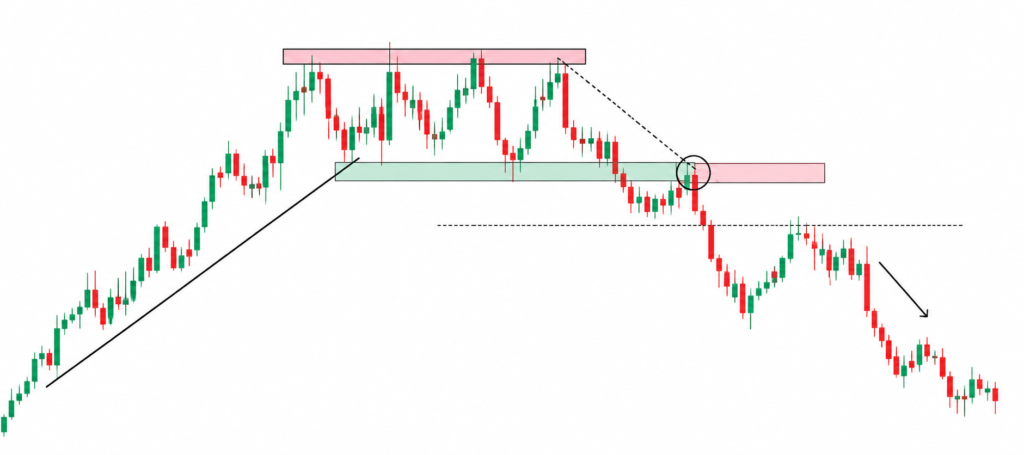
Why Volatility-Based Stops Beat Fixed-Pip Stops
Fixed stops feel comforting because they are simple, but simplicity here hides a real cost. When you place every stop at the same distance regardless of conditions, you guarantee that the level will sometimes sit far too close and sometimes far too wide. A tight stop in a volatile market gets clipped by ordinary noise, and you exit a trade that was actually working. A wide stop in a calm market exposes more capital than the setup deserves. Either way, the fixed approach forces a compromise that the market never agreed to.
Proper atr stop loss placement forex flips that logic. Instead of asking how many pips feel safe, you ask how much room this pair needs right now to stay in the trade without hugging the noise. If EUR/USD shows an ATR of 60 pips on the daily chart, a stop placed 30 pips away is begging to be hit during a normal session, while the same 30 pips might be generous on a quiet minor pair. Anchoring your stop to a multiple of ATR removes that guesswork and replaces emotion with measurement.
There is a psychological benefit too. Traders who use round-number stops cluster at the same obvious levels, and price often dips into those zones before reversing. A volatility-based stop usually sits beyond that clustering, giving your trade a better chance to breathe through the inevitable wicks. You stop donating to the stop-hunting crowd and start placing exits where they actually belong.
How to Set Trailing Stop with ATR: A Step-by-Step Method
Learning how to set trailing stop with atr is straightforward once you break it into stages. Start by adding the ATR indicator to your chart and confirming the period, with 14 as the standard Wilder setting. Read the current ATR value in the pair’s price units and convert it to pips so you know exactly how far one unit of volatility stretches. This single number becomes the foundation for everything that follows.
Next, choose your multiplier based on your trading style, which we cover in the table below. Multiply the ATR by that figure to get your stop distance. For a long position, your initial stop sits that distance below your entry, or more precisely below the recent swing low. For a short, it sits above the swing high. Place it, then let the trade develop without touching it until price moves in your favor.
The trailing part is where the strategy earns its name. As each new candle closes and price advances, you recalculate the stop and move it up to follow, but you never move it backward. If price rises and the new ATR-based level is higher than your current stop, you raise the stop. If price stalls or the new level would be lower, you leave the stop exactly where it is. This ratchet mechanism is the heart of the method, and it ensures you continually lock in profit while still giving the trend room to extend. Many traders prefer to recalculate only on closed candles to avoid being whipsawed by intrabar spikes.
A popular formalized version of this is the Chandelier Exit, which trails the stop from the highest high since entry minus a multiple of ATR (commonly three). It is a clean, rules-based way to apply the same principle without manual recalculation, and most charting platforms offer it natively.
This article is educational and not financial advice; always test any strategy before risking real capital.
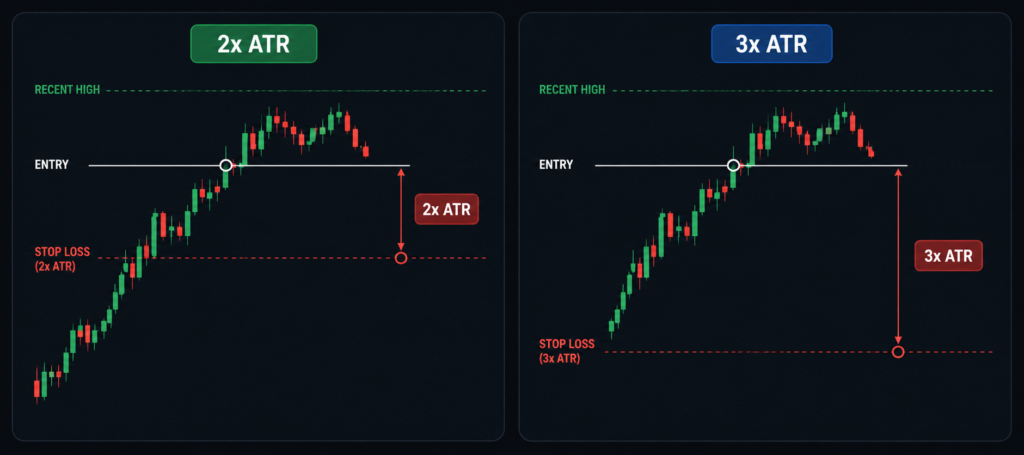
Choosing the Right ATR Multiplier for Your Style
The multiplier is the dial that tunes the whole strategy to your personality and timeframe. A small multiplier creates a tight, reactive stop that locks in gains quickly but gets shaken out of trends early. A large multiplier gives the trade enormous room and captures big moves but surrenders more open profit on each pullback. Neither is right or wrong; the correct choice depends on whether you are scalping minutes or holding for weeks.
The table below offers sensible starting points. Treat these as a baseline to backtest, not as fixed law, because every pair and market regime behaves differently.
| Trading Style | Timeframe | ATR Period | Suggested Multiplier | Trade-Off |
|---|---|---|---|---|
| Scalping | 1M to 5M | 7 to 14 | 1.0 to 1.5 | Tight stops, frequent exits, less drawdown |
| Day Trading | 15M to 1H | 14 | 1.5 to 2.0 | Balanced room versus protection |
| Swing Trading | 4H to Daily | 14 | 2.5 to 3.5 | Wide room, rides multi-day trends |
| Position Trading | Daily to Weekly | 14 to 20 | 3.5 to 5.0 | Maximum room, captures macro moves |
Notice the pattern: the longer your intended hold, the larger your multiplier should be. Short-term traders need their stops close because they take many trades and cannot afford large per-trade losses. Position traders accept deeper pullbacks because the trends they chase are far bigger than any single retracement. Match the multiplier to your holding period first, then refine it through testing on the specific pairs you trade.
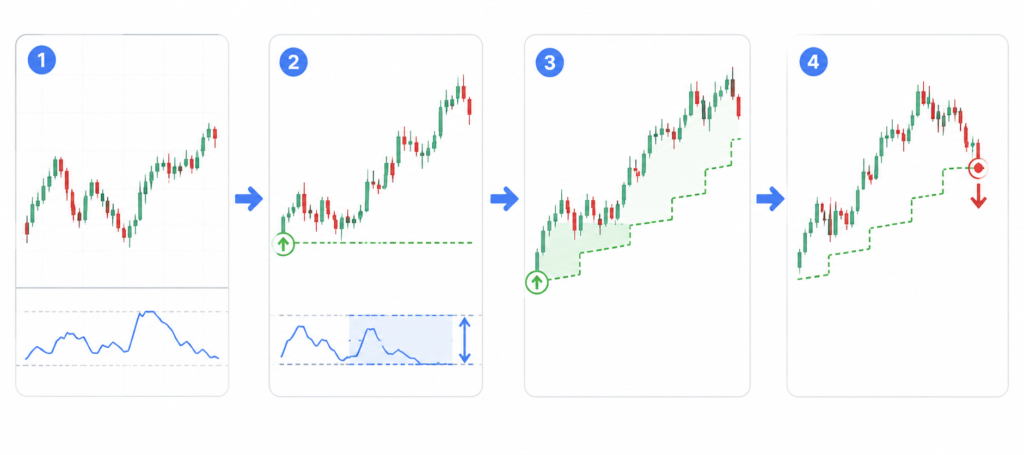
Reading ATR Expansion and Contraction
The real edge appears when you stop treating ATR as a static input and start reading its movement. ATR expansion, when the value climbs candle after candle, signals that volatility is building and a trend or breakout may be underway. During these phases your trailing stop naturally widens, which protects you from being knocked out of an explosive move by ordinary volatility. The indicator is doing exactly what you want without any intervention.
ATR contraction tells the opposite story. When the value steadily falls, the market is coiling and ranges are shrinking, often before a fresh expansion. In these quiet conditions your trailing stop tightens, locking in more of whatever profit you have accumulated. Some traders also use sustained low ATR as a filter, avoiding new breakout entries until volatility confirms genuine momentum rather than a false start. Reading the rhythm of expansion and contraction turns a simple exit tool into a context indicator that improves both entries and trade management.
ATR Stop Placement Across Different Pairs and Assets
Not all pairs move alike, and your stop logic must respect that. Major pairs like EUR/USD and USD/JPY tend to show steadier, more predictable ATR readings, which makes volatility-based stops especially reliable. Cross pairs and exotics swing far more violently, so the same multiplier can produce a dramatically wider stop in absolute pips. This is a feature, not a flaw, because the wider stop reflects the genuinely larger risk those pairs carry.
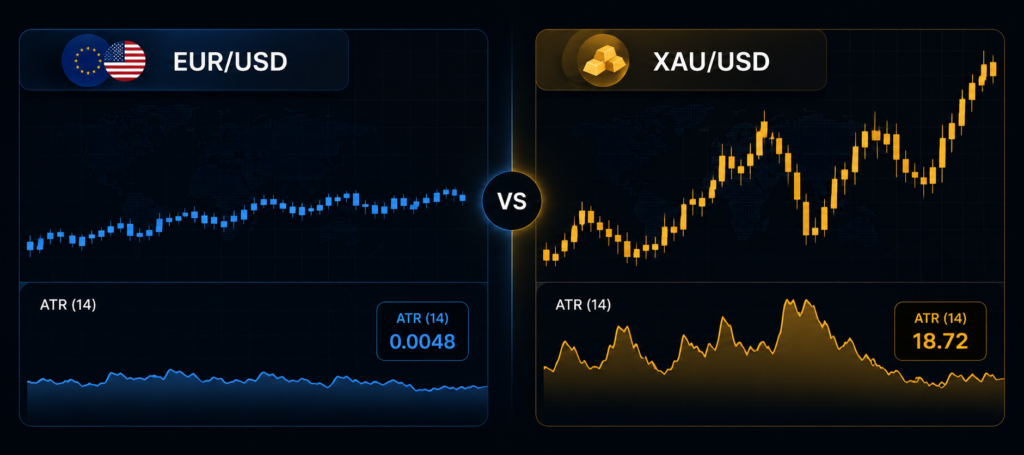
Gold and other volatile instruments demand particular care. XAU/USD can post ATR values many times larger than a quiet currency pair, so a fixed-pip stop would be almost meaningless there, while an ATR-based one scales automatically. The lesson is to let ATR do the translation for you. Rather than memorizing different pip distances for every market, you apply the same multiplier and trust the indicator to convert your risk into the correct distance for each instrument. That consistency is what makes the framework so portable across a diversified watchlist.
Position sizing should follow the same volatility logic. If your ATR-based stop is wider on a volatile pair, reduce your lot size so the dollar risk stays constant. Tying both your stop distance and your position size to ATR keeps your risk per trade uniform no matter how wild or calm the chosen market happens to be.
Common Mistakes That Wreck ATR Trailing Stops
The most frequent error is widening or moving a stop against the trade once it goes red. The entire point of a trailing stop is that it only ratchets in your favor, never away from it. Traders who override the rule in a moment of hope usually turn a small, planned loss into a large, painful one. Discipline here is not optional; it is the strategy.
A second mistake is choosing a multiplier that clashes with the timeframe, such as a tight 1.0 multiplier on a daily swing trade. That mismatch guarantees you will be stopped out of perfectly good trends by routine pullbacks. Equally common is forgetting to scale position size when ATR widens, which silently inflates risk on volatile pairs. Finally, many traders trail intrabar and get whipsawed by single spikes; recalculating on closed candles smooths that noise. Avoid these traps and the method does its job quietly in the background, exactly as intended.
What Top Traders and Research Say
The foundation here belongs to one man. J. Welles Wilder introduced Average True Range in his 1978 book New Concepts in Technical Trading Systems, the same work that gave traders the RSI and the Parabolic SAR. Wilder built ATR specifically to capture volatility including gaps, which is precisely why it underpins modern trailing-stop logic. For broader context, John Murphy’s Technical Analysis of the Financial Markets remains the standard reference and explains how volatility indicators fit into a complete charting approach.
On the research side, Brad Barber and Terrance Odean’s widely cited study “Trading Is Hazardous to Your Wealth” analyzed thousands of retail accounts and found that excessive trading and poor risk discipline, not bad market views, drove most underperformance. That conclusion is a strong argument for systematic, rules-based exits like an ATR trail, which remove the emotional tinkering that the data shows is so costly.
The practitioner wisdom lines up neatly. As trend-following legend Ed Seykota put it, “The trend is your friend except at the end when it bends.” A trailing stop is simply the mechanical way to stay friends with the trend right up until it bends, then step aside before the reversal does real damage.
Frequently Asked Questions
What is the best ATR multiplier for a trailing stop in forex?
There is no single best number, but most traders start between 1.5 and 3.0. Day traders favor the lower end for tighter protection, while swing traders use the higher end to ride longer trends. The right multiplier for your atr trailing stop strategy forex depends on your timeframe and the pair’s behavior, so backtest a few values before committing real capital.
What ATR period should I use for stop loss placement?
The standard is 14, the original Wilder setting, and it works well across most timeframes. Scalpers sometimes drop to 7 or 10 for faster reaction, while position traders may stretch to 20 for smoother readings. Good atr stop loss placement forex starts with 14 and only deviates after testing shows a clear improvement on your specific markets.
How is a trailing stop different from a fixed stop loss?
A fixed stop stays at one price for the life of the trade, while a trailing stop moves in your favor as price advances and locks in profit. Learning how to set trailing stop with atr lets the exit adapt to volatility automatically. The trailing version only ratchets forward and never moves against you, which protects gains during strong trends.
Can I use the ATR trailing stop on any currency pair or on Gold?
Yes, and that portability is a major strength. Because the stop is based on a multiple of current volatility, it scales automatically to each instrument, whether you trade EUR/USD, an exotic cross, or XAU/USD. Just remember to reduce position size when ATR widens so your dollar risk per trade stays consistent.
Does an ATR trailing stop guarantee I will not lose money?
No strategy guarantees profit, and this one is no exception. An ATR trail manages risk and protects open gains, but gaps, slippage, and sudden news can still cause losses beyond your intended level. Treat it as a disciplined risk-management tool, test it thoroughly, and never risk money you cannot afford to lose.
Should I recalculate the ATR stop on every tick or only on closed candles?
Recalculating on closed candles is usually safer because it filters out intrabar spikes that can whipsaw you out of good trades. Tick-by-tick trailing reacts faster but exposes you to single-spike stop-outs. For most traders, updating the stop once each candle closes gives the cleanest balance between protection and patience.
Final Thoughts
The atr trailing stop strategy forex approach succeeds because it respects a truth most traders ignore: markets are not equally volatile from one hour to the next, so your stops should not be either. By anchoring your exit to Average True Range, you give every trade exactly the room it needs, you stop feeding the predictable round-number stop hunts, and you let your winners stretch while your losses stay contained. Pair the right multiplier with your timeframe, recalculate on closed candles, scale position size to volatility, and resist the urge to move a stop against your trade, and you have a robust, repeatable framework that does its work quietly in the background. The edge comes from discipline and testing, not from any magic setting. For more practical forex strategy guides, indicator breakdowns, and trade-management frameworks, keep reading and growing your edge at forextradingboards.com.