

Introduction
Passing an evaluation feels like the finish line, but in reality it is only the starting gun. Keeping a funded account alive and collecting consistent payouts is where the majority of traders quietly struggle. The right funded trading account tips have far less to do with flashy strategies or secret indicators and far more to do with discipline, risk control, and a deep respect for the rules that govern your buying power. The capital is generous, but the rules are strict, and the traders who thrive are the ones who treat those rules as a framework rather than an obstacle.
This guide gives you a practical, repeatable framework for managing a funded account the right way. You will learn how to think about the firm’s capital, how to internalize the rules, how to handle drawdown, how to size your trades, and how to plan your payouts so your profits actually reach your bank account. Treat these principles as a daily routine, and a funded account becomes a dependable income stream instead of a short-lived gamble that ends with a single careless session.

Fig 1.1 :(Funded account trading rules to follow summarized on a one-page trader checklist)
Treat the Capital as Real Money
The first and most important shift is mental. Because the capital technically belongs to the firm, some traders treat it carelessly, sizing up and gambling in ways they never would with their own savings. That detachment almost always ends in a blown account, because reckless trading and strict rules are a guaranteed collision. The mindset you bring to the account shapes every decision you make on it.
Treat every dollar in the account as if it were your own hard-earned money, the kind you would use to pay your rent or your mortgage. When you protect the firm’s capital with that level of care, your risk decisions sharpen instantly and naturally. You stop chasing marginal trades, you size more conservatively, and you become far more patient. This single shift in attitude quietly underpins every other tip in this guide.
Among all the funded trading account tips you will ever read, respecting the capital is the foundation that everything else is built upon. The rules around drawdown, daily loss, and consistency are all really just formal expressions of the same idea: trade responsibly, as a disciplined professional would. Adopt that identity first, and following the specific rules becomes far easier because you are already thinking like the trader the firm wants to fund.
Know Your Rules Before You Trade
You simply cannot follow rules you have never read, and yet a surprising number of funded traders lose their accounts not from bad trades but from breaking a rule they did not fully understand. A perfectly profitable trade can still violate the account if it breaches a hidden consistency requirement or a restriction around news events. Ignorance of the rules is one of the most avoidable ways to fail.
Learning the funded account trading rules to follow is therefore non-negotiable and should happen before your first trade, not after a violation. Study your maximum drawdown, your daily loss limit, any consistency requirements, your minimum trading days, and any restrictions on trading during high-impact news or holding over weekends. Different firms structure these differently, so never assume the rules match a firm you used before.
A practical habit is to write every key rule onto a single page and keep it beside your screen while you trade. When the rules are visible and top of mind, you are far less likely to break one in the heat of a fast-moving market. This small act of preparation removes an entire category of unnecessary failures and lets you focus your energy on actually trading well rather than scrambling to remember what is allowed.
Master the Drawdown
Drawdown is the single biggest account killer in the funded world, so understanding it deeply is essential rather than optional. A static drawdown sets a fixed loss limit that never moves, giving you a stable, predictable floor that is easy to plan around. A trailing drawdown, by contrast, follows your account’s highest balance and tightens as you profit, which can close an account even after a strong run if you give back too much from the peak.
Knowing exactly which type your firm uses changes how you should trade from day one. With a trailing drawdown, locking in gains and avoiding large give-backs becomes critical, because every new high you reach also raises the floor that can end your account. Many traders are shocked to lose a funded account after a profitable week simply because they did not understand how their trailing drawdown was calculated.
Before trading real size, walk through a few scenarios in your head. Picture a winning streak followed by a normal pullback and ask where your drawdown limit would sit. If the answer makes you uncomfortable, adjust your sizing or reconsider whether the firm’s structure suits your style. This kind of preparation turns drawdown from a hidden trap into a known, manageable boundary that you can confidently trade within.
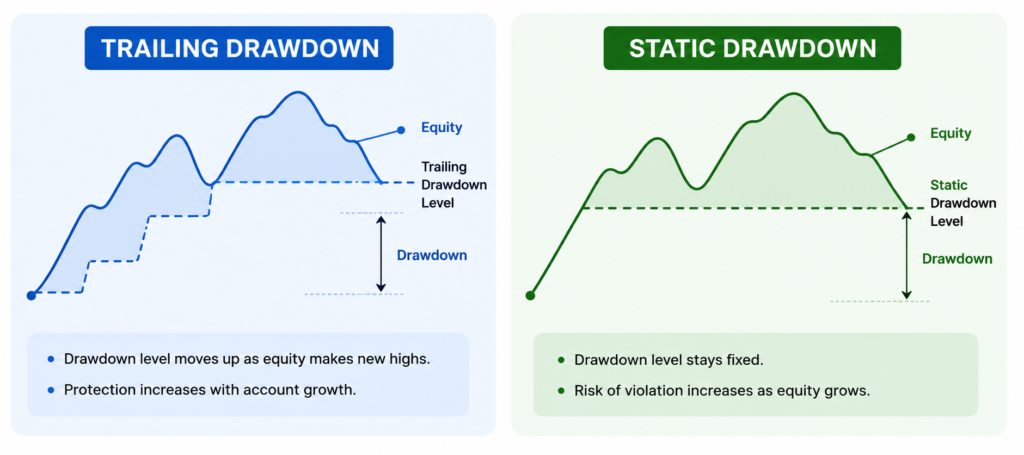
fig 1.2: (Funded trading account tips explaining trailing versus static drawdown with a chart)
Risk Small, Win Consistently
The core of how to manage a funded trading account comes down to conservative, consistent position sizing. Risk a small, fixed amount per trade so that no single loss ever threatens the account as a whole. Many of the most successful funded traders risk well under one percent of the account on any given position, which keeps each individual outcome almost irrelevant in the bigger picture.
Small, fixed risk accomplishes three powerful things at once. It allows you to survive the inevitable losing streaks without breaching your drawdown, it keeps your emotions calm because no trade carries crushing weight, and it satisfies the consistency rules that penalize accounts dependent on one or two enormous winning days. Steady, repeatable gains keep accounts alive far longer than dramatic home-run swings ever could.
| Step | Action |
|---|---|
| Before trading | Review your rules and mark key levels and bias |
| Per trade | Risk a fixed small percentage and set the stop loss first |
| Daily limit | Stop trading the moment you hit the loss cap, no exceptions |
| After trading | Journal your results, reasoning, and emotions |
| Weekly | Review your journal and refine the plan |
Respect the Daily Loss Limit
The daily loss limit exists for one clear reason: to stop a single bad day from ending your entire account. The discipline to walk away the moment you hit it is one of the sharpest dividing lines between funded traders who last and those who flame out within weeks. The limit is not a punishment; it is a circuit breaker designed to protect you from your own worst moments.
When you reach the daily loss limit, close the platform and step away from the screen. Do not try to win the money back, and do not convince yourself that the next trade will fix everything. Revenge trading after a rough morning is one of the fastest and most common routes to a rule violation, and it has ended countless promising funded accounts in a single afternoon of frustration.
The traders who endure are the ones who treat each day as a self-contained chapter. A losing day is simply closed and forgotten, not battled until it gets worse. By accepting the small, contained loss and returning fresh the next session, you preserve both your capital and your psychology. Over time, this calm acceptance of bad days is what allows the good days to accumulate into real, withdrawable profit.
Plan Your Payouts Strategically
Earning a profit is only half the job; safely withdrawing it is the other half, and it is the half most traders overlook. Every firm has its own payout schedule, minimum trading days, and consistency conditions tied to withdrawals, and misunderstanding any of these can leave a valid profit stuck in the account. Knowing the payout rules is just as important as knowing the risk rules.
Plan your trading around these requirements rather than bumping into them by accident. If your firm enforces a consistency rule that no single day can represent too large a share of total profit, then spreading your gains across several steady sessions matters more than hitting one huge win. Reaching the profit target while respecting these conditions ensures your hard-earned gains actually clear into your account instead of being withheld on a technicality.
Thinking about payouts from day one also shapes healthier trading behavior. When you trade with the goal of producing steady, consistent, withdrawable profit, you naturally avoid the reckless, lumpy swings that both threaten the account and trip consistency rules. The payout structure, properly understood, becomes a guide that nudges you toward exactly the kind of disciplined trading that keeps funded accounts alive in the first place.
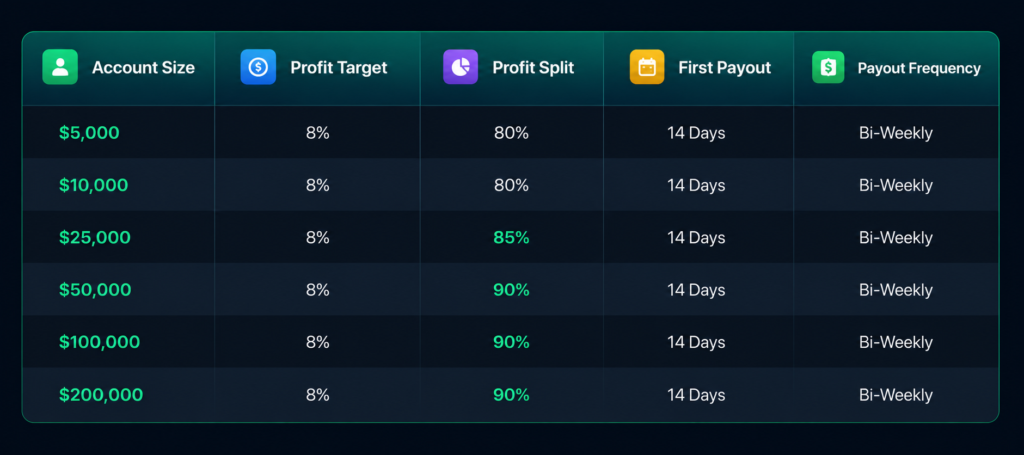
Fig 1.3: (Funded trading account payout schedule and withdrawal planning example )
Keep a Funded Account Journal
A trading journal is your performance mirror, and on a funded account it is more valuable than ever. By logging every trade along with your reasoning and your emotional state, you build a clear record of what actually helps and hurts your account over time. Memory is unreliable and biased, but a journal tells the truth about your patterns, your discipline, and your leaks.
Reviewing that journal weekly transforms raw, scattered experience into deliberate, structured improvement. You begin to see which setups consistently pay, which times of day cost you money, and exactly where your discipline tends to slip under pressure. Those insights are invisible in the moment but obvious in the aggregated data, and they point directly to the changes that will protect your account and grow your payouts.
Over the long run, this feedback loop is what quietly transforms a funded trader into a consistent earner. The journal holds you accountable to your own rules, reinforces the habits that work, and exposes the ones that do not. Few practices offer such a high return for so little daily effort, which is precisely why the most professional funded traders treat journaling as a non-negotiable part of their routine.
Avoid Common Funded-Account Mistakes
The most frequent ways traders lose funded accounts are painfully avoidable: over-leveraging to hit targets faster, ignoring or misunderstanding a trailing drawdown, and revenge trading through the daily loss limit. Any one of these can end an account in a single session, and they share a common root in impatience and the desire for quick results. Recognizing them in advance is half the battle.
The cure for all three is the same blend of patience, conservative sizing, and respect for the rules. Trade small, let consistent execution compound across many sessions, and treat every rule as a boundary you simply do not cross. A funded account is not a sprint toward a fast payout; it is a marathon of disciplined, unremarkable days that quietly add up to a reliable income. Protect the downside relentlessly, and the upside takes care of itself.
Frequently Asked Questions
What are the most important funded trading account tips?
The most important funded trading account tips are treating the capital as if it were your own money, knowing every rule before you trade, mastering your drawdown type, risking only a small fixed amount per trade, and respecting the daily loss limit without exception. Together these protect both the account and your future payouts. They are less about clever strategy and more about consistent, professional discipline applied every single session.
How do I manage a funded trading account successfully?
Learning how to manage a funded trading account comes down to conservative position sizing, strict adherence to the firm’s risk rules, and journaling every trade you take. Steady, repeatable gains keep accounts alive far longer than aggressive swings, because they avoid both large drawdowns and consistency-rule violations. Build a simple daily routine of reviewing rules, sizing small, honoring your daily limit, and journaling, then repeat it relentlessly.
What funded account trading rules should I follow most closely?
The key funded account trading rules to follow are the maximum drawdown, the daily loss limit, the consistency requirements, the minimum trading days, and any restrictions around news events or weekend holds. Violating any one of these can instantly end the account, regardless of how profitable you are. Write them on a single page and keep them visible while you trade so they stay top of mind.
Why do funded traders lose their accounts?
Most funded traders lose by over-leveraging in a rush to hit targets, by misunderstanding or ignoring a trailing drawdown, or by revenge trading after hitting the daily loss limit. All three stem from impatience and the desire for fast results. Conservative, fixed-percentage risk combined with strict rule discipline prevents nearly all of these failures and keeps the account alive long enough to produce real income.
How can I make sure I actually get paid?
To ensure you get paid, understand your firm’s payout schedule, minimum trading days, and any consistency conditions before you start, then plan your trading to satisfy them. Spreading gains across several steady sessions rather than relying on one enormous day helps you meet consistency rules. Hitting your target while respecting these conditions ensures your profits clear into your account instead of being withheld on a technicality.
Should I risk more to hit the profit target faster?
No, increasing your risk to reach the target faster is one of the most common and costly mistakes. Larger positions move you closer to your drawdown and daily loss limits, and a single bad sequence can end the account before you ever withdraw. Steady, small risk reaches the target more reliably, even if it takes a little longer, because it keeps you in the game and inside the rules.
Final Thoughts
Keeping a funded account is ultimately a test of discipline far more than a test of raw talent, and the best funded trading account tips all point in the same direction: protect the capital, respect the rules, and size small enough that no single day can hurt you. Learn how to manage a funded trading account by mastering your specific drawdown type, risking a fixed small percentage on every trade, and honoring your daily loss limit as an unbreakable boundary. Treat the funded account trading rules to follow as a checklist you review before every session, keep an honest journal that exposes your patterns, and plan your payouts around the firm’s exact requirements so your profits actually clear. Do all of this consistently, day after unremarkable day, and a funded account stops being a fragile gamble and becomes a genuine, scalable, and reliable income stream that rewards your patience and professionalism.