
Introduction
Prop firms have become one of the hottest topics in trading, promising aspiring traders access to large amounts of capital in exchange for passing an evaluation. But this raises an obvious, important question that every trader should ask before handing over a fee: how does a prop firm make money? Understanding a firm’s revenue model is not just academic curiosity it tells you whether the firm’s interests align with yours or work against you. In this guide, we give you the honest answer, explaining how prop firms earn revenue through several different streams and tackling the controversial question head-on: do prop firms profit from losing traders?
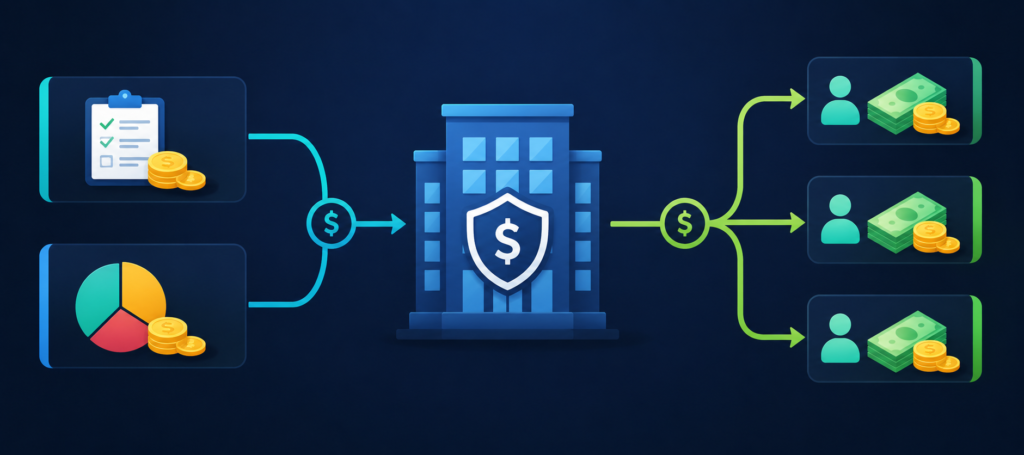
How Does a Prop Firm Make Money? The Core Revenue Streams
To understand how does a prop firm make money, you have to recognize that firms typically earn from several streams at once, not just one. The most visible is evaluation fees. Traders pay to attempt a challenge, and since most traders fail their first attempt and many pay for resets or new attempts, these fees form a substantial revenue base. A firm with thousands of paying applicants generates significant income from fees alone.
The second major stream, for reputable firms, is a share of profits from successful funded traders. When a funded trader earns money, the firm keeps an agreed portion often a meaningful slice of those profits. A firm that successfully identifies and funds genuinely skilled traders earns a steady, sustainable income as those traders generate returns over time. This is the revenue model that aligns the firm’s interests with the trader’s.
A third stream comes from the spread between the two sides of the business. Many firms operate on a model where most evaluation accounts are simulated, and the firm decides which traders’ performance to mirror in the real market. Profits from fees and from the gap between failing and succeeding traders contribute to the bottom line. Understanding this mix is the key to evaluating any firm honestly.
How Prop Firms Earn Revenue From Fees
Evaluation fees are the most straightforward way prop firms earn revenue, and they are entirely legitimate when the firm is transparent. A trader pays a fee to attempt an evaluation, and that fee covers the firm’s costs, its risk in potentially funding the trader, and its profit margin. Because trading is genuinely difficult and most people who attempt evaluations fail, the firm collects far more fees than it pays out in funded-account success.
Reset and retry fees add to this stream. When a trader breaches an evaluation but wants to try again, many firms offer a discounted reset or require a new purchase. Given how common it is for traders to fail repeatedly before passing if they pass at all these recurring fees can become a major revenue contributor. A motivated trader chasing a funded account may pay several fees over time.
This fee-based model is not inherently predatory. Firms incur real costs and take real risk, and charging for evaluations is reasonable. The concern arises only when a firm relies almost entirely on fees from failing traders and designs its rules to maximize failures rather than to identify skilled traders. The model becomes a problem when the firm profits more from your failure than from your success, which is exactly the conflict to watch for.
Do Prop Firms Profit From Losing Traders?
This is the controversial heart of the matter: do prop firms profit from losing traders? The honest answer is nuanced. In the evaluation stage, yes firms profit when traders fail, because failed traders forfeit their fees and may pay for resets. A trader who never passes is, from a pure fee perspective, a paying customer who costs the firm nothing in payouts. This creates an inherent tension in the model.
However, the best firms do not want you to fail, and here is why: a firm that genuinely funds and shares profits with skilled traders earns far more, sustainably, from their ongoing success than from a single forfeited fee. Reputable firms invest in identifying real talent because funded traders who consistently profit are valuable long-term assets. Their business depends on a healthy pipeline of successful traders generating shared profits.
The danger lies with firms whose model leans heavily on the failure side. Some operate with rules engineered to make consistent success extremely difficult, profiting primarily from a churn of failing, fee-paying applicants. These firms have little incentive to see you succeed.
| Aspect | Reputable Firm | Predatory Firm |
|---|---|---|
| Main revenue | Profit split with winners plus fair fees | Fees from constant failures |
| Rules | Clear, challenging but achievable | Hidden traps, near-impossible |
| Payout record | Reliable, prompt | Slow, excuses, disputes |
| Trader success | Actively wants it | Indifferent or obstructive |
| Sustainability | Long-term trader relationships | Churn of new applicants |
The takeaway is that whether prop firms profit from losing traders depends entirely on the firm. Choose one whose revenue depends on your success, not your failure.

How to Tell a Firm's Interests From Its Model
Since revenue models determine whether a firm is on your side, learning to read those models protects you. A firm with a strong, verifiable record of paying funded traders signals that its business depends on trader success. If many traders publicly confirm receiving prompt, hassle-free payouts, the firm clearly profits from funding winners, which aligns its interests with yours.
Conversely, certain signs reveal a firm leaning on the failure side. Rules that seem designed to trip traders up extremely tight trailing drawdowns, hidden consistency requirements, restrictive time limits, and vague conditions buried in fine print suggest a model built around churning failing applicants. Difficulty withdrawing profits, frequent disputes, and a poor payout reputation are major red flags pointing to a firm that does not truly want you funded.
Transparency is the clearest tell. Firms confident in their model make their rules easy to find and understand, publish their payout track record, and communicate clearly. Firms relying on failure obscure their terms, pressure you with urgency tactics, and make the path to actual income murky. By examining how a firm earns and how it treats successful traders, you can usually tell whose side its business model is on before you ever pay a fee.
Are Prop Firms Legit?
Given all this, a fair question is whether prop firms are legitimate at all. The answer is that the model itself is legitimate and can genuinely benefit both sides. A skilled trader gains access to capital they could never fund themselves, while the firm earns from fair fees and a share of the profits that talented traders generate. When both parties are honest, it is a real partnership that creates value.
The industry, however, is unregulated in many respects and varies wildly in quality. Excellent firms operate transparently and pay reliably, while a fringe of predatory operators exploit the model to profit from failure. This means the burden falls on you to do your due diligence. The legitimacy of any given firm is something you must verify through its track record, its transparency, and the experiences of real funded traders.
Approached wisely, a prop firm can be a powerful tool for a disciplined, profitable trader. The key is to treat the decision seriously: understand how does a prop firm make money in general, then investigate how your specific firm earns and whether it has a genuine history of funding and paying traders. Choose a firm whose success depends on yours, and the relationship can be mutually rewarding.

What Top Traders and Research Say
The principle of aligning incentives is fundamental to sound financial relationships, and it applies directly here. In The Psychology of Money, Morgan Housel emphasizes understanding the incentives behind any financial arrangement, because incentives drive behavior more than intentions do. A prop firm whose incentives reward your success will behave very differently from one whose incentives reward your failure, regardless of its marketing.
Research on trader outcomes provides important context for the fee model. Barber and Odean’s study “Trading Is Hazardous to Your Wealth” found that most active retail traders lose money over time. This statistical reality is precisely why fee-based evaluation models can be so profitable for firms: most applicants will fail simply because most retail traders struggle. Understanding this helps you see why evaluation fees are such a reliable revenue stream and why some firms exploit it.
As Warren Buffett advised, “Never invest in a business you cannot understand.” The same applies to choosing a prop firm. If you cannot understand how the firm makes money or whether its interests align with yours, you should be cautious. A firm that is transparent about its model and has a proven record of paying traders is far easier to trust than one whose revenue logic is hidden behind hype and fine print.
Frequently Asked Questions
How does a prop firm make money?
The answer to how does a prop firm make money is that firms typically earn from several streams at once. The most visible is evaluation fees, paid by traders attempting challenges, which add up because most traders fail and many pay for resets. The second, for reputable firms, is a share of the profits generated by successful funded traders. A third comes from the structure of the business, where many accounts are simulated and the firm benefits from the gap between failing and succeeding traders. The healthiest firms rely heavily on sharing profits with genuinely skilled traders.
How do prop firms earn revenue beyond evaluation fees?
Beyond fees, prop firms earn revenue primarily by taking a share of the profits that funded traders generate. When a skilled funded trader makes money, the firm keeps an agreed portion, creating a sustainable income stream from ongoing trader success. Reputable firms invest in identifying real talent precisely because consistently profitable traders are valuable long-term assets. Some firms also earn from spreads, commissions, or the structural gap between simulated and live performance. The most trustworthy firms depend significantly on winning traders, which aligns their interests with yours rather than against you.
Do prop firms profit from losing traders?
The honest answer to do prop firms profit from losing traders is that it depends on the firm. In the evaluation stage, firms do profit when traders fail, since failed traders forfeit fees and may pay for resets. However, the best firms earn far more, sustainably, from funding and sharing profits with skilled traders than from forfeited fees, so they genuinely want you to succeed. The danger lies with predatory firms whose rules are engineered to maximize failure, profiting mainly from a churn of failing, fee-paying applicants. Choosing a firm whose revenue depends on your success is essential.
Are prop firms legitimate or a scam?
The prop firm model itself is legitimate and can benefit both sides: skilled traders gain access to capital, and firms earn from fair fees and profit splits. However, the industry is largely unregulated and varies enormously in quality. Excellent firms operate transparently and pay reliably, while a fringe of predatory operators exploit the model to profit from failure. No blanket answer applies, so the burden falls on you to verify each firm through its payout record, transparency, and real funded-trader experiences. Approached with due diligence, a reputable prop firm can be a genuine, valuable partnership.
How can I tell if a prop firm wants me to succeed?
You can tell a firm’s true incentives by examining its payout record, its rules, and its transparency. A firm with a strong, verifiable history of paying funded traders promptly clearly profits from trader success, aligning its interests with yours. Warning signs of a failure-based model include extremely tight trailing drawdowns, hidden consistency or time rules, vague fine print, and difficulty withdrawing profits. Transparent firms make their rules and payout history easy to find, while predatory ones obscure terms and use urgency tactics. Verify how a firm earns and how it treats winners before paying any fee.
Final Thoughts
The question how does a prop firm make money is one every trader should answer before paying a single fee, because the answer reveals whether the firm is a genuine partner or a fee machine in disguise. Firms earn through a mix of evaluation fees, profit splits with successful funded traders, and the structural economics of their business. Understanding how prop firms earn revenue lets you cut through the marketing and see what truly drives each firm. The controversial question do prop firms profit from losing traders has a nuanced answer: in the evaluation stage, yes, but the best firms earn far more from funding and paying skilled traders sustainably, which means they genuinely want you to win. Your job is to choose wisely. Verify the payout record, read every rule, watch for hidden traps, and favor firms whose success depends on yours.
This article is for educational purposes only and does not constitute financial advice. Prop firm evaluations carry real costs and risk, and most traders fail them. Only risk fees and capital you can afford to lose.
Choose a firm that is on your side. Visit forextradingboards.com for honest prop firm breakdowns, payout insights, and market analysis built to help you make informed, confident decisions.