
Introduction
Among the many tools in the Inner Circle Trader toolkit, few generate as much confusion and as much opportunity as the ICT breaker block. It is a reversal concept built on a simple but powerful idea: when price fails to continue in one direction and aggressively reverses, the structure left behind becomes a high-probability area for future trades. Master it, and you gain a precise way to time entries at the moment the market shifts hands. Misunderstand it, and you will mark the wrong zones and wonder why price keeps blowing through them. In this guide, we break down exactly what a breaker block is, how to build a reliable breaker block trading strategy, and how to settle the common confusion of ICT breaker block vs order block. You will learn to identify breakers correctly, trade them with discipline, and combine them with the wider ICT framework.
What Is an ICT Breaker Block?
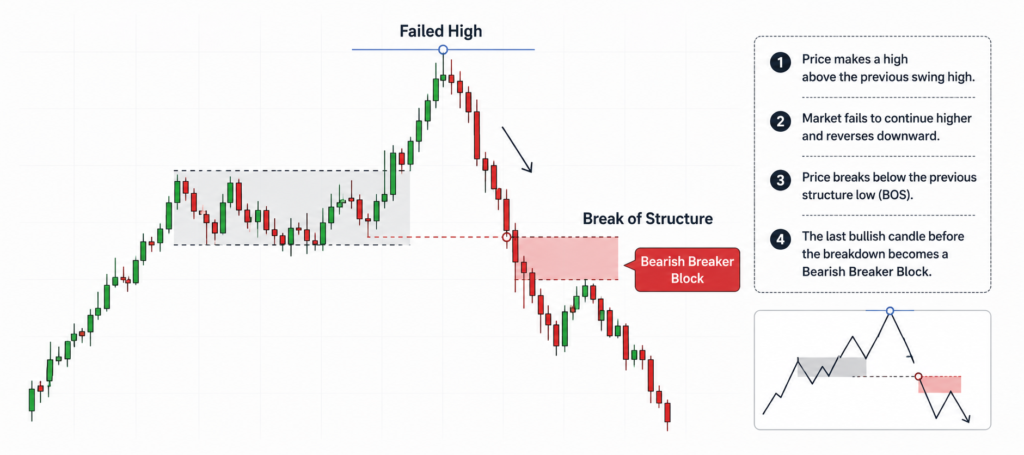
An ICT breaker block is a specific price zone created when the market structure shifts after a failed move. Picture price making a swing high, pulling back, and then pushing to a higher high only to reverse sharply and break below the earlier swing low. That failure to continue higher, followed by a decisive break of structure to the downside, leaves behind a breaker block: the last up-candles before the reversal, which now act as resistance.
The logic rests on order flow and trapped traders. When price makes that final push and then fails, the traders who bought the breakout are now offside. As price returns to the breaker zone, those trapped buyers look to exit at breakeven, and institutional sellers add to positions, creating a wall of selling pressure. The breaker block marks where that pressure is likely to reappear.
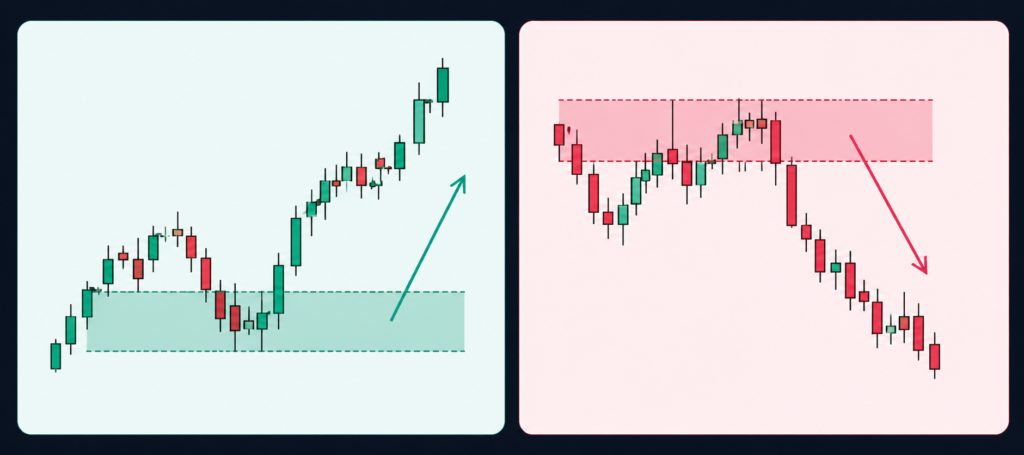
A bullish breaker is the mirror image. Price makes a swing low, rallies, makes a lower low, then reverses powerfully and breaks above the prior swing high. The down-candles before that bullish reversal become the bullish breaker block a support zone where trapped sellers and institutional buyers are expected to drive price higher on a retest.
ICT Breaker Block vs Order Block
The confusion over ICT breaker block vs order block is the single biggest hurdle for newcomers, so let us settle it clearly. An order block is the last opposing candle before a strong move that continues in the new direction it marks where institutions entered to drive price, and price often returns to it before continuing. An order block is fundamentally a continuation concept built around the origin of a move.
A breaker block, by contrast, is a reversal concept built around a failed move. It forms only after price fails to continue, sweeps liquidity, and then breaks structure in the opposite direction. The breaker is the failed order block the candles that should have pushed price one way but instead became the launchpad for a reversal. Where an order block expects continuation, a breaker expects a turn.
| Feature | Order Block | Breaker Block |
|---|---|---|
| Concept type | Continuation | Reversal |
| Forms when | Move continues from origin | Move fails, structure breaks |
| Trapped traders | Not central | Central to the logic |
| Bias on retest | Continue the trend | Reverse against prior move |
| Best context | With the trend | At trend exhaustion or shift |
In short, the order block says the move will continue, while the breaker says the move failed, and now it reverses. Knowing which you are looking at determines whether you trade with or against the recent direction.
How a Breaker Block Forms Step by Step
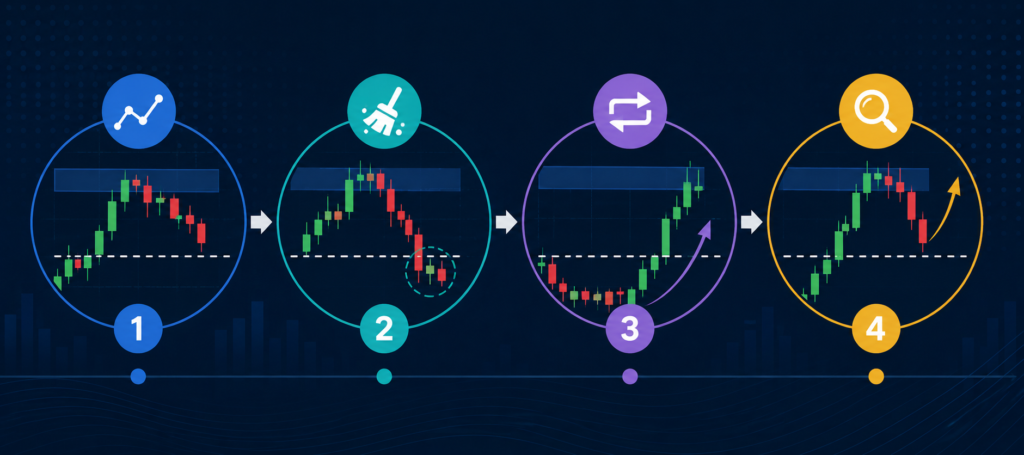
A valid breaker block follows a recognizable sequence, and learning to spot it in order keeps you from marking random zones. First, price establishes a swing point a clear high or low that creates a level of liquidity. Second, price runs past that level, often sweeping the stops resting beyond it, creating the impression of a breakout.
Third, and crucially, price fails to hold the new extreme and reverses with force, breaking back through structure in the opposite direction. This sharp reversal, ideally accompanied by displacement a strong, decisive move confirms that the breakout was a trap. The candles that formed just before the failed extreme are now your breaker block.
Fourth, you wait for price to return to that breaker zone. The retest is your opportunity. When price trades back into the breaker, you look for it to react, rejecting the level and resuming the reversal direction. This patient, sequential approach swing, sweep, reversal, retest is what separates a real breaker from a line drawn in hindsight.
Building a Breaker Block Trading Strategy
A disciplined breaker block trading strategy begins with higher-timeframe context. Breakers work best when they align with the larger market structure and with key liquidity levels. Identify where price is likely to reverse on a higher timeframe, then drop down to refine your breaker zone and entry. Trading breakers against a powerful higher-timeframe trend, without strong reason, is a common way to get run over.
For the entry, wait for price to return to the breaker block and show a reaction rather than entering blindly the instant it touches. Many ICT traders combine the breaker retest with a lower-timeframe confirmation, such as a market structure shift or a fair value gap within the zone. This confirmation reduces the chance of entering just before price slices straight through a level that was never going to hold.
Risk management defines the trade. The stop loss naturally sits just beyond the breaker zone, because a clean move through it invalidates the idea. Your target can be the liquidity that price is likely to seek next an opposing swing high or low, or a fair value gap. Aim for a reward that comfortably exceeds your risk, and size the position so a single failed breaker costs only a small fraction of your account.
Where Breaker Blocks Work Best
Breaker blocks shine at points of trend exhaustion and structural shifts. When a trend has run for a while, swept obvious liquidity, and then fails to make a new extreme, a breaker forming at that failure marks a high-probability reversal zone. These are the moments when smart money is widely understood to be reversing positions, and the breaker gives you a precise area to act.
Confluence dramatically improves results. A breaker block that aligns with a higher-timeframe level, a liquidity pool, or a premium or discount zone carries far more weight than one floating in isolation. The strongest setups stack several reasons for price to reverse at the same place, so the breaker is not the only signal but the trigger that confirms a story the chart was already telling.
Liquidity is the engine behind it all. ICT concepts revolve around the idea that price moves to seek liquidity the clusters of stops resting above highs and below lows. A breaker block forms precisely because price swept that liquidity, trapped traders, and reversed. Reading where liquidity sits, and recognizing when a breaker forms after a sweep, is what makes the strategy coherent rather than a collection of disconnected zones.
What Top Traders and Research Say
While ICT concepts are modern and proprietary, the principles beneath them are old. In Technical Analysis of the Financial Markets, John Murphy describes how failed breakouts and false moves often precede sharp reversals, because trapped traders are forced to unwind their positions. The breaker block is essentially a precise, structured way to trade that failed-breakout phenomenon Murphy long described.
Academic research on the behavior of traders supports the trapped-trader logic. Shefrin and Statman’s work on the disposition effect showed that traders tend to hold losers too long, hoping to break even. This is exactly the behavior that fuels a breaker retest: traders trapped on the wrong side of a failed move cluster their exit orders at breakeven, providing the order flow that drives price away from the breaker zone.
As Paul Tudor Jones noted, “I always believe that prices move first and fundamentals come second.” The breaker block embodies this price-first philosophy, reading the market’s structural footprints — sweeps, failures, and reversals — rather than waiting for news to explain them. Trading the structure as it forms, with disciplined risk, is the practical heart of the approach.
Suggested Images
Frequently Asked Questions
What is an ICT breaker block in simple terms?
An ICT breaker block is a reversal zone that forms when price fails to continue in one direction and breaks structure the other way. For a bearish breaker, price makes a higher high, then reverses sharply and breaks the prior swing low, leaving the last up-candles as resistance. For a bullish breaker, the opposite happens, leaving down-candles as support. The concept works because traders who bought or sold the failed move are trapped, and their exit orders, combined with institutional activity, drive price away from the breaker on a retest.
What is the difference between a breaker block and an order block?
The key difference in ICT breaker block vs order block is direction of expectation. An order block is a continuation concept: it marks where a strong move originated, and price often returns to it before continuing in the same direction. A breaker block is a reversal concept: it forms only after a move fails, liquidity is swept, and structure breaks the opposite way. An order block says the trend continues; a breaker says the move failed and reverses. Correctly identifying which you are looking at determines whether you trade with or against recent price direction.
How do I trade a breaker block trading strategy?
A sound breaker block trading strategy starts with higher-timeframe context to find where price is likely to reverse. Once a valid breaker forms after a structure break and reversal, you wait for price to return to the zone and show a reaction, ideally with a lower-timeframe confirmation such as a market structure shift. Enter on confirmation, place your stop just beyond the breaker since a clean break invalidates it, and target the next liquidity pool. Always size the position so a single failed breaker costs only a small portion of your account.
Where should I place my stop loss on a breaker block trade?
The natural stop loss for a breaker block sits just beyond the zone, on the far side from your entry. For a bearish breaker acting as resistance, the stop goes above the breaker high; for a bullish breaker acting as support, it goes below the breaker low. This placement ties your risk directly to the logic of the trade, because a decisive move through the breaker proves the reversal idea wrong. Keeping the stop here ensures your losses stay controlled and your risk remains defined on every trade.
Do breaker blocks work on all timeframes?
Breaker blocks can form on any timeframe, but their reliability improves when they align with higher-timeframe structure and liquidity. Many ICT traders identify the broader context and key levels on higher timeframes, then refine the breaker zone and entry on lower timeframes. Lower-timeframe breakers generate more signals but also more noise, so they demand stronger confirmation and tighter risk control. Aligning a lower-timeframe breaker with a higher-timeframe reason to reverse produces the cleanest, highest-probability setups within the ICT framework.
Final Thoughts
The ICT breaker block rewards traders who take the time to understand its logic rather than memorize a shape. At its heart, it is a structured way to trade failed moves the moments when price sweeps liquidity, traps a crowd on the wrong side, and reverses with conviction. That trapped-trader dynamic is what gives the breaker its edge, and recognizing it correctly is what separates a genuine setup from a random zone. The most important discipline is settling the ICT breaker block vs order block confusion in your own mind: one expects continuation, the other expects reversal, and trading them backward means fighting the market. Build your breaker block trading strategy on higher-timeframe context, wait for the retest and confirmation, place your stop beyond the zone, and size every trade conservatively. Treat the breaker as a precise trigger within a wider read of liquidity and structure, and it becomes one of the sharpest reversal tools in the ICT arsenal.
This article is for educational purposes only and does not constitute financial advice. Forex trading carries significant risk, and advanced concepts like breaker blocks do not guarantee profits. Only trade with capital you can afford to lose.
Sharpen your smart-money edge. Visit forextradingboards.com for ICT breakdowns, strategy guides, and market analysis built to help you trade structure with precision and discipline.