
Market Structure Shift Trading: The Smart Money Strategy Every Forex Trader Needs
If you have been losing trades at the wrong turning points, you are not alone. Most retail traders follow indicators that lag behind price. Smart money traders use a different edge they read market structure shift trading to catch reversals before they happen.
This guide breaks down everything you need to know. You will understand the concept clearly, learn how to apply it, and walk away with a proven edge.
What Is Market Structure Shift Trading?
Market structure shift trading is a price action concept. It identifies the exact moment when a market stops trending in one direction and starts moving in another.
In simple terms, it signals a trend reversal and it does so early.
Smart money traders, institutions, and banks use this concept daily. They do not wait for a moving average crossover. They read the structure of price itself.
Market Structure Shift Explained: The Core Concept
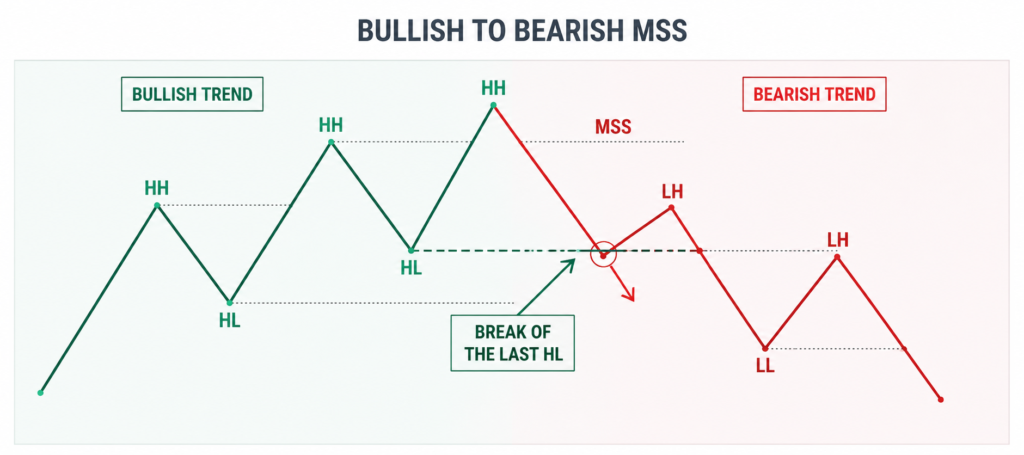
To understand market structure shift explained properly, you first need to understand two basics:
Bullish Market Structure:
- Price makes higher highs (HH)
- Price makes higher lows (HL)
Bearish Market Structure:
- Price makes lower lows (LL)
- Price makes lower highs (LH)
A market structure shift (MSS) happens when price breaks the last significant low in a bullish trend or the last significant high in a bearish trend. That break signals that the previous trend is over and a new one may be starting.
This is not a random candle. It is a structural break with purpose behind it.
Related guides:
MSS vs Break of Structure (BOS) Know the Difference
Many traders confuse these two. Understanding the difference makes your strategy much sharper.
Feature | Break of Structure (BOS) | Market Structure Shift (MSS) |
Direction | Continues the trend | Reverses the trend |
Signal Type | Continuation | Reversal |
Trading Action | Trade with trend | Trade counter-trend |
Smart Money Use | Confirms momentum | Signals entry reversal |
A BOS happens when price continues in the same direction. An MSS happens when price breaks against the trend — signaling a shift in momentum.
Never trade an MSS the same way you trade a BOS. They are opposites.
MSS Trading Forex Strategy Step-by-Step Setup
The MSS trading forex strategy is clean, repeatable, and high-probability when applied correctly. Here is how to build it:
Step 1: Identify the Current Trend Mark the most recent swing highs and swing lows on your chart. Know whether price is in a bullish or bearish structure.
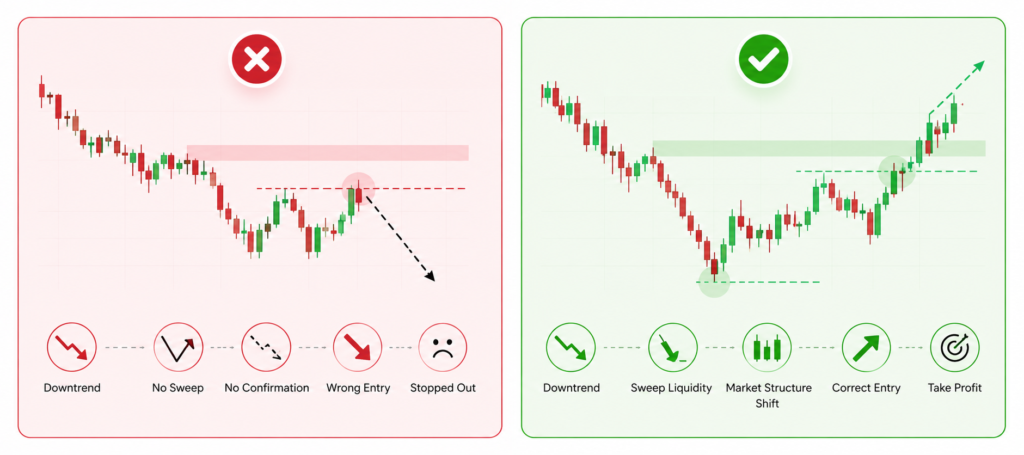
Step 2 : Spot the Liquidity Sweep Before an MSS, smart money usually sweeps a key level a previous high or low to grab retail stop losses. Watch for this wick.
Step 3: Look for the Structural Break After the sweep, wait for price to break the last significant higher low (in a bullish trend) or the last significant lower high (in a bearish trend). That break is your MSS.
Step 4: Wait for Confirmation Do not enter immediately. Wait for:
- A fair value gap (FVG) to form
- An order block to get respected
- A lower timeframe MSS in your trade direction
Step 5: Enter the Trade Enter at the retest of the FVG or order block. Place your stop loss above the sweep wick. Target the next liquidity pool or structural level.
MSS vs Break of Structure (BOS) Know the Difference
Many traders confuse these two. Understanding the difference makes your strategy much sharper.
Feature | Break of Structure (BOS) | Market Structure Shift (MSS) |
Direction | Continues the trend | Reverses the trend |
Signal Type | Continuation | Reversal |
Trading Action | Trade with trend | Trade counter-trend |
Smart Money Use | Confirms momentum | Signals entry reversal |
A BOS happens when price continues in the same direction. An MSS happens when price breaks against the trend — signaling a shift in momentum.
Never trade an MSS the same way you trade a BOS. They are opposites.
MSS Trading Forex Strategy Step-by-Step Setup
The MSS trading forex strategy is clean, repeatable, and high-probability when applied correctly. Here is how to build it:
Step 1: Identify the Current Trend Mark the most recent swing highs and swing lows on your chart. Know whether price is in a bullish or bearish structure.
Step 2: Spot the Liquidity Sweep Before an MSS, smart money usually sweeps a key level a previous high or low to grab retail stop losses. Watch for this wick.
Step 3: Look for the Structural Break After the sweep, wait for price to break the last significant higher low (in a bullish trend) or the last significant lower high (in a bearish trend). That break is your MSS.
Step 4: Wait for Confirmation Do not enter immediately. Wait for:
- A fair value gap (FVG) to form
- An order block to get respected
- A lower timeframe MSS in your trade direction
Step 5: Enter the Trade Enter at the retest of the FVG or order block. Place your stop loss above the sweep wick. Target the next liquidity pool or structural level.
Why Smart Money Uses Market Structure Shift Trading
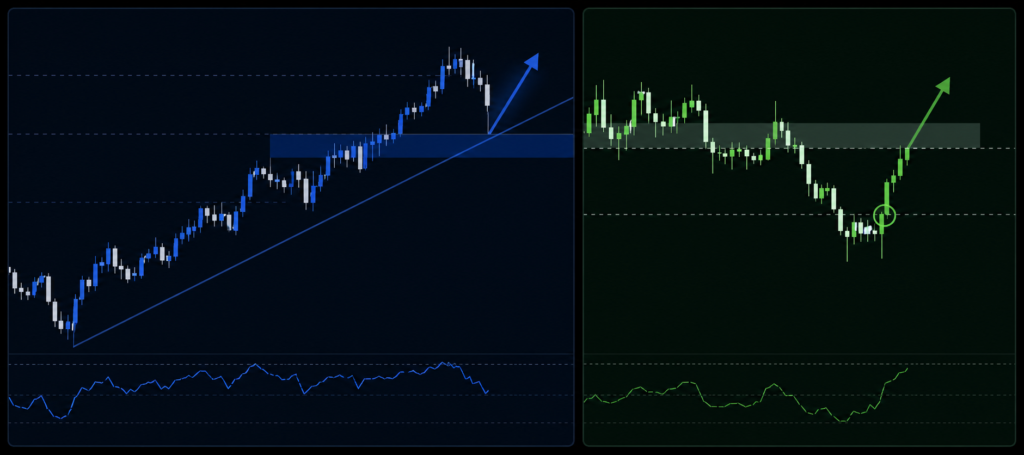
Retail traders chase price. Smart money creates price. Here is why institutions rely on market structure shift trading:
- Precision entries. MSS gives a clear structural reason to enter not a lagging signal.
- Defined risk. The stop loss placement above the sweep is logical, not arbitrary.
- High reward setups. MSS entries often come at the beginning of a new move, giving excellent risk-to-reward ratios.
- Works on all timeframes. Apply it on the 15-minute for day trading or the daily chart for swing trading.
- Pairs with ICT concepts. MSS fits perfectly with order blocks, FVGs, and liquidity theory.
Best Timeframes for MSS Trading
Not all timeframes give equal results. Here is a quick breakdown:
Timeframe | Best Use | Trader Type |
1H / 4H | Trend identification | Swing Traders |
15M / 30M | Entry confirmation | Day Traders |
5M / 1M | Precision entry | Scalpers |
Daily / Weekly | Macro structure | Position Traders |
Always use a top-down approach. Identify the trend on higher timeframes. Find your MSS entry on the lower timeframe.

Common Mistakes Traders Make with MSS
Even good traders fall into these traps:
- Entering on the break candle: Wait for a retest. Do not chase.
- Ignoring liquidity sweeps: A valid MSS almost always comes after a sweep.
- Trading MSS against the higher timeframe trend: Your entries must align with the bigger picture.
- Using MSS in isolation: Combine it with order blocks, FVGs, and liquidity zones for stronger confirmation.
- Over-trading small timeframes: Stick to higher timeframe MSS signals for cleaner setups.
FAQs : Market Structure Shift Trading
What is the difference between MSS and BOS in trading?
How do I confirm a market structure shift?
Is market structure shift trading suitable for beginners?
What markets work best with MSS trading?
Final Thoughts : Start Trading Smarter
Market structure shift trading is not a secret. It is the language of smart money and now you can read it too.
When you understand market structure shift explained, you stop guessing and start trading with logic. The MSS trading forex strategy gives you a structured, repeatable framework to catch reversals before the crowd even notices them.
Apply it consistently. Combine it with confluence. Manage your risk properly. Over time, the results will speak for themselves.