
SMC Trading Strategy: The Complete Smart Money Concepts Guide for Forex Traders
Are you tired of losing trades? Do you feel like the market always moves against you right after you enter? You are not alone. Most retail traders lose because they ignore how the market actually works. The solution lies in understanding the SMC trading strategy one of the most powerful frameworks in modern forex trading.
In this guide, you will learn everything about smart money concepts, the ICT trading strategy, and how to trade like institutional players.
What Is SMC in Trading?
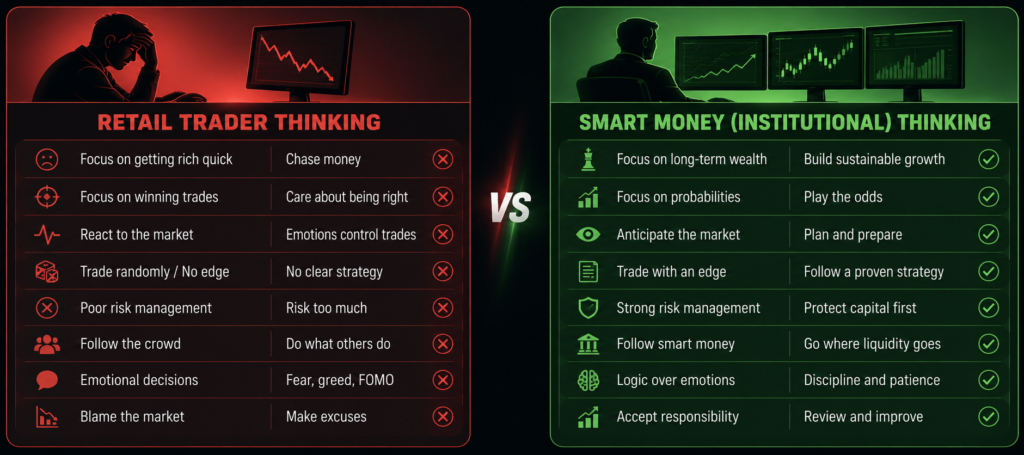
What is SMC in trading? SMC stands for Smart Money Concepts. It is a trading methodology that focuses on how large financial institutions banks, hedge funds, and market makers move price in the forex market.
These institutions are called “smart money.” They control billions of dollars in trading volume. Their moves create patterns that retail traders can learn to follow.
The SMC trading strategy teaches you to:
- Identify where institutions are buying and selling
- Spot liquidity pools and stop-hunt zones
- Enter trades at high-probability order blocks
- Avoid retail trading traps and false breakouts
The Core Pillars of Smart Money Concepts ICT Trading Strategy
The smart money concepts ICT trading strategy was largely developed and popularized by Michael Huddleston, known online as ICT (Inner Circle Trader). His framework broke down how institutions manipulate price before making their real move.
Here are the core pillars every trader must understand:
1. Market Structure
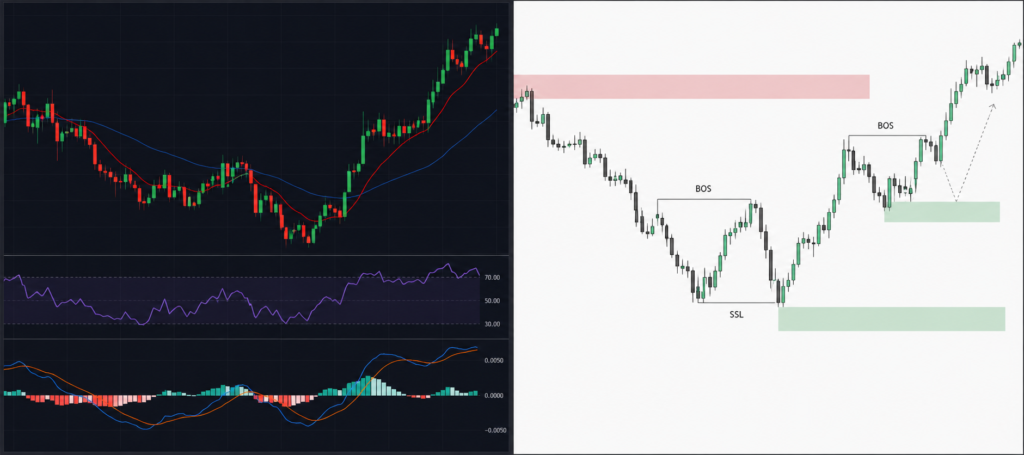
Market structure is the foundation of SMC trading. Price moves in consistent patterns higher highs and higher lows in an uptrend, and lower highs and lower lows in a downtrend.
- Break of Structure (BOS): Price breaks a key level in the direction of the trend.
- Change of Character (CHOCH): Price reverses trend structure a signal that smart money has shifted direction.
Understanding BOS and CHOCH helps you stay on the right side of the market.
2. Order Blocks
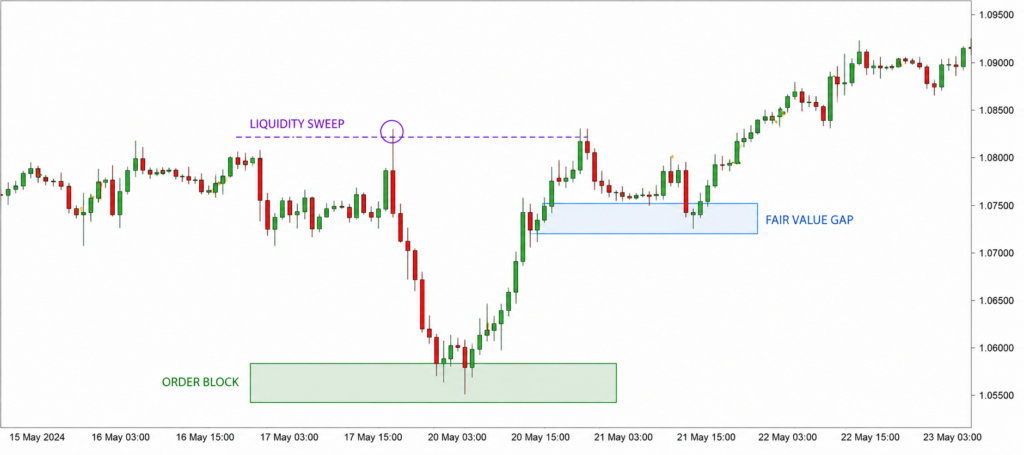
Order blocks are the most talked-about concept in SMC trading strategy. An order block is the last candle before a major price move. It marks the zone where institutions placed their orders.
- Bullish order block: Last bearish candle before a strong bullish move
- Bearish order block: Last bullish candle before a strong bearish move
When price returns to these zones, it often reacts strongly giving you a high-probability entry.
3. Liquidity and Stop Hunts
Smart money needs liquidity to fill their massive orders. They deliberately push price to where retail stop-losses are clustered below swing lows or above swing highs.
- This is called a liquidity sweep or stop hunt.
- After sweeping liquidity, price often reverses sharply.
- Recognizing these moves is one of the most profitable skills in SMC forex trading.
4. Fair Value Gaps (FVG)
A fair value gap forms when price moves so aggressively that it leaves a gap between candles. These gaps act as magnets price tends to return and fill them.
- FVGs are used as entry zones in the SMC trading strategy
- They combine powerfully with order blocks and market structure
5. Premium and Discount Zones
Smart money buys in discount (below 50% of a price range) and sells in premium (above 50%). Using Fibonacci retracement to identify these zones is a key part of the ICT trading strategy.
- Buy setups form in discount zones
- Sell setups form in premium zones
How to Build an SMC Trading Strategy Step by Step
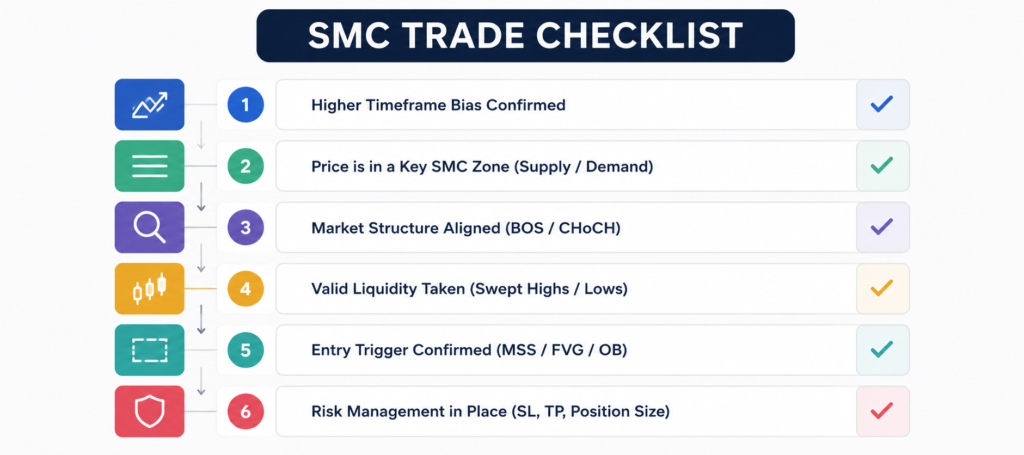
Now that you understand the concepts, here is a simple SMC trading strategy model you can use every day:
Step
Action
Purpose
Step 1
Identify trend on higher timeframe (H4/D1)
Determine direction
Step 2
Mark key liquidity zones
Find where stop hunts will happen
Step 3
Wait for a CHOCH or BOS
Confirm trend or reversal
Step 4
Drop to lower timeframe (M15/H1)
Find entry precision
Step 5
Enter at order block or FVG
High-probability entry
Step 6
Set SL below order block
Protect capital
Step 7
Target next liquidity zone
Maximize reward-to-risk
This process is repeatable, rule-based, and built on institutional logic. Follow it consistently and your results will improve.
Step | Action | Purpose |
Step 1 | Identify trend on higher timeframe (H4/D1) | Determine direction |
Step 2 | Mark key liquidity zones | Find where stop hunts will happen |
Step 3 | Wait for a CHOCH or BOS | Confirm trend or reversal |
Step 4 | Drop to lower timeframe (M15/H1) | Find entry precision |
Step 5 | Enter at order block or FVG | High-probability entry |
Step 6 | Set SL below order block | Protect capital |
Step 7 | Target next liquidity zone | Maximize reward-to-risk |
SMC vs Traditional Trading Strategies
Many traders ask: why use SMC trading instead of standard indicators like RSI or MACD?
Here is a clear comparison:
Feature
Traditional Strategy
SMC Trading Strategy
Based on
Lagging indicators
Price action & institution logic
Stop hunts
Caught off guard
Anticipated and used as entries
Market structure
Basic trend lines
BOS, CHOCH, order blocks
Entry quality
Average
High precision
Win rate potential
40–50%
55–70% with practice
Learning curve
Low
Medium to high
The SMC trading strategy gives you a genuine edge because it mirrors how the market actually operates at the institutional level.
Feature | Traditional Strategy | SMC Trading Strategy |
Based on | Lagging indicators | Price action & institution logic |
Stop hunts | Caught off guard | Anticipated and used as entries |
Market structure | Basic trend lines | BOS, CHOCH, order blocks |
Entry quality | Average | High precision |
Win rate potential | 40–50% | 55–70% with practice |
Learning curve | Low | Medium to high |
Common Mistakes Traders Make with SMC
Even with the best strategy, mistakes happen. Here are the most common ones:
Trading without market structure context: Always identify the trend before placing trades.
Entering too early at order blocks: Wait for a confirmation candle or FVG overlap.
Ignoring liquidity: Never place stops at obvious swing lows/highs where liquidity sits.
Overtrading: The SMC trading strategy rewards patience. Quality setups are rare wait for them.
Skipping multi-timeframe analysis: Top-down analysis is non-negotiable in smart money concepts trading.
Trading without market structure context: Always identify the trend before placing trades.
Entering too early at order blocks: Wait for a confirmation candle or FVG overlap.
Ignoring liquidity: Never place stops at obvious swing lows/highs where liquidity sits.
Overtrading: The SMC trading strategy rewards patience. Quality setups are rare wait for them.
Skipping multi-timeframe analysis: Top-down analysis is non-negotiable in smart money concepts trading.
Who Should Use the SMC Trading Strategy?
The SMC trading strategy is suitable for:
Beginners who want to start with a solid institutional framework
Intermediate traders who are struggling with retail strategies
Forex traders looking to improve win rate and risk management
Crypto traders: SMC works on all liquid markets
Part-time traders: higher timeframe SMC setups require less screen time
If you are serious about trading, smart money concepts will transform how you read the market.
Beginners who want to start with a solid institutional framework
Intermediate traders who are struggling with retail strategies
Forex traders looking to improve win rate and risk management
Crypto traders: SMC works on all liquid markets
Part-time traders: higher timeframe SMC setups require less screen time
Frequently Asked Questions (FAQs)
What is SMC in trading?
Is the SMC trading strategy good for beginners?
What is the difference between SMC and ICT trading strategy?
Does SMC work on all markets?
How long does it take to learn SMC trading?
What timeframes work best for SMC trading?
Final Thoughts
The SMC trading strategy is not a shortcut. It is a serious, professional approach to understanding financial markets. When you learn smart money concepts, you stop fighting the market and start following the institutions that control it.
Whether you are new to trading or frustrated with your current results, the smart money concepts ICT trading strategy gives you the tools to make smarter, more confident decisions.
Study it. Backtest it. Apply it. The market will start to make sense in ways it never did before.
Related guides: