

Introduction
If you spend any time around modern forex content, you will hear the term ICT thrown around constantly, usually with great confidence and very little explanation. Traders mention order blocks, liquidity sweeps, and killzones as if everyone already knows what they mean, leaving newcomers more confused than informed. Understanding what is ict in trading cuts through that noise and unlocks a genuinely powerful way of reading the market through the lens of institutional behavior rather than guesswork.
ICT is not just another indicator or a single magic setup. It is a complete framework for understanding why price moves the way it does, built around the idea that large institutions deliberately engineer market movement to fill their enormous orders. In this guide, you will learn where the term comes from, what it really means, and the core concepts every ICT trader relies on, all explained in plain language. By the end, you will have a clear mental map of the framework and a sensible path for learning it without drowning in jargon.

Fig 1.1: (What is ICT in trading concept map of order blocks, liquidity, market structure and killzones)
What Does ICT Mean?
ICT stands for Inner Circle Trader, the trading alias of Michael Huddleston, who developed and popularized a framework for trading the way large institutions do. The ict meaning in trading therefore refers to both the man and the entire body of methodology he teaches. When traders say they “trade ICT,” they mean they apply his concepts about liquidity, market structure, and institutional order flow to their own charts.
At its heart, ICT is a collection of interconnected concepts that explain how so-called smart money, meaning banks, funds, and other large players, moves price to fill positions that are simply too big to execute all at once. Instead of viewing the market as random or purely emotional, ICT treats price movement as a deliberate, strategic hunt for liquidity. Every spike, every fakeout, and every sharp reversal becomes part of a logical story rather than meaningless noise.
That single shift in perspective is what makes the framework so compelling to serious traders. Once you stop seeing price as chaotic and start seeing it as engineered, you begin to anticipate moves instead of merely reacting to them. The market stops feeling like it is personally hunting your stops and starts revealing a pattern you can learn to read, which is exactly the sense of clarity that draws so many traders to ICT in the first place.
Inner Circle Trader Forex Explained
To get inner circle trader forex explained in the simplest possible terms, picture the market as a giant game of liquidity. Large institutions cannot buy or sell in massive size without moving the price against themselves, so they engineer moves designed to trigger the predictable stop-loss orders of retail traders. Those triggered orders create the volume institutions need to enter their real positions at favorable prices.
ICT teaches you to spot the footprints of this activity rather than fall victim to it. When price spikes sharply to grab obvious stops sitting above a high or below a low, and then immediately reverses, an ICT trader sees clear institutional intent instead of confusion. The frustrating wick that stopped you out moments before a big move was not bad luck; it was a deliberate liquidity grab, and ICT trains you to expect and trade alongside it.
This is precisely why ICT sits comfortably under the broader umbrella of smart money concepts. The entire philosophy revolves around aligning yourself with the large players who actually drive the market, rather than fighting against them as unaware liquidity. By learning to read where institutions are likely to hunt and where they are likely to commit, you position yourself on the same side as the money that moves price, which is the core promise of the inner circle trader approach.
The Core ICT Concepts
ICT is built from several interlocking ideas, and while you do not need every one of them to begin, understanding the main concepts gives you a solid working foundation. Each concept answers a different question about price: where institutions entered, where price moved too quickly, and where the market is likely headed next. Together they form a coherent system rather than a random collection of tricks.
| Concept | What It Means |
|---|---|
| Order block | The last opposing candle before a strong institutional move |
| Fair value gap | A price imbalance left behind by fast movement |
| Liquidity | Pools of stop orders resting above highs and below lows |
| Market structure | The pattern of highs and lows that defines the trend |
| Killzones | High-probability time windows of institutional activity |
These five concepts are the pillars of the framework. Order blocks reveal where smart money entered, fair value gaps show where price became inefficient and may return, and liquidity reveals where the market is being drawn. Layered on top, market structure provides the broader trend context, and killzones tell you when these forces are most active. Master these first, and the more advanced ICT tools become far easier to absorb later.
Liquidity: The Heart of ICT
Liquidity is the single most important idea in the entire ICT framework, and grasping it changes how you see every chart. Above every obvious high and below every obvious low sit clusters of stop-loss orders placed by traders protecting their positions. These pools of resting orders are exactly what large players target, because they provide the volume needed to fill institutional-sized positions without slippage.
Once you truly understand this, the classic retail trap suddenly makes perfect sense. The painful spike that stops you out moments before price runs in your intended direction is rarely random; it is usually a deliberate liquidity grab engineered to collect those resting stops. What felt like the market personally hunting you is simply institutions doing what they must to enter their trades efficiently. The frustration gives way to recognition.
ICT trains you to anticipate these sweeps rather than become their victim. Instead of placing your stops in the same obvious spots as everyone else, you learn to expect that those areas will be raided, and you plan your entries around the reversal that often follows. This single concept, learning to read and anticipate liquidity, is the foundation on which nearly every other ICT setup is built, which is why experienced traders insist that beginners master it before anything else.
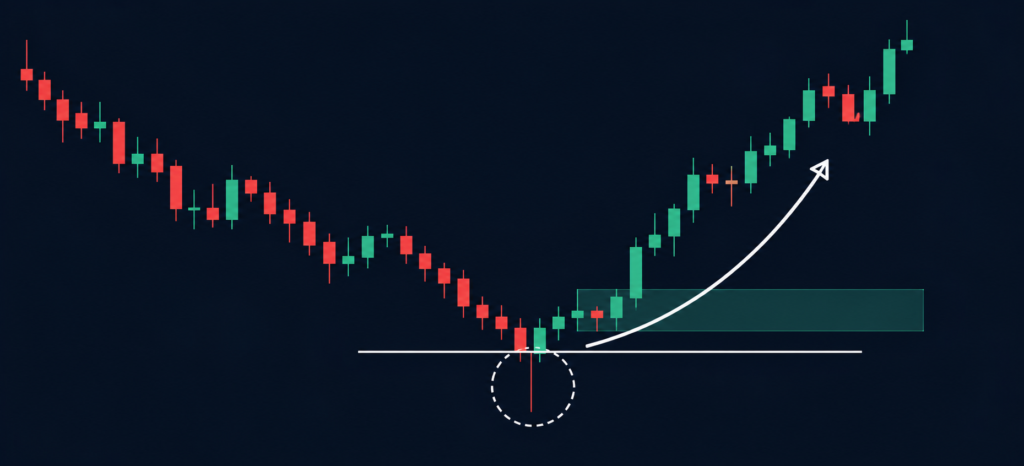
Fig 1.2(ICT meaning in trading shown by a liquidity sweep above highs and reversal on a forex chart)
Market Structure and Trend
ICT places heavy emphasis on reading market structure, which is simply the sequence of highs and lows that defines whether a market is trending or reversing. A series of higher highs and higher lows signals an uptrend, while lower highs and lower lows signal a downtrend. When that pattern breaks, it tells you something important about a potential shift in direction.
Two specific events matter most here. A break of structure occurs when price pushes decisively beyond a prior swing point, signaling momentum continuing or a new direction taking hold. A change of character, by contrast, is the first sign that an existing trend may be ending, often appearing right after a liquidity grab. Reading these signals keeps you aware of the bigger picture rather than getting lost in small fluctuations.
By mapping structure clearly on higher timeframes, you always know the broader context for any trade you take. This keeps you trading with the dominant flow instead of fighting against it, which is one of the most practical and immediately useful benefits of the entire method. Many losing trades come from buying into a downtrend or selling into an uptrend, and disciplined structure reading is the simplest defense against that costly mistake.
Killzones and Timing
Timing matters enormously in ICT, and this is where the concept of killzones comes in. The framework identifies specific windows, most notably during the London and New York sessions, when institutional activity and market volatility reliably peak. These high-activity windows are called killzones, and they are when the liquidity grabs and structure shifts ICT relies on are most likely to occur with real conviction.
Trading during killzones increases the probability that the moves you see are driven by genuine institutional order flow rather than thin, random noise. Outside of these windows, the market often drifts in low-volume conditions where setups are less reliable and false signals are more common. Concentrating your attention on these few high-probability hours filters out a great deal of poor-quality price action.
Many dedicated ICT traders build their entire trading day around these windows, focusing intensely for a couple of hours and then stepping away. This selective approach improves both their results and their work-life balance, because they are not glued to the screen all day chasing every minor move. Knowing when to trade, it turns out, is just as important as knowing what to trade, and killzones give you a clear, repeatable answer to the timing question.
Fig 1.3: (ICT killzones during London and New York trading sessions timing chart)
Is ICT Right for You?
ICT is detailed, layered, and takes genuine study to master, so it is worth being honest about what it demands. It rewards traders who enjoy understanding the deeper why behind price movement and who are willing to spend real time practicing how to read charts patiently. If you are curious about market mechanics and motivated to learn a structured framework, ICT can be deeply satisfying and genuinely powerful.
That said, if you strongly prefer simple, mechanical systems with few moving parts, the depth of ICT may feel heavy and overwhelming at first. The framework has many concepts, and trying to learn them all at once is a common reason beginners give up. The smarter path is to start with liquidity and market structure, build confidence with those, and then gradually add the other concepts as your understanding matures.
For those who commit to that gradual approach, ICT offers something rare: a coherent, logical view of the market that connects liquidity, structure, timing, and institutional intent into a single, unified framework. Rather than a bag of disconnected tricks, you gain a way of thinking that helps every chart make more sense. Whether or not you adopt every concept, understanding the ICT mindset will sharpen how you read price for the rest of your trading career.
Frequently Asked Questions
What is ICT in trading?
What is ict in trading refers to the Inner Circle Trader methodology created by Michael Huddleston. It is a framework of smart money concepts that explains how large institutions move price to gather liquidity and fill their orders. Rather than treating the market as random, ICT helps traders position themselves alongside the big players by reading liquidity, market structure, and institutional order flow on their charts.
What is the simple ICT meaning in trading?
The ict meaning in trading is reading the market through the lens of institutional behavior rather than emotion or randomness. It focuses on core ideas like liquidity, order blocks, fair value gaps, and market structure to understand why price moves. In practice, it means learning to anticipate the deliberate moves institutions make to fill positions, instead of getting trapped by them.
Can you give inner circle trader forex explained for beginners?
Inner circle trader forex explained simply means learning to spot where large players grab stop-loss liquidity and then trading in their direction. Institutions engineer moves to trigger retail stops, creating the volume they need, and ICT teaches you to recognize and trade alongside that activity. For beginners, the key takeaway is that price is engineered around liquidity, not moving randomly.
Is ICT good for beginner traders?
ICT can work well for beginners, but it requires patient, structured study because it contains many interlocking concepts. Trying to learn everything at once is overwhelming and a common reason people quit. The smarter path is to start with liquidity and market structure, build real confidence with those two pillars, and then gradually add the other concepts as your understanding deepens.
What are killzones in ICT?
Killzones are specific high-probability time windows, usually during the London and New York sessions, when institutional activity and volatility peak. Trading during these windows increases the odds that the moves you see are driven by genuine order flow rather than thin, random noise. Many ICT traders focus only on these few hours each day, which improves both their results and their schedule.
How is ICT different from regular technical analysis?
Traditional technical analysis often relies on indicators and patterns without explaining the underlying reason price moves. ICT instead focuses on institutional intent, liquidity, and market structure to explain the why behind the moves. Rather than reacting to lagging indicators, ICT traders aim to anticipate where smart money will hunt liquidity and commit, which gives the approach its forward-looking, logical character.
Final Thoughts
Understanding what is ict in trading fundamentally changes how you see the market, replacing the idea of random, chaotic movement with a logical story of liquidity, structure, and deliberate institutional intent. The ict meaning in trading comes down to one core insight: large players engineer price moves to fill their orders, and you can position yourself alongside them once you learn to read the footprints they leave behind. With inner circle trader forex explained through liquidity pools, order blocks, fair value gaps, market structure, and killzone timing, you gain a coherent framework rather than a scattered bag of tips. ICT rewards patient, gradual study, so resist the urge to learn everything at once. Master liquidity and structure first, focus your trading on high-probability windows, and let your understanding of smart money deepen one chart at a time. Do that, and the market that once felt random will start to reveal a pattern you can genuinely read.