
Introduction
If you have spent any time in trading communities lately, you have almost certainly seen the letters ICT thrown around alongside terms like liquidity, order blocks, and fair value gaps. For newcomers, it can feel like an entire secret language, and the gatekeeping around it only adds to the confusion. So let us clear it up directly: what is ICT in trading, and is it worth your time to learn? In this guide, we give you the inner circle trader forex explained from the ground up, defining the ICT meaning in trading and the core concepts behind it in plain English. You will learn where ICT came from, what makes it different from traditional technical analysis, and the foundational ideas that hold the whole framework together.

What Is ICT in Trading?
To answer what is ICT in trading directly: ICT stands for the Inner Circle Trader, the trading alias of Michael Huddleston, who developed and popularized a comprehensive framework of price-action concepts focused on how institutional money moves the markets. ICT is not a single indicator or a simple strategy; it is an entire methodology built around the idea that large institutions, not retail traders, drive price, and that their footprints can be read on the chart.
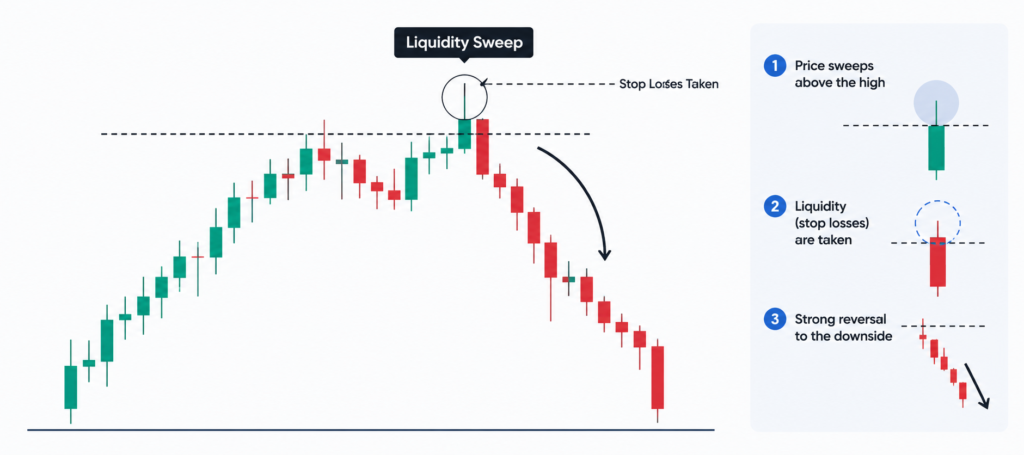
The core premise is that the market is engineered to take liquidity. According to ICT, price is deliberately driven to areas where retail traders place their stop losses above obvious highs and below obvious lows so that institutions can fill their large orders by trading against the crowd. Understanding where this liquidity sits, and how price moves to grab it, is the foundation of the entire approach.
In practice, ICT gives traders a vocabulary and a framework for reading these institutional movements: concepts like order blocks, fair value gaps, liquidity pools, and market structure shifts. Rather than relying on lagging indicators, ICT traders read raw price action through this institutional lens, aiming to align their trades with the smart money rather than against it. That, in essence, is the ICT meaning in trading.
Where ICT Came From
ICT emerged from Michael Huddleston’s years of studying the markets and his desire to explain why traditional retail trading approaches so often fail. He observed that many beginners lose money following obvious patterns and indicators, and he built a framework to explain why: those obvious levels are precisely where institutions hunt for liquidity. ICT reframes the market as a game between large players and the retail crowd.
Over time, Huddleston released an enormous body of free educational content, teaching his concepts through extensive video series and mentorships. This accessibility, combined with the framework’s depth, helped ICT spread rapidly through online trading communities. It became one of the most discussed methodologies in retail trading, spawning countless interpretations, derivatives, and an entire ecosystem of smart money concepts content.
It is worth noting honestly that ICT is proprietary and somewhat controversial. Its terminology overlaps with older concepts from technical analysis and Wyckoff theory, repackaged with new names and an institutional narrative. Some traders swear by it, while others argue it overcomplicates price action. Approaching ICT with curiosity but a critical mind testing its ideas rather than accepting them on faith is the healthiest way to learn it.
The Core Concepts of ICT
The inner circle trader forex explained properly requires understanding a handful of foundational concepts. The first is liquidity, the lifeblood of the entire framework. Liquidity refers to the clusters of orders, particularly stop losses, that rest above highs and below lows. ICT teaches that price moves to take this liquidity, and recognizing where it sits is the starting point for every ICT trade.
The second is the order block, a key candle or zone where institutions are believed to have placed large orders, often the last opposing candle before a strong move. Price frequently returns to these zones before continuing. The third is the fair value gap, an imbalance left when price moves so quickly that it skips a range of prices, which the market often returns to fill. These imbalances act as magnets and potential entry areas.
| Concept | Plain-English Meaning | Why It Matters |
|---|---|---|
| Liquidity | Stops resting above highs and below lows | Price moves to take it |
| Order block | Zone of institutional orders | Price often returns to it |
| Fair value gap | Imbalance from a fast move | Acts as a magnet to fill |
| Market structure | The pattern of highs and lows | Shows trend and shifts |
| Displacement | A strong, decisive move | Confirms institutional intent |
These concepts interlock. A typical ICT idea reads as a story: price sweeps liquidity above a high, displaces sharply lower, leaves a fair value gap and an order block, and then returns to that zone before continuing down. Learning to read this narrative is the heart of the method.

How ICT Differs From Traditional Analysis
ICT differs from traditional technical analysis primarily in its lens. Where conventional analysis relies heavily on indicators like moving averages, RSI, and MACD, ICT focuses almost entirely on raw price action interpreted through an institutional framework. ICT traders generally view popular indicators as lagging and unnecessary, preferring to read structure, liquidity, and imbalance directly from the candles.
The narrative is also different. Traditional analysis often treats patterns as self-fulfilling crowd behavior, while ICT frames the market as actively engineered by institutions to deceive retail traders. This smart-money-versus-retail story is central to ICT and shapes how its practitioners interpret every move. Rather than asking what pattern is this, an ICT trader asks where is the liquidity, and what are institutions likely doing.
Time is another distinctive element. ICT places heavy emphasis on specific high-probability time windows, often called killzones, during which institutional activity is believed to concentrate. Traditional analysis is generally less time-specific. This focus on trading particular sessions and windows, combined with the liquidity-and-structure lens, gives ICT a distinctive rhythm that sets it apart from indicator-based approaches.
Is ICT Worth Learning?
For a beginner wondering whether to invest time in ICT, the honest answer is that it depends on your temperament and goals. ICT is deep, detailed, and demands significant study. The framework has helped many traders develop a sophisticated understanding of price action, liquidity, and market structure, and the concepts of liquidity and imbalance are genuinely valuable regardless of which methodology you ultimately adopt.
However, ICT’s complexity is also a risk. Beginners can fall into the trap of endlessly consuming content, marking up charts with dozens of zones, and overanalyzing every move without ever developing consistent profitability. The framework offers so many concepts that traders can always find a reason for any move in hindsight, which is comforting but not necessarily profitable. Discipline and selectivity matter as much here as in any approach.
The wisest path is to learn the core ideas, test them rigorously through backtesting and demo trading, and keep only what demonstrably works for you. ICT is not a magic key to guaranteed profits, despite how some present it. Like any methodology, it is a lens that, applied with discipline and proper risk management, can sharpen your trading but it cannot replace the fundamentals of capital protection and consistency that every trader needs.
What Top Traders and Research Say
Many ICT concepts echo older market wisdom, repackaged. The idea that price moves to take liquidity and trap the crowd resonates strongly with Wyckoff’s century-old work on accumulation, distribution, and the composite operator. In Technical Analysis of the Financial Markets, John Murphy similarly describes how false breakouts trap traders and precede reversals the same liquidity-grab dynamic ICT formalizes with new terminology.
Academic research lends partial support to the underlying ideas. Studies on market microstructure confirm that institutional order flow and liquidity genuinely drive short-term price movements, and the work “Foundations of Technical Analysis” by Lo, Mamaysky, and Wang found that some technical patterns carry real information when defined rigorously. This suggests ICT’s focus on structure and liquidity is not baseless, provided it is applied with discipline rather than treated as infallible.
As Warren Buffett wryly noted, “Risk comes from not knowing what you are doing.” For an ICT beginner, this is the crucial warning. The framework’s depth can create an illusion of understanding while real, tested skill is still missing. Learning ICT properly means testing its claims, not simply believing them, and always pairing the concepts with rigorous risk management.
Frequently Asked Questions
What is ICT in trading?
The answer to what is ICT in trading is that ICT stands for the Inner Circle Trader, the alias of Michael Huddleston, who developed a framework of price-action concepts focused on how institutional money moves the markets. ICT is not a single indicator but an entire methodology built on the idea that institutions drive price by taking liquidity — moving price to where retail stop losses sit so they can fill large orders. It gives traders concepts like order blocks, fair value gaps, and liquidity pools to read these institutional movements and align their trades with the smart money.
What does ICT mean in trading, in simple terms?
In simple terms, the ICT meaning in trading is reading price action through an institutional lens. Instead of relying on lagging indicators, ICT traders study where liquidity rests, how price moves to grab it, and the structural footprints institutions leave behind. The framework reframes the market as a game between large players and the retail crowd, teaching that obvious highs and lows are targets where institutions hunt stop losses. The goal is to anticipate these moves and trade in the direction of the smart money rather than getting trapped alongside the crowd.
Is the inner circle trader method good for beginners?
The inner circle trader forex explained properly is deep and demanding, which makes it a double-edged sword for beginners. The core concepts of liquidity and imbalance are genuinely valuable, but ICT’s complexity can overwhelm newcomers, leading to information overload and cluttered, overanalyzed charts. Beginners can spend months consuming content without developing consistent profitability. If you choose to learn ICT, focus on a few core ideas, test them rigorously through backtesting and demo trading, and always pair them with strict risk management. It is a useful lens, not a shortcut to guaranteed profits.
How is ICT different from regular technical analysis?
ICT differs from traditional technical analysis mainly in its lens and emphasis. Conventional analysis leans on indicators like moving averages, RSI, and MACD, while ICT focuses on raw price action interpreted through liquidity, order blocks, and market structure. ICT frames the market as engineered by institutions to trap retail traders, whereas traditional analysis often treats patterns as crowd behavior. ICT also emphasizes specific high-activity time windows, called killzones, more than traditional methods do. Many ICT concepts echo older ideas like Wyckoff theory, repackaged with new terminology and an institutional narrative.
Does ICT trading actually work?
ICT can work for traders who learn it properly, apply it selectively, and pair it with disciplined risk management, but it is not a guaranteed money-maker despite how some present it. The underlying ideas that institutional order flow and liquidity drive short-term price moves have support in market microstructure research. However, the framework’s depth lets traders explain any move in hindsight, which can create an illusion of skill without real profitability. Like any methodology, ICT is a tool that works only when tested, applied with discipline, and combined with sound capital protection.
Final Thoughts
So, what is ICT in trading? It is the Inner Circle Trader methodology a deep, detailed framework that reads the market through the lens of institutional order flow and liquidity, giving traders a vocabulary of order blocks, fair value gaps, market structure, and killzones to interpret price action. Understanding the ICT meaning in trading strips away the gatekeeping and reveals a system rooted in a single powerful idea: that price moves to take liquidity and trap the retail crowd, and that those movements leave readable footprints. With the inner circle trader forex explained in plain terms, you can now decide for yourself whether to pursue it. If you do, approach it with discipline rather than faith: focus on the core concepts, test everything rigorously, keep your charts clean, and never let the framework’s complexity substitute for genuine risk management.
This article is for educational purposes only and does not constitute financial advice. Forex trading carries significant risk, and no methodology guarantees profits. Only trade with capital you can afford to lose.
Decode the markets with clarity. Visit forextradingboards.com for ICT breakdowns, beginner guides, and honest market analysis built to help you learn smart-money concepts the right way.