
Forex Arbitrage: The Complete Guide to Currency Arbitrage in 2025
Introduction
The forex market moves fast. Every second, thousands of price quotes update across hundreds of brokers and exchanges worldwide. In that speed lies an opportunity forex arbitrage.
If you have ever wondered how professional traders earn consistent profits without betting on market direction, arbitrage in forex is your answer. This guide breaks it all down clearly, professionally, and practically.
What Is Forex Arbitrage?
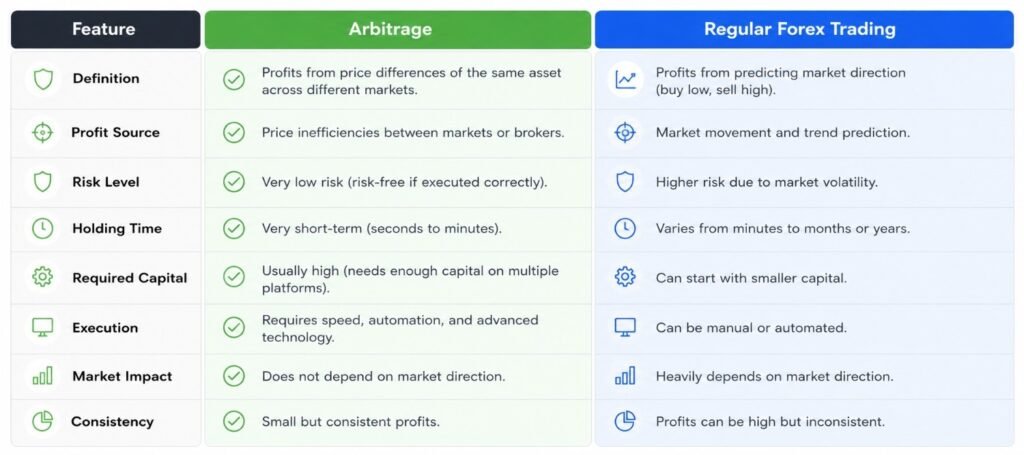
Forex arbitrage is a trading strategy that exploits price differences for the same currency pair across different brokers, platforms, or markets.
In simple terms: you buy a currency at a lower price from one source and simultaneously sell it at a higher price from another. The price gap no matter how small becomes your profit.
This is not speculation. You are not guessing where the market will go. You are simply capitalizing on market inefficiency.
How Does Currency Arbitrage Work?
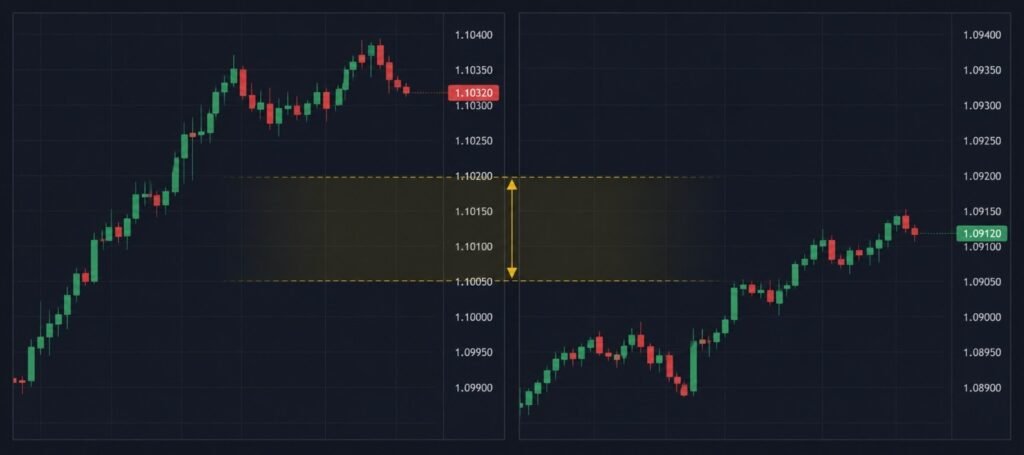
Currency arbitrage works because the forex market is decentralized. No single exchange controls all prices. Different brokers receive price feeds from different liquidity providers. Sometimes, these prices do not match perfectly even for a fraction of a second.
Here is a basic example:
- Broker A quotes EUR/USD at 1.1050
- Broker B quotes EUR/USD at 1.1055
A trader buys EUR/USD from Broker A and sells it on Broker B. The 5-pip difference is the profit.
This sounds simple. But in practice, execution speed, spreads, and broker rules all play a role.
Types of Forex Arbitrage
There are several powerful forms of arbitrage in forex. Each has a unique approach and risk profile.
1. Simple (Two-Broker) Arbitrage
- Compares prices between two brokers for the same currency pair.
- Requires fast execution often automated.
- Best suited for traders with low-latency connections.
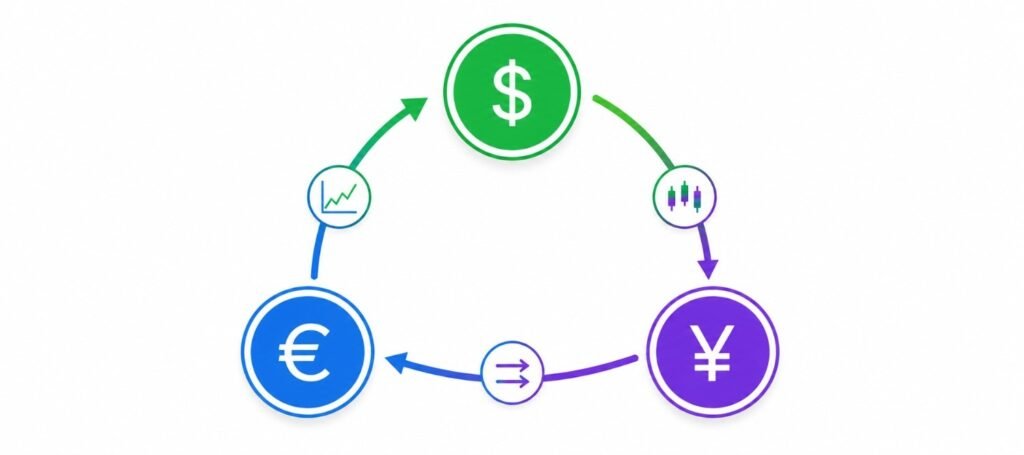
2. Triangular Arbitrage
- Involves three currency pairs in a loop for example, USD, EUR, and GBP.
- The trader converts one currency to a second, then a third, then back to the first.
- The profit comes from mismatches in cross-rate calculations.
- Common in institutional and algorithmic trading.
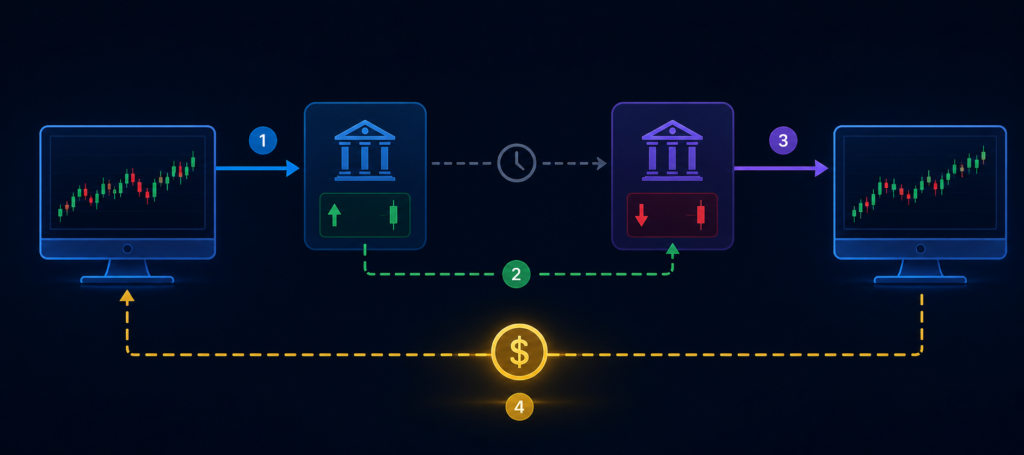
3. Latency Arbitrage
- Exploits the time delay between a slow broker’s price feed and a faster one.
- The trader sees a price update on a fast feed before the slow broker adjusts.
- Highly effective but increasingly restricted by brokers.
4. Statistical Arbitrage
- Uses historical correlation between currency pairs to find pricing anomalies.
- More complex and data-driven.
- Relies on mathematical models and backtested algorithms.
Is Forex Arbitrage Legal?
Yes forex arbitrage is legal. It is a legitimate trading strategy used by hedge funds, institutional desks, and retail traders globally.
However, some brokers explicitly prohibit arbitrage in their terms and conditions. These brokers may:
- Cancel or reverse arbitrage trades
- Limit your account
- Delay order execution intentionally
Always review your broker’s terms before using an arbitrage strategy. Choose brokers that allow algorithmic and arbitrage trading openly.
Is Currency Arbitrage Profitable?
Currency arbitrage can be highly profitable but only under specific conditions.
Here is what affects profitability:
Factor | Impact on Profit |
Execution speed | Faster = more opportunities captured |
Spread size | Wider spreads eat into arbitrage margins |
Broker restrictions | Some brokers block or delay arbitrage trades |
Slippage | Can turn a profit into a loss if price moves during execution |
Capital size | Larger capital magnifies small pip gains |
The best results come from automated forex arbitrage systems software or expert advisors (EAs) that scan prices and execute trades in milliseconds.
Arbitrage in Forex: Tools and Software
Manual arbitrage is nearly impossible in today’s fast market. You need the right tools.
Here are common tools traders use for arbitrage in forex:
- Arbitrage EA (Expert Advisor) : Runs on MetaTrader 4 or MT5 and auto-executes trades
- Price Feed Scanners: Compare live quotes across multiple brokers simultaneously
- VPS (Virtual Private Server): Reduces latency between your trading terminal and broker
- Arbitrage Calculators: Measure potential profit before placing a trade
- Co-location Services: Place your server physically close to a broker’s server for ultra-low latency
Most professional arbitrage traders run their systems 24/5, capturing opportunities automatically.
Risks of Forex Arbitrage
No strategy is completely risk-free. Here are the main risks of forex arbitrage:
- Execution risk: Price may change before your trade completes
- Broker risk: Your broker may reject, delay, or reverse trades
- Technology risk: Software bugs or connection issues can cause losses
- Regulatory risk: Rules differ across jurisdictions
- Spread widening: Sudden spread increases can eliminate profit margins
Risk management is still essential. Use arbitrage as part of a diversified trading approach.
Who Should Use Forex Arbitrage?
Forex arbitrage is best suited for:
- Algorithmic and automated traders
- Traders with access to fast, reliable internet and VPS
- Experienced traders who understand broker policies
- Developers building trading bots or EAs
- Institutional traders and prop firms
It is not ideal for beginner traders relying on manual execution.
FAQs About Forex Arbitrage
What is the easiest type of forex arbitrage for beginners?
Simple two-broker arbitrage is the most straightforward entry point. It requires comparing prices between two brokers and executing quickly ideally using an EA.
Can I do currency arbitrage on a small account?
Yes, but profits will be proportionally small. Currency arbitrage profits are measured in pips, so larger capital generates more meaningful returns.
How fast do I need to execute arbitrage in forex?
Speed is critical. Most arbitrage in forex opportunities last milliseconds. Automated systems with low-latency connections are strongly recommended.
Do all forex brokers allow arbitrage?
No. Many brokers prohibit or restrict it. Always read the terms of service. ECN and STP brokers are generally more arbitrage-friendly.
Is forex arbitrage still possible in 2025?
Absolutely. Price discrepancies still exist especially between slower retail brokers and faster institutional feeds. Smart, automated systems can still find and exploit these gaps profitably.
Final Thoughts
Forex arbitrage remains one of the most intellectually sound and technically exciting approaches in currency trading. It does not rely on prediction. It relies on precision.
Whether you explore currency arbitrage through triangular strategies or latency-based systems, the core principle remains: find the inefficiency, act faster than the market corrects it, and capture the profit.