
Forex ATR: The Complete Guide to Using Average True Range in Forex Trading
The forex market moves fast. Prices rise and fall in seconds. Without the right tools, you can lose money even with a good strategy.
That’s where forex ATR comes in.
The Average True Range (ATR) is one of the most powerful volatility indicators in forex trading. It tells you how much a currency pair typically moves in a given period. Traders use it to set smarter stop-losses, plan better entries, and protect their capital.
This guide covers everything from basics to advanced strategies. Whether you are a beginner or experienced trader, you will find clear, actionable insights here.
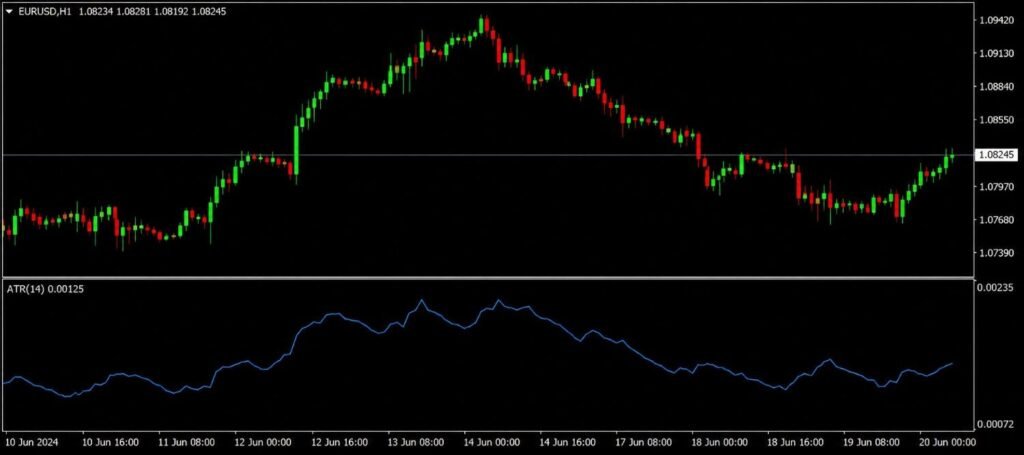
What Is Forex ATR? (Average True Range Explained)
Forex ATR, or Average True Range, is a technical indicator developed by J. Welles Wilder Jr. in 1978. He introduced it in his book New Concepts in Technical Trading Systems.
The ATR measures market volatility. It does not show direction. It shows how much price moves up or down over a set number of candles.
Here’s the simple formula:
True Range = Highest of:
- Current High minus Current Low
- Current High minus Previous Close (absolute value)
- Current Low minus Previous Close (absolute value)
ATR = Moving Average of True Range over N periods (default: 14)
A higher ATR forex value means the market is volatile. A lower ATR means the market is calm and ranging. This information is gold for traders.
Why Forex Traders Love the ATR Indicator
The ATR indicator is not just for measuring volatility. Smart traders use it for:
Stop-loss placement: Set stops based on actual market movement, not guesswork
Position sizing: Adjust trade size to match current volatility
Entry timing: Enter trades when volatility is favorable
Profit targets: Set realistic take-profit levels based on ATR range
Filtering signals: Avoid trading during abnormally low or high volatility
The ATR adapts to market conditions. That makes it more reliable than fixed pip-based strategies.
Stop-loss placement: Set stops based on actual market movement, not guesswork
Position sizing: Adjust trade size to match current volatility
Entry timing: Enter trades when volatility is favorable
Profit targets: Set realistic take-profit levels based on ATR range
Filtering signals: Avoid trading during abnormally low or high volatility
How to Read the ATR in Forex
Reading ATR forex values is simple once you understand the basics.
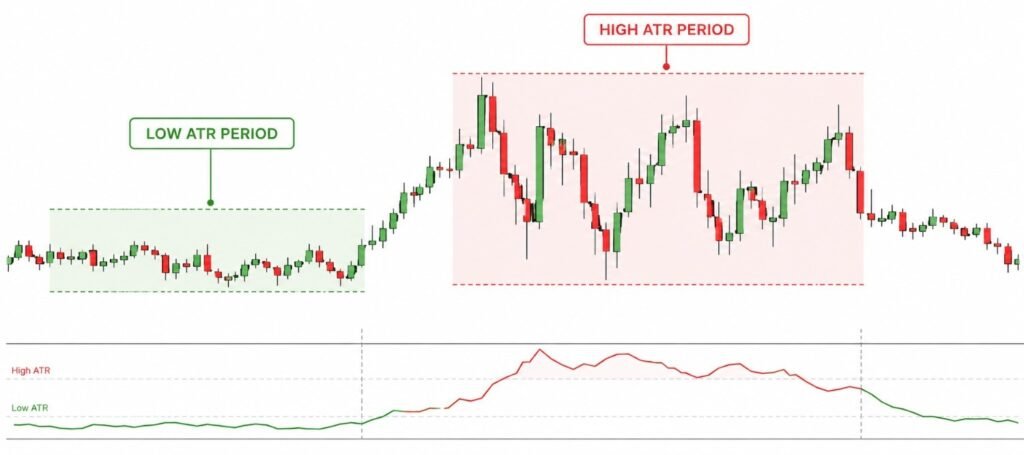
The ATR appears below your price chart as a single line. Here's what the values mean:
ATR Value
Market Condition
What It Means
Low ATR (below average)
Low volatility
Slow, ranging market — be cautious
Rising ATR
Increasing volatility
Momentum building — breakouts possible
High ATR (above average)
High volatility
Strong trending market — wider stops needed
Falling ATR
Decreasing volatility
Market cooling down — pullback or pause
Example: If EUR/USD has an ATR of 80 pips on the daily chart, the pair typically moves 80 pips per day. You can use this to set realistic stop-losses and targets.
ATR Value | Market Condition | What It Means |
Low ATR (below average) | Low volatility | Slow, ranging market — be cautious |
Rising ATR | Increasing volatility | Momentum building — breakouts possible |
High ATR (above average) | High volatility | Strong trending market — wider stops needed |
Falling ATR | Decreasing volatility | Market cooling down — pullback or pause |
Best ATR Settings for Forex Trading
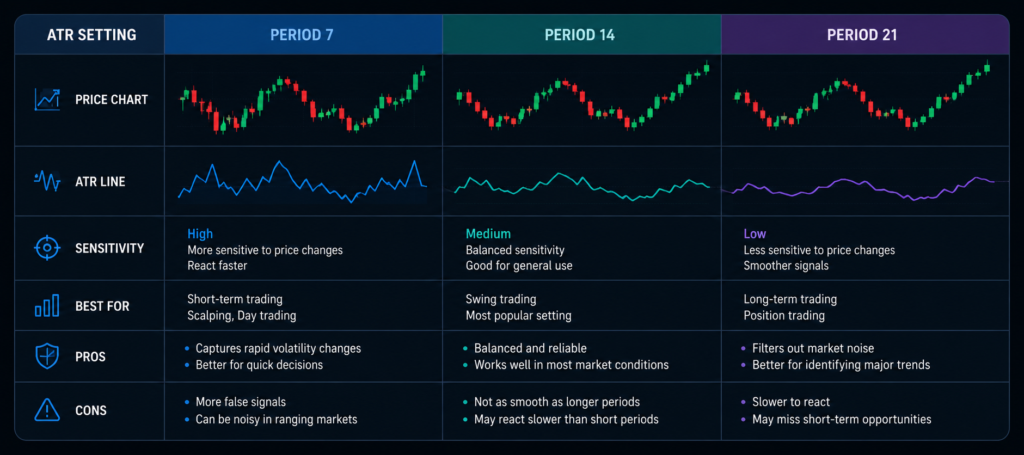
The default ATR period is 14. But not every strategy uses the same settings. Here's a breakdown:
ATR Period
Best For
Sensitivity
ATR (7)
Scalping, short-term trading
High — reacts fast to price changes
ATR (14)
Day trading, swing trading
Balanced — most commonly used
ATR (21)
Long-term, position trading
Smooth — less noise, slower signals
ATR Period | Best For | Sensitivity |
ATR (7) | Scalping, short-term trading | High — reacts fast to price changes |
ATR (14) | Day trading, swing trading | Balanced — most commonly used |
ATR (21) | Long-term, position trading | Smooth — less noise, slower signals |
ATR Stop-Loss Strategy Trade Smarter, Not Harder
One of the best uses of forex ATR is setting dynamic stop-losses. This method removes emotion from your decision-making.
Formula: Stop-Loss = Entry Price ± (ATR Value × Multiplier)
Common multipliers are 1.5x and 2x.
Example:
EUR/USD ATR (14) = 60 pips
Multiplier = 1.5x
Stop-Loss Distance = 90 pips
This stop-loss reflects actual market volatility. It is not too tight (avoiding early stop-outs) and not too wide (risking too much capital).
Benefits of ATR-based stop-loss:
Adjusts automatically as market conditions change
Prevents premature exits during normal market fluctuations
Aligns risk management with real price behavior
Works on all timeframes and currency pairs
EUR/USD ATR (14) = 60 pips
Multiplier = 1.5x
Stop-Loss Distance = 90 pips
Adjusts automatically as market conditions change
Prevents premature exits during normal market fluctuations
Aligns risk management with real price behavior
Works on all timeframes and currency pairs
ATR + Forex Pivot Points Strategy
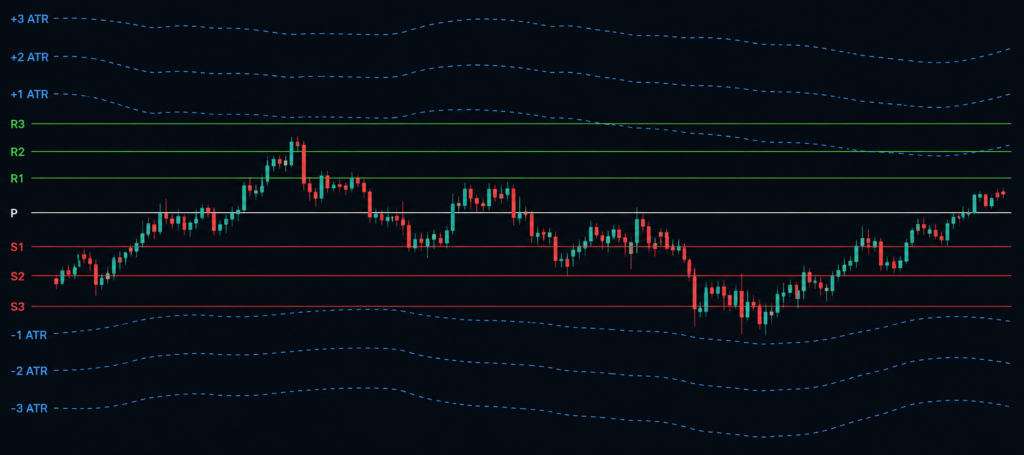
Combining ATR with forex pivot points creates a powerful confluence-based trading system.
Forex pivot points are horizontal price levels calculated from the previous session's high, low, and close. They act as support and resistance zones.
How to combine them:
Identify key forex pivot points on your chart (daily or weekly)
Wait for price to approach a pivot level
Check the ATR forex value is volatility high enough to sustain a move?
Enter the trade when price reacts at the pivot point
Set your stop-loss using 1.5x ATR below/above the pivot
Target the next pivot level as your take-profit
Why this works:
Pivot points give you clear entry and exit zones
ATR confirms whether momentum exists to drive the trade
Together, they reduce false signals significantly
This strategy works well on H1, H4, and Daily charts
Quick Tip: Avoid trading forex pivot points when ATR is extremely low. Low ATR means low momentum the price may not reach your target.
Identify key forex pivot points on your chart (daily or weekly)
Wait for price to approach a pivot level
Check the ATR forex value is volatility high enough to sustain a move?
Enter the trade when price reacts at the pivot point
Set your stop-loss using 1.5x ATR below/above the pivot
Target the next pivot level as your take-profit
Pivot points give you clear entry and exit zones
ATR confirms whether momentum exists to drive the trade
Together, they reduce false signals significantly
This strategy works well on H1, H4, and Daily charts
ATR Forex Breakout Strategy
Breakout trading is popular in forex. The ATR helps you identify real breakouts from fake ones.
Setup:
Mark the previous day's high and low
Check the ATR value look for ATR above its 20-period average
When price breaks above the high or below the low with rising ATR, enter the trade
Place stop-loss at 1.5x ATR from entry
Target: 2x ATR for take-profit
Mark the previous day's high and low
Check the ATR value look for ATR above its 20-period average
When price breaks above the high or below the low with rising ATR, enter the trade
Place stop-loss at 1.5x ATR from entry
Target: 2x ATR for take-profit
ATR Forex Position Sizing Protect Your Capital
Position sizing is critical in forex. The ATR makes this process mathematical and consistent.
Formula: Lot Size = (Account Risk in $) ÷ (ATR Value in $ per pip × Multiplier)
Example:
Account: $5,000
Risk per trade: 1% = $50
ATR = 50 pips, pip value = $1
Stop distance = 1.5 × 50 = 75 pips
Position size = $50 ÷ $75 = 0.67 mini lots
This method keeps your risk consistent regardless of how volatile the market is. It is one of the most professional approaches to forex risk management.
Account: $5,000
Risk per trade: 1% = $50
ATR = 50 pips, pip value = $1
Stop distance = 1.5 × 50 = 75 pips
Position size = $50 ÷ $75 = 0.67 mini lots
TR Forex Common Mistakes to Avoid
Even experienced traders misuse the ATR. Avoid these mistakes:
Using ATR as a directional signal: ATR measures volatility, not price direction
Ignoring ATR during news events: Spikes can give false ATR readings; wait for the market to settle
Using the same multiplier always: Adjust your multiplier based on market conditions and timeframe
Setting tight stops during high ATR: High volatility needs wider stops; respect the data
Ignoring ATR on different timeframes: Always check ATR on the chart you're trading, not just the daily
Using ATR as a directional signal: ATR measures volatility, not price direction
Ignoring ATR during news events: Spikes can give false ATR readings; wait for the market to settle
Using the same multiplier always: Adjust your multiplier based on market conditions and timeframe
Setting tight stops during high ATR: High volatility needs wider stops; respect the data
Ignoring ATR on different timeframes: Always check ATR on the chart you're trading, not just the daily
ATR vs. Other Forex Indicators
Indicator
Measures
Best Use
ATR
Volatility
Stop-loss, position sizing, breakout confirmation
Bollinger Bands
Volatility + Price
Overbought/oversold conditions
RSI
Momentum/strength
Entry timing, trend reversals
Forex Pivot Points
Support/Resistance
Entry zones, profit targets
MACD
Trend + Momentum
Trend confirmation
Indicator | Measures | Best Use |
ATR | Volatility | Stop-loss, position sizing, breakout confirmation |
Bollinger Bands | Volatility + Price | Overbought/oversold conditions |
RSI | Momentum/strength | Entry timing, trend reversals |
Forex Pivot Points | Support/Resistance | Entry zones, profit targets |
MACD | Trend + Momentum | Trend confirmation |
FAQs: Forex ATR
What is the best ATR setting for forex day trading?
Can I use ATR forex for scalping?
How does ATR help with forex pivot points?
What does a rising ATR mean in forex?
Is ATR available on MT4 and MT5?
What is a good ATR value for EUR/USD?
Final Thoughts: Master Forex ATR for Consistent Results
The forex ATR indicator is not just a tool it is a mindset shift.
When you trade with ATR, you stop guessing. You start trading with data. You know how much the market moves. You set stops that make sense. You size your positions intelligently.
Combined with forex pivot points, the ATR becomes even more powerful. You get clear trade levels AND volatility confirmation in one system.
Whether you are day trading, swing trading, or scalping the ATR forex indicator belongs in your strategy. It is trusted by professional traders worldwide, and for good reason.
Start with the default ATR (14). Practice on a demo account. Learn how the values behave on your preferred currency pairs. Then apply it with discipline and consistency.
Smart trading starts with smart tools. ATR is one of the best.