
Forex Breakout Strategy: The Complete 2026 Guide to Trade Breakouts Like a Pro
The forex market rewards preparation. One of the most powerful tools in a trader’s arsenal is the forex breakout strategy. It is simple in concept, proven in practice, and used by traders at every level from beginners to institutional desks.
If you want to catch explosive price moves early and trade with momentum on your side, this guide is built for you.
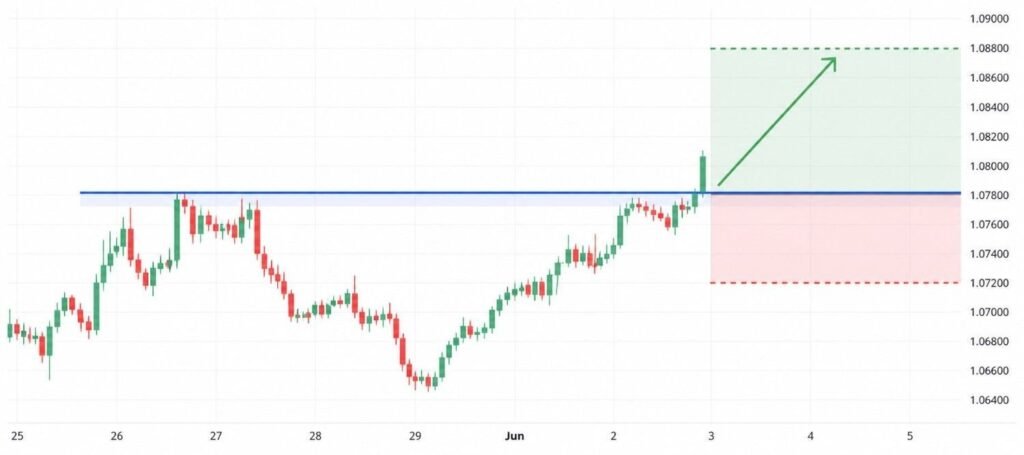
What Is a Forex Breakout Strategy?
A forex breakout strategy is a trading approach where you enter the market when price moves decisively beyond a defined support or resistance level. That move signals a potential shift in market momentum. It tells you that buyers or sellers have taken control and a new trend may be forming.
Think of price like a coiled spring. When the market consolidates for a period, pressure builds. The moment price breaks free from that range, it often moves fast and far.
That is the opportunity breakout trading captures.
Types of Forex Breakout Strategies
Not all breakouts are the same. Understanding the type helps you plan your trade accurately.
- Continuation Breakout Price consolidates within an existing trend, then breaks out in the same direction. This confirms the trend is resuming. Common patterns include flags, pennants, and triangles.
- Reversal Breakout Price breaks against the prevailing trend. This signals a potential trend change. Double tops, double bottoms, and head-and-shoulders patterns often produce reversal breakouts.
- Range Breakout Price trades between a clear ceiling and floor for an extended period. When it finally breaks either boundary with momentum, a strong directional move often follows.
- News-Driven Breakout Major economic events such as central bank decisions or NFP releases can push price through key levels instantly. These breakouts move fast and require tight risk management.
How to Identify a High-Quality Breakout Setup
Not every break of a level is worth trading. A solid breakout strategy relies on quality, not quantity. Here is what to look for before entering a trade.
- Level strength: The more times price has tested a support or resistance level, the more significant the breakout becomes. Look for levels tested at least two to three times.
- Momentum confirmation: Use indicators like ATR, RSI, or MACD to confirm that momentum is building behind the move.
- Candle close: Wait for a full candle to close beyond the level. A wick that briefly pokes through and reverses is not a confirmed breakout.
- Volume context: In forex, direct volume data is limited. Use momentum indicators as a proxy to assess whether the move has genuine force behind it.
- Market session: Breakouts during the London or New York sessions tend to be stronger. The Asian session is quieter and often produces fakeouts.
Step-by-Step: How to Execute a Breakout Trading Strategy
Follow these steps for a clean, disciplined trade execution.
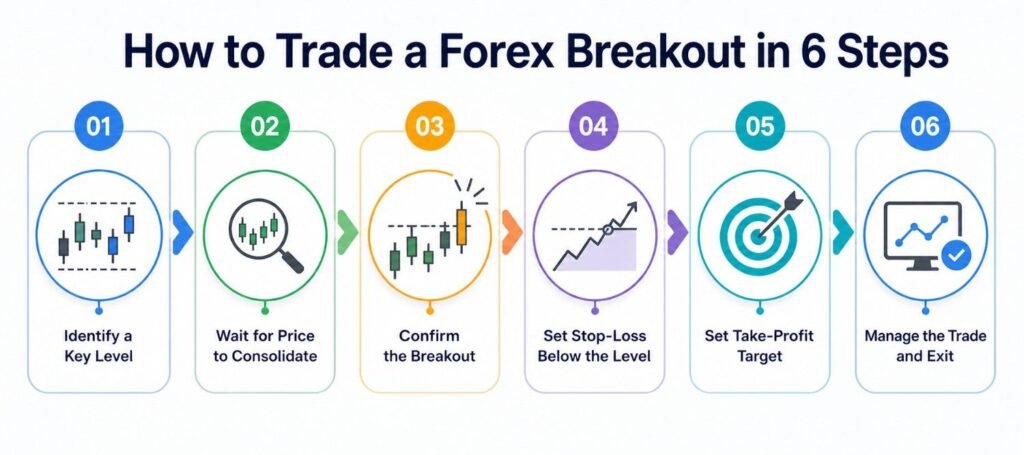
Step 1: Identify the Key Level Mark horizontal support and resistance levels that price has respected multiple times. These are your breakout zones.
Step 2: Wait for the Breakout Candle Do not jump in on the first touch. Wait for price to close convincingly beyond the level. Patience is your edge here.
Step 3: Confirm With an Indicator Check RSI for momentum. Check ATR to ensure volatility is expanding. Both tools help you filter out weak or false moves.
Step 4: Enter the Trade Enter at the close of the breakout candle or on a slight retest of the broken level. A retest entry often provides a better risk-to-reward ratio.
Step 5: Set Your Stop Loss Place your stop loss just outside the breakout candle or the recent swing high/low. This protects you if the move reverses.
Step 6: Set Your Take Profit Use a measured move based on the size of the consolidation range. Target the next significant support or resistance zone. Always aim for a minimum 2:1 risk-to-reward ratio.
How to Avoid False Breakouts (Fakeouts)
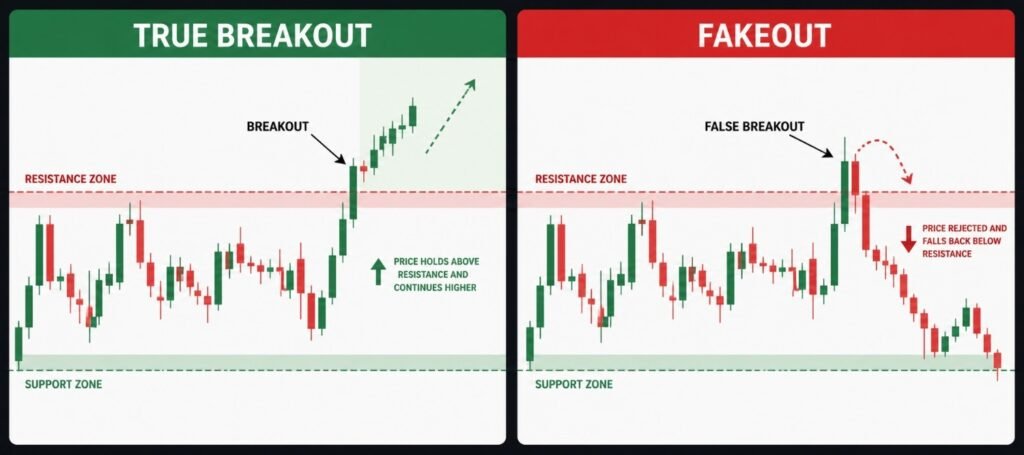
The biggest risk in breakout trading strategy is the fakeout. This is when price briefly crosses a key level, triggers your entry, and then snaps back inside the range.
Here is how to reduce that risk.
- Wait for candle close: Never enter mid-candle. A close beyond the level carries more weight than a temporary spike.
- Avoid thin market hours: Fakeouts are more common during low-liquidity periods like the Asian session or late US hours.
- Use confluence: A breakout that aligns with the higher timeframe trend, a key news event, or a strong technical pattern is far more reliable.
- Retest entry: If you miss the initial breakout, wait for price to pull back and retest the broken level. This gives you a lower-risk entry with confirmation.
- Check the bigger picture: If the overall trend is against your breakout direction, proceed with extreme caution.
Best Indicators for a Forex Breakout Strategy
Indicator | Purpose | How to Use |
ATR (Average True Range) | Measures market volatility | Expanding ATR confirms a real breakout |
RSI (Relative Strength Index) | Measures momentum | RSI above 50 (bullish) or below 50 (bearish) confirms direction |
MACD | Trend and momentum | MACD crossover in breakout direction adds confirmation |
Bollinger Bands | Volatility squeeze | Price breaking above/below the bands signals a breakout |
Volume Oscillator | Assesses buying/selling pressure | Rising momentum on breakout candle validates the move |
Best Forex Pairs and Sessions for Breakout Trading
Choosing the right pair and time matters a great deal. Here are the best options.
Top Forex Pairs for Breakout Trading:
- EUR/USD: High liquidity, tight spreads, clean technical levels
- GBP/USD: Volatile with strong momentum moves
- USD/JPY: Reacts well to news-driven breakouts
- GBP/JPY: High volatility, large pip moves
Best Sessions for Breakout Setups:
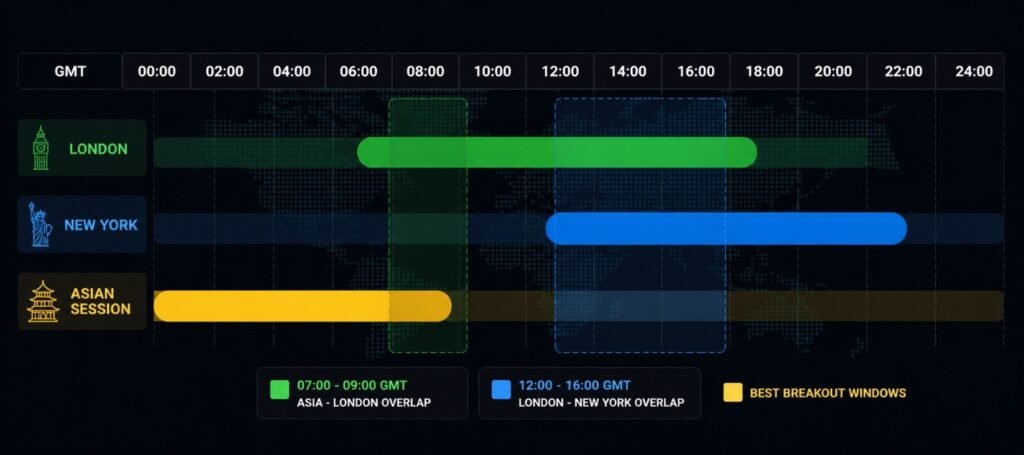
- London Open (8:00–10:00 AM GMT): The most active breakout session. Many of the cleanest forex breakout setups form here.
- New York Open (1:00–3:00 PM GMT): Strong volume and sharp directional moves. Excellent for continuation breakouts.
- London-New York Overlap: The highest liquidity window of the trading day. Breakouts here carry the most follow-through.
Risk Management in Breakout Trading
Even the best breakout strategy fails without solid risk management. Follow these principles on every trade.
- Risk only 1–2% of your account per trade. This protects your capital during losing streaks.
- Always use a stop loss. Place it beyond the breakout structure, not randomly.
- Never move your stop loss to breakeven too early. Give the trade room to breathe before adjusting.
- Scale out at targets. Take partial profits at your first target and let the rest run with a trailing stop.
- Track your trades. Review every breakout trade weekly to identify patterns in your wins and losses.
Common Mistakes Breakout Traders Make
Many traders struggle with breakout trading not because the strategy is flawed but because they break the rules.
- Entering before the candle closes beyond the level
- Ignoring the broader market trend
- Trading every small consolidation without checking level quality
- Setting stops too tight and getting knocked out before the move develops
- Chasing breakouts that have already moved too far from the entry zone
Frequently Asked Questions (FAQs)
What is a forex breakout strategy?
How do I confirm a breakout in forex?
What is the difference between a breakout and a fakeout?
Which session is best for breakout trading?
Can beginners use a breakout strategy?
What risk-to-reward ratio should I target on breakout trades?
What timeframes work best for forex breakout trading?
Final Thoughts
The forex breakout strategy is one of the most reliable and widely used approaches in the market for good reason. It gives you a clear entry trigger, defined risk, and the potential to ride powerful directional moves.
The key is patience. Wait for the right level. Wait for confirmation. Manage your risk on every trade.
Traders who apply the breakout trading strategy with discipline and consistency find that it delivers repeatable, high-quality setups across all market conditions. Whether you trade EUR/USD during the London open or GBP/JPY during major news events, the principles remain the same.
Learn the rules. Follow the process. Protect your capital. The profits take care of themselves.
Stay sharp, stay disciplined, and trade what you see not what you hope for.