
Introduction
A forex expert advisor is software that trades currency pairs for you, following rules you set and never sleeping. Many traders dream of an algorithm that watches the market around the clock, enters at the right moment, and removes emotion from every decision. That dream is real, but it comes with hard truths that marketing pages rarely mention. This guide explains what an expert advisor actually does, how it runs on MetaTrader 4 and MetaTrader 5, and the different strategy styles you will meet. You will learn how to judge the best forex robot, how to backtest and forward-test honestly, and how a VPS keeps your trades fast. We also cover risks, scams, and realistic expectations so you can automate with confidence rather than blind hope.
Quick SERP Snapshot
This is an offline, knowledge-based estimate, since live SERP results cannot be scraped here. For the phrase “forex expert advisor,” the front page typically mixes broker education hubs, the MQL5 marketplace and similar EA stores, robot-review blogs, and forum threads where traders argue about results. Most of those pages either sell a product or list options without teaching judgment. The content gap is clear: few resources explain, in plain prose, how an EA truly works, how to test one without fooling yourself, and how to separate honest tools from hype. This article fills that gap.
What a Forex Expert Advisor Really Is
A forex expert advisor is a program written to follow trading rules automatically. It reads price data, applies logic you or a developer defined, and then opens, manages, and closes trades without you touching the mouse. People call these tools EAs, forex robots, or bots, and the names point to the same idea: a machine that trades by rule rather than by feeling.
The appeal is easy to understand. Human traders get tired, scared, and greedy. An EA does not. It checks the chart the same way at 3 a.m. as it does at noon. It follows the plan even when the plan feels uncomfortable. For traders who struggle with discipline, that consistency can be the single biggest benefit.
Yet an EA is only as smart as its rules. It does not think, predict, or learn unless it was specifically built to do so. If the logic is weak, the robot will lose money quickly and tirelessly. So the question is never simply “does this EA work.” The real question is whether its strategy fits current market conditions and whether you understand what it does. Treat an expert advisor as a tool, not a magic income machine, and you start on the right foot.
How EAs Work on MT4 and MT5
Most expert advisors run inside MetaTrader 4 or MetaTrader 5, the two platforms that dominate retail forex. You attach the EA to a chart, and from that moment it watches every new price tick. On each tick it asks the same questions its code defines: Are my entry conditions met? Do I already hold a position? Should I move my stop or take profit? Based on the answers, it acts or waits.
MT4 uses a language called MQL4, while MT5 uses MQL5. MT5 is newer and offers faster backtesting, more order types, and better handling of stocks and futures alongside forex. Many modern robots ship in both versions, but if a developer only supports MT4, that can be a quiet sign the tool is aging.
The platform also gives you the Strategy Tester, a built-in lab for running an EA against historical data. This is where serious evaluation begins. You can replay months or years of price action in minutes and watch how the robot would have behaved. The Strategy Tester is not perfect, and we will discuss its limits later, but it is the first checkpoint every credible automated forex trading software must pass before it touches real money.
Main Types of Forex Robots
Expert advisors are not all built the same way. They fall into a few broad families, and knowing the family tells you a great deal about the risk you are accepting.
Trend-following EAs try to catch sustained moves. They buy strength and sell weakness, aiming to ride a wave for as long as it lasts. These robots often lose small amounts during choppy, sideways markets and then make it back during strong directional runs. Patience is part of the design.
Scalping EAs aim for many tiny profits from small price moves, sometimes holding trades for seconds or minutes. They depend heavily on low spreads and fast execution, which is why a quality broker and VPS matter so much for this style. A scalper that looks brilliant on paper can collapse once real spreads and slippage appear.
Grid and martingale EAs place layered orders and, in the martingale case, increase position size after losses to recover. These can show smooth, attractive equity curves for long stretches, then suffer a single catastrophic drawdown that wipes the account. Their danger is hidden, not absent, so treat them with extra caution.
News-trading EAs react to scheduled economic releases, trying to profit from sudden volatility. They require precise timing and a broker that tolerates news trading. The table below summarizes how these styles compare.
| EA Type | Typical Goal | Main Strength | Main Risk |
|---|---|---|---|
| Trend-following | Ride large moves | Big wins in trends | Losses in sideways markets |
| Scalping | Many small gains | Frequent profits | Spread and slippage sensitive |
| Grid | Profit from ranges | Smooth gains in ranges | Exposure during breakouts |
| Martingale | Recover losses | Long winning streaks | Rare but severe blowups |
| News trading | Exploit volatility | Fast, large moves | Slippage and broker limits |
How to Choose the Best Forex Robot
Choosing the best forex robot is less about chasing the highest advertised return and more about matching a proven tool to your goals and risk tolerance. Start by ignoring screenshots of huge profits. Anyone can curve-fit a demo result or post a lucky week. Instead, ask for verified track records, ideally on a third-party site like Myfxbook or FX Blue, where the account history cannot be faked easily.
Look closely at drawdown, not just profit. A robot that earned forty percent but suffered a sixty percent drawdown is far riskier than one that earned twenty percent with a ten percent dip. Drawdown tells you how much pain you would have felt holding the system, and most people quit during pain, not during gains.
Check how long the live record runs. A few weeks proves nothing. A year or more across different market conditions, including quiet and volatile months, carries real weight. Also consider whether the seller is transparent about the strategy. Honest developers explain the logic in general terms. Sellers who hide everything behind secrecy and promises deserve suspicion.
Finally, weigh support, updates, and community feedback. Markets change, and a good developer adjusts the robot over time. A tool that was abandoned years ago will eventually break against modern conditions, no matter how good it once was.
Evaluating and Backtesting Automated Forex Trading Software
Backtesting is how you study the past behavior of automated forex trading software before risking capital. In the MetaTrader Strategy Tester you load historical data, set your spread and starting balance, and run the EA across that period. A clean, profitable backtest is encouraging, but it is only the beginning, because the past does not promise the future.
Quality matters enormously. Use high-quality tick data and a realistic spread, not the tiny spread some tests default to. Test across several years so the robot meets trends, ranges, crashes, and calm. Beware of curve fitting, which happens when settings are tuned so perfectly to old data that they fail on anything new. A robot optimized to death often looks flawless in the test and falls apart live.
After backtesting comes forward testing on a demo account, then a small live account. Demo trading reveals problems backtests hide, such as how the EA handles real-time gaps and weekend openings. A small live account adds the final missing pieces: real spread, real slippage, and real broker behavior. Only after a system survives all three stages does it deserve meaningful capital. This patient sequence is what separates serious algorithmic traders from gamblers.
VPS, Execution, and Costs
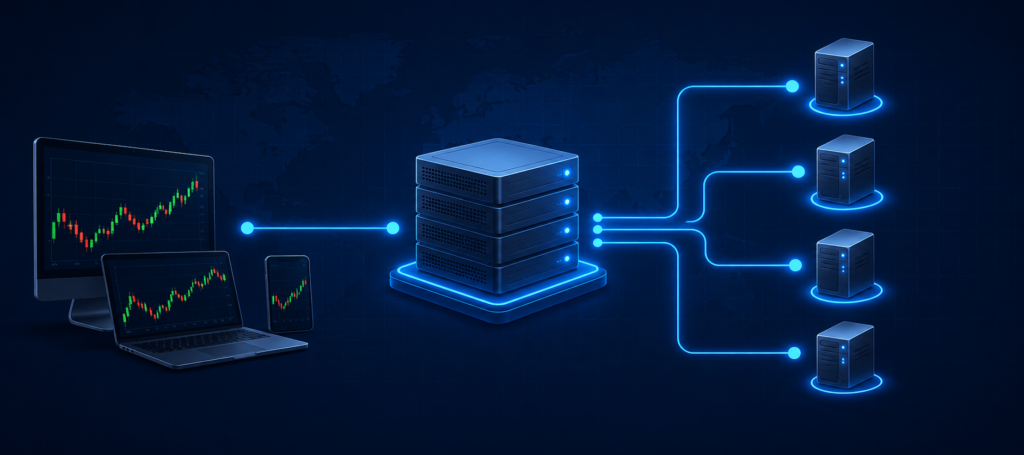
An expert advisor must stay running to do its job. If your home computer sleeps, loses power, or drops its internet connection, the robot stops, and an unmanaged trade can turn ugly. A Virtual Private Server, or VPS, solves this by running your MetaTrader platform on a remote machine that stays online every hour of every day.
A VPS also reduces latency, the tiny delay between your order and the broker’s server. For scalpers and news traders, milliseconds matter, and a VPS located near the broker’s servers can meaningfully improve fills. Costs are modest, and many brokers offer free VPS hosting once you trade a certain volume.
Pricing for the tools themselves varies widely, so it helps to see typical tiers in one place. The table below shows common price ranges you will encounter, expressed in US dollars.
| Item | Typical Price Range | Notes |
|---|---|---|
| Free EA | 0 dollars | Often basic or unproven |
| Entry robot | 30 to 100 dollars | One-time, single license |
| Premium robot | 200 to 600 dollars | Established sellers, updates |
| Subscription EA | 30 to 100 dollars monthly | Ongoing support and signals |
| Forex VPS | 10 to 35 dollars monthly | Some brokers offer it free |
| Custom EA build | 300 to 2000 dollars plus | Bespoke developer work |
Remember that a higher price does not guarantee better performance. Some excellent tools are cheap, and some expensive ones are worthless. Judge by verified results and transparency, not by the size of the invoice.
Risks, Scams, and Red Flags
The forex robot market is full of honest developers and, sadly, plenty of scammers. The most common trick is the promise of guaranteed profit. No legitimate seller can guarantee returns, because no one controls the market. When you see “100 percent win rate” or “double your account every month,” walk away. Those claims are bait.
Watch for fake backtests with perfect, straight-line equity curves. Real trading is bumpy, with losing periods mixed into the winning ones. A curve that only goes up was almost certainly curve-fitted or faked. Be equally wary of sellers who refuse to show a verified live account and instead rely on testimonials and luxury-car photos.
Hidden martingale logic is another danger. Some robots advertise smooth, low-risk results while quietly using position-doubling that can blow an account in a single bad day. Always ask whether the EA uses martingale or grid recovery, and assume the worst if the answer is vague.
The deepest risk, though, is your own behavior. Many traders switch robots constantly, abandoning a sound system the moment it has a losing week. Others over-leverage, risking far too much per trade. An expert advisor cannot save you from poor risk management. Decide your maximum risk per trade and your maximum account drawdown before you start, and let those limits guide every decision.
What Top Traders and Research Say
Automation does not exempt you from the timeless lessons of the markets, and the best sources make that clear. In Algorithmic Trading: Winning Strategies and Their Rationale, Ernest Chan walks through how systematic strategies are built, tested, and, crucially, how they can fail through overfitting and poor risk control. His work is a sober reminder that a clever model is worthless without disciplined execution and honest evaluation, which is exactly the standard an expert advisor should meet.
Academic research adds another warning. In their well-known study “Trading Is Hazardous to Your Wealth,” Barber and Odean found that the most active individual traders earned the worst returns, largely because frequent trading piled up costs and mistakes. The lesson translates directly to automation: an EA that trades constantly is not automatically better. More activity often means more spread paid and more chances to be wrong, not more profit.
A short line from trader Ed Seykota captures the mindset that survives both manual and automated trading: “The trend is your friend except at the end.” Respect the trend, respect your costs, and respect your risk limits, and your robot has a fighting chance.
Frequently Asked Questions (FAQs)
Is a forex expert advisor profitable?
A forex expert advisor can be profitable, but profit is never guaranteed. Results depend on the strategy, current market conditions, your risk settings, and your broker. Some robots perform well for years, while others fail within weeks. The safest mindset is to expect modest, uneven returns rather than instant riches. Always verify a live track record and test the tool yourself before trusting it with real money.
What is the best forex robot for beginners?
The best forex robot for a beginner is usually a simple, transparent one with a long verified track record and clear risk controls. Avoid complex martingale systems that promise huge gains, since their hidden risk can be brutal. Look for tools with strong community feedback, honest documentation, and active developer support. Start on a demo account, then move to a small live account once you understand exactly how the robot behaves.
Do I need a VPS to run automated forex trading software?
A VPS is strongly recommended for any serious use of automated forex trading software. It keeps your MetaTrader platform online every hour, even when your own computer is off or offline. It also reduces latency, which helps scalping and news strategies get better fills. While you can run an EA on a home PC, a single power cut or dropped connection can leave a trade unmanaged, so a low-cost VPS is cheap insurance.
How do I know if a forex EA is a scam?
Watch for guaranteed profits, perfect win rates, and equity curves that only go up, since real trading is always bumpy. Honest sellers show verified live accounts on third-party sites and explain their strategy in plain terms. Scammers hide everything behind secrecy and flashy lifestyle photos. If a forex EA refuses to provide a real, auditable track record, treat that silence as your answer and keep looking.
Can a forex robot replace a human trader?
A forex robot can replace the manual, emotional parts of trading, but it cannot replace human judgment entirely. Markets change, and an EA built for one environment may struggle in another. You still need to monitor performance, manage risk, and decide when to pause or retire a system. Think of your expert advisor as a tireless assistant that executes your plan, not as a fully independent decision-maker.
Final Thoughts
A forex expert advisor offers something genuinely valuable: tireless, disciplined execution that strips emotion out of trading and works while you sleep. But that value only appears when you treat the robot as a serious tool rather than a shortcut to easy wealth. The traders who succeed with automation are the ones who understand how their EA works, who insist on verified results and realistic backtests, and who respect drawdown as much as profit. They run quality tools on a reliable VPS, they avoid the guaranteed-profit traps, and they set firm risk limits before they begin. Whether you buy a proven robot or commission a custom build, let transparency, patient testing, and sound money management guide every choice. Do that, and the best forex robot becomes a steady partner in your trading rather than a costly gamble. Approach automated forex trading software with clear eyes, and you give yourself a real, durable edge.
Disclaimer: This article is for educational purposes only and does not constitute financial, investment, or trading advice. Forex trading carries a high level of risk, and you can lose more than your initial deposit. Always do your own research and consult a licensed professional before trading.
Ready to trade smarter with automation? Explore more honest guides, robot reviews, and strategy breakdowns at forextradingboards.com.