
Forex Liquidity Explained: What Every Trader Needs to Know
forex liquidity is one of the most important concepts in trading. Yet many beginners ignore it completely. That is a costly mistake.
Whether you are just starting out or have been trading for years, understanding liquidity in forex can dramatically change how you read the market, place trades, and manage risk.
This guide breaks it all down simply, clearly, and practically.
What Is Forex Liquidity?
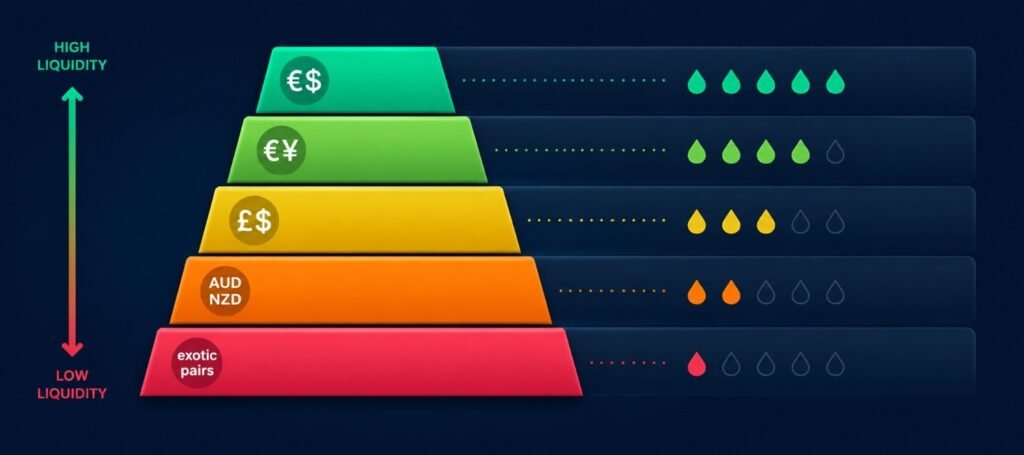
Forex liquidity refers to how easily a currency pair can be bought or sold without significantly moving its price.
Think of it this way. If you want to buy EUR/USD right now, there are thousands of sellers ready instantly. That is high liquidity. But if you try to trade an exotic pair like USD/TRY at 2 AM, you may find very few buyers. That is low liquidity.
In simple terms:
- High liquidity = tight spreads, fast execution, stable prices
- Low liquidity = wide spreads, slow execution, price gaps
Liquidity forex conditions directly affect every single trade you make.
Why Forex Liquidity Matters So Much
Most traders focus only on strategy. But even the best strategy fails in poor liquidity conditions.
Here is why forex liquidity is critical:
- Spread costs: Low liquidity widens spreads. This eats into your profits before the trade even moves.
- Slippage: Your order fills at a worse price than expected. This happens when there are not enough buyers or sellers at your target level.
- Price manipulation: Thin liquidity makes it easier for large players to move the market quickly often triggering stop losses.
- Execution speed: High liquidity in forex means your orders fill instantly. Low liquidity causes delays and requotes.
Understanding liquidity forex is not optional. It is essential.
Most Liquid Currency Pairs in 2026
Not all currency pairs carry the same level of forex liquidity. Here is a quick breakdown:
Currency Pair | Liquidity Level | Avg. Daily Volume |
EUR/USD | Extremely High | ~$1.5 trillion |
USD/JPY | Very High | ~$900 billion |
GBP/USD | High | ~$700 billion |
USD/CHF | High | ~$400 billion |
AUD/USD | Moderate-High | ~$350 billion |
USD/CAD | Moderate | ~$300 billion |
Exotic Pairs | Low | Under $50 billion |
The major pairs dominate liquidity in forex. They offer the tightest spreads and best execution. Exotic pairs carry much higher risk due to thin markets.
Forex Liquidity and Trading Sessions
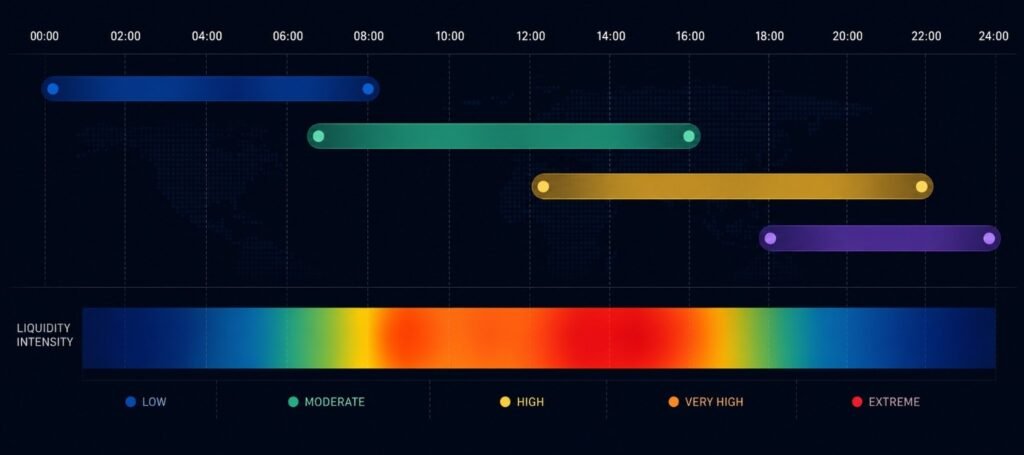
Liquidity forex is not constant throughout the day. It changes based on which global markets are open.
Here are the key sessions and their liquidity impact:
London Session (8 AM – 5 PM GMT) This is the most liquid session in the world. Nearly 35% of all global forex liquidity flows through London. Spreads are at their tightest here.
New York Session (1 PM – 10 PM GMT) The second most liquid session. The overlap between London and New York (1 PM – 5 PM GMT) is the absolute peak of liquidity in forex daily.
Asian Session (12 AM – 9 AM GMT) Liquidity drops significantly. JPY pairs remain active. Other majors see wider spreads. Avoid large trades in this window unless trading JPY.
Pro Tip: Always match your trade timing with peak forex liquidity hours. It reduces costs and improves execution.
Smart Money and Forex Liquidity Zones
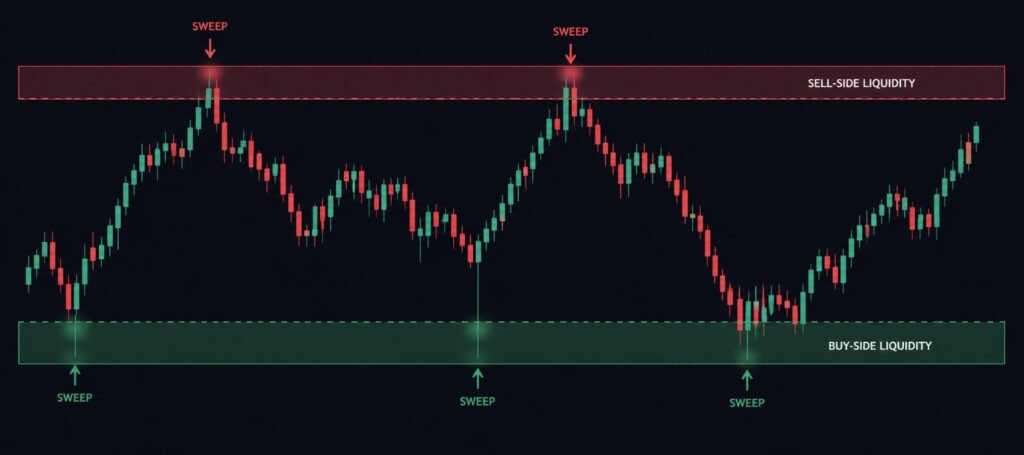
Advanced traders use forex liquidity concepts from smart money and ICT (Inner Circle Trader) methodology.
Key concepts include:
- Buy-side liquidity: Areas above recent highs where stop losses from short sellers sit. Price often sweeps these zones before reversing.
- Sell-side liquidity: Areas below recent lows where stop losses from buyers cluster. A liquidity grab here can signal a reversal upward.
- Liquidity sweep: When price briefly breaks a key level to grab liquidity in forex before reversing sharply. This traps retail traders.
- Liquidity pools: Clusters of pending orders at obvious price levels like round numbers, previous highs, and lows.
Understanding these zones helps you stop being the trader who gets swept and start being the trader who anticipates the move.
How Forex Liquidity Providers Work
Behind every trade you place, there is a forex liquidity provider working in the background.
Tier 1 providers are the biggest banks JPMorgan, Citi, Barclays, Deutsche Bank. They supply the deepest liquidity in forex globally.
Prime of Prime (PoP) providers like B2Broker, LMAX, IS Prime, and Finalto bridge smaller brokers to Tier 1 banks. They give retail brokers access to institutional-grade pricing.
Your broker connects to these providers and passes pricing to you.
The quality of your broker’s liquidity forex connections directly affects:
- How tight your spreads are
- How fast your orders execute
- How much slippage you experience
Always choose a broker with strong, transparent forex liquidity infrastructure.
Tips to Trade Smarter Using Forex Liquidity
Here are practical ways to use liquidity in forex to your advantage:
- Trade during London-New York overlap for the best spreads and execution
- Avoid trading 30 minutes before major news liquidity drops sharply and spreads widen
- Stick to major pairs for consistent forex liquidity and lower transaction costs
- Watch for liquidity sweeps at key highs and lows before entering trades
- Use limit orders instead of market orders in low-liquidity conditions to control your fill price
Forex Liquidity: FAQs
What does forex liquidity mean for beginners?
Which forex pair has the highest liquidity?
When is forex liquidity the highest?
How does low liquidity affect my trades?
What is a liquidity sweep in forex?
Do all brokers have the same liquidity?
Final Thoughts
Forex liquidity is not a technical concept reserved for experts. It is a fundamental reality of every trade you place.
Understanding liquidity in forex helps you trade at better prices, avoid costly mistakes, and read the market the way institutional players do.
Trade with the flow of liquidity forex not against it. Choose high-liquidity sessions, stick to liquid pairs, and learn to spot liquidity zones on your charts.
The traders who respect liquidity consistently outperform those who ignore it.
Stay informed. Trade smart. Visit ForexMarketTrendss.com for more professional forex guides updated regularly.