Introduction
Every chart you study and every strategy you back-test eventually runs into one stubborn obstacle: you. A forex positive trading mindset is the difference between a trader who follows the plan and one who panics at the first red candle. Markets do not reward the smartest person in the room; they reward the most disciplined and emotionally steady. In this guide, you will learn what a positive trading mindset actually means, why it matters more than any indicator, and how to build it step by step. We will cover the psychology behind fear and greed, the daily habits that keep your head clear, and the routines top traders rely on. By the end, you will have a practical framework for how to improve trading mindset and trade with calm confidence instead of raw emotion.

Why Mindset Beats Strategy in Forex
Most new traders believe success comes from finding the perfect system. They jump between indicators, copy signal groups, and tweak settings endlessly. Yet two traders can use the exact same strategy and end up with opposite results. One follows the rules through a drawdown; the other abandons them at the worst moment. The strategy was never the problem. The mind behind it was.
A forex positive trading mindset acts like the operating system that runs your strategy. A good plan executed by a frightened, impatient trader becomes a bad plan in practice. You hesitate on valid setups, exit winners too early, and hold losers too long. The market does not change, but your interpretation of it does. Emotions distort what you see, turning a routine pullback into a personal threat.
This is why professionals obsess over psychology. They know edges are small and fragile. Even a winning system loses on plenty of trades, sometimes several in a row. Without the right mental framework, those normal losses feel like proof that something is broken, so you change everything and destroy the very edge you spent months building. Mastering positive thinking for forex traders keeps you loyal to a sound process long enough for the math to work in your favor.
What a Positive Trading Mindset Actually Means
A positive trading mindset is often misunderstood. It does not mean blind optimism or expecting every trade to win. Forced positivity can be dangerous because it encourages you to ignore risk. Real positivity in trading is grounded and realistic. It means you approach the market with confidence in your process while fully accepting that any single trade can lose.
At its core, this mindset rests on acceptance. You accept that losses are a cost of doing business, the same way a shop owner accepts rent. You accept uncertainty as the natural state of markets. You accept that you control your actions, not the outcomes. This quiet acceptance removes the desperation that fuels most trading mistakes. When you stop fighting reality, you stop reacting emotionally to it.
Positivity also shows up as resilience. A strong trader treats a loss as feedback rather than failure. The chart did not insult you; it simply gave information. That reframing is the heart of how to improve trading mindset. Instead of asking why this always happens to you, you ask what this can teach you about your execution. The first question breeds helplessness. The second builds skill.
The Psychology of Fear and Greed
Two emotions drive nearly every poor trading decision: fear and greed. Fear makes you skip valid setups, close profitable trades early, and freeze when you should act. Greed makes you oversize positions, chase moves you missed, and refuse to take profit because you want just a little more. Both feelings are normal and human. The goal is not to eliminate them but to recognize them before they run the show.
Fear usually comes from focusing on money instead of process. When you fixate on the dollar value of a trade, every tick feels like pain or pleasure. Greed often follows a win, when overconfidence convinces you that you have figured the market out. Many blown accounts come not from a losing streak but from a winning one that inflated the ego and the position size.
Awareness is your first defense. The moment you label a feeling, its grip weakens. Saying to yourself that this is fear talking creates a gap between the emotion and your action. In that gap lives discipline. Cultivating positive thinking for forex traders is largely about building this self-awareness so that fear and greed inform you without controlling you.
This article is for educational purposes only and is not financial advice. Trading forex carries significant risk.
Negative Habits and Their Positive Replacements
Changing your mindset becomes easier when you can spot specific harmful habits and swap them for healthier ones. The table below maps common negative patterns to the positive behaviors that disciplined traders practice instead. Use it as a quick diagnostic the next time you feel your emotions creeping in.
| Negative Mindset Habit | Positive Replacement |
|---|---|
| Trading to make back a loss | Trading only valid, planned setups |
| Measuring every trade in dollars | Measuring success by rule-following |
| Expecting every trade to win | Thinking in probabilities and series |
| Reacting to single trade outcomes | Judging performance over 50 plus trades |
| Risking large amounts to recover fast | Keeping risk small and consistent |
| Blaming the market or broker | Reviewing your own execution honestly |
| Checking the chart obsessively | Trusting your plan and stepping away |
| Hiding or ignoring losses | Logging losses calmly in a journal |
The left column describes a reactive trader ruled by emotion. The right column describes a process-driven trader who has internalized a forex positive trading mindset. Notice that none of the positive replacements require predicting the market. They only require controlling yourself, which is the one variable you truly own.
How to Build Emotional Discipline Day by Day
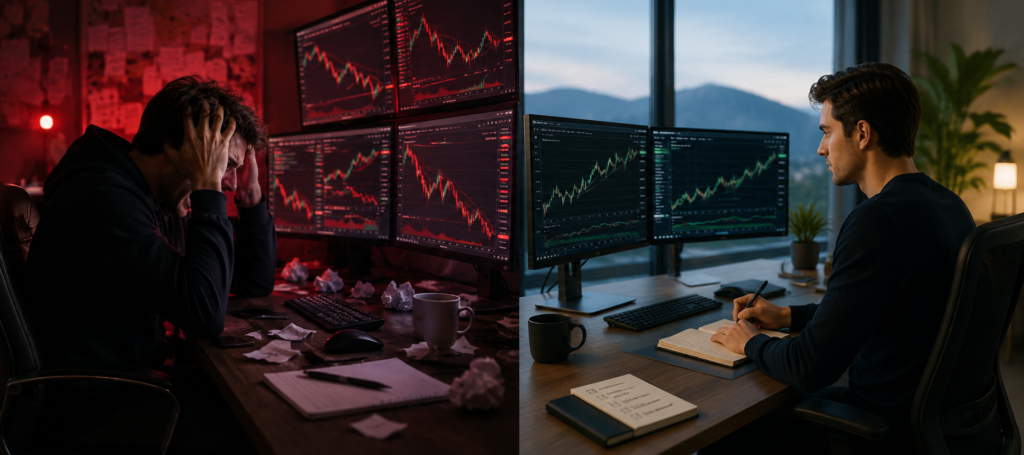
Discipline is not a personality trait you either have or lack. It is a muscle you train through small, repeated choices. The most reliable way to strengthen it is to shrink your decisions into rules you make in advance, while you are calm. Decide your entry, stop loss, and target before you open a position. Once the trade is live, your only job is to follow the plan you already wrote.
Position sizing is the foundation of emotional control. When you risk a small, fixed percentage of your account on each trade, no single loss can hurt you. That safety lets you stay rational. Traders who risk too much feel every trade in their gut, and that pressure guarantees emotional decisions. Reasonable risk turns the market from a threat into a series of low-stakes experiments.
Routine does the rest. Start each session with a short pre-market check: how do you feel, what is your plan, what will you not do today? End each session with a brief review. Over time these rituals build a stable rhythm that protects you from impulsive behavior. Learning how to improve trading mindset is really about stacking many tiny disciplined habits until they become automatic.
The Power of a Trading Journal
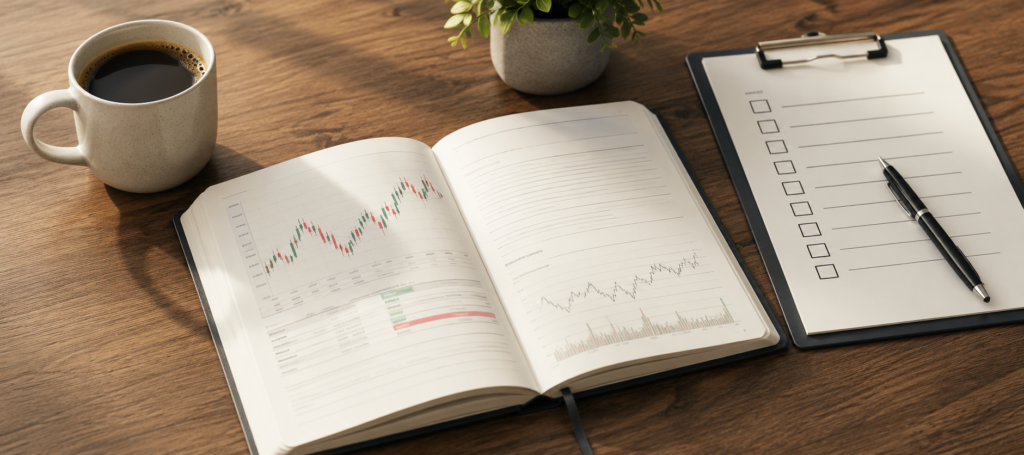
If you want to change your mind, you first have to see it clearly, and a journal is the mirror. Most traders remember their wins and conveniently forget their mistakes. A written record removes that bias. By logging every trade along with your emotional state, you start to notice patterns you would otherwise miss, like a tendency to overtrade after a loss or to oversize after a win.
A useful journal goes beyond numbers. Record what you were thinking and feeling at entry and exit. Note whether you followed your plan or broke it, and why. Over weeks, this turns vague frustration into concrete, fixable data. You might discover that your strategy is fine and your impulsiveness is the leak. That single insight can transform your results.
The journal also reinforces a healthy identity. Each time you log a disciplined trade, you cast a vote for the trader you want to become. This steady evidence builds genuine confidence, the kind rooted in behavior rather than wishful thinking. Few tools do more to support positive thinking for forex traders than an honest, consistent journal.
Reframing Losses and Building Resilience
Losses are where mindset is truly tested. A single loss can trigger a spiral: frustration leads to revenge trading, which leads to bigger losses, which leads to despair. Breaking that chain requires a deliberate reframe. A loss is not a verdict on your worth or skill. In a probabilistic game, losses are simply part of the distribution. Even a strategy that wins 60 percent of the time loses four out of every ten trades.
Resilient traders zoom out. They judge themselves over a large sample, not a single trade or even a single day. When you think in series rather than singles, one red trade loses its sting. You expect a certain number of losses the same way a casino expects to pay out some winners while staying profitable overall. This perspective is the antidote to revenge trading and tilt.
It also helps to separate good decisions from good outcomes. You can follow your plan perfectly and still lose, and you can break every rule and still win by luck. Process-focused traders reward themselves for good decisions regardless of outcome. That habit protects a forex positive trading mindset through the inevitable rough patches and keeps you from learning the wrong lessons from random results.
Daily Habits That Strengthen Your Trading Mindset
A strong mind is built away from the charts as much as in front of them. Physical state heavily influences emotional control. Sleep, exercise, and nutrition are not lifestyle extras; they directly affect your patience and decision-making. A tired, stressed trader makes impulsive choices. A rested, calm one waits for quality setups. Treat your body as part of your trading system.
Mindfulness practices give you a noticeable edge. A few minutes of focused breathing before a session settles the nervous system and sharpens attention. Many top performers use short meditation routines to create distance between feeling and reaction. You do not need anything elaborate. The simple act of pausing and breathing when you feel the urge to overtrade can save your account.
Finally, manage your information diet. Constant exposure to loud opinions, hype, and noise breeds anxiety and fear of missing out. Curate your environment so that calm, quality input surrounds you. Below is one short checklist of daily anchors worth keeping.
- Set a clear intention and risk limit before the first trade.
- Take scheduled breaks to reset focus and avoid screen fatigue.
- Review your journal and one lesson learned at the day’s close.
What Top Traders and Research Say
The most respected voices in trading psychology agree that the mind, not the method, separates winners from losers. Mark Douglas, in his classic book Trading in the Zone, argues that consistency comes from accepting risk and thinking in probabilities rather than predicting individual outcomes. His central idea, that you must believe anything can happen, is foundational to a forex positive trading mindset and explains why acceptance matters more than certainty.
Academic research backs this up. The work of psychologists Daniel Kahneman and Amos Tversky on prospect theory revealed loss aversion: people feel the pain of a loss roughly twice as intensely as the pleasure of an equivalent gain. This bias explains why traders hold losers too long and cut winners too soon. Knowing the bias exists is the first step to counteracting it with rules and awareness rather than raw emotion.
The wisdom of veteran traders points the same direction. As Ed Seykota famously put it, “Win or lose, everybody gets what they want out of the market.” It is a sharp reminder that your trading results often mirror your inner state. Fix the mindset, and the outcomes tend to follow. Morgan Housel’s The Psychology of Money extends the lesson beyond trading, showing that behavior, not intelligence, drives long-term financial success.
Frequently Asked Questions
What is a forex positive trading mindset?
A forex positive trading mindset is a grounded, disciplined mental approach to trading. It means having confidence in your process while fully accepting that any single trade can lose. It is not blind optimism. Instead, it blends realism, patience, and emotional control. Traders with this mindset treat losses as feedback, think in probabilities, and stay loyal to their plan rather than reacting to fear or greed.
How can I improve my trading mindset as a beginner?
The fastest path for how to improve trading mindset is to reduce your risk per trade so emotions stay low. Keep a detailed trading journal that records both your decisions and your feelings. Build a simple pre-session and post-session routine. Focus on following your rules rather than chasing profit. Over time, these small disciplined habits compound into genuine confidence and emotional stability.
Why do emotions matter so much in forex trading?
Emotions matter because they directly shape your execution. Fear makes you exit good trades early or freeze on valid setups, while greed pushes you to oversize and chase. Even a profitable strategy fails when fear and greed drive the decisions. Strong positive thinking for forex traders keeps these emotions visible and manageable, so your edge actually gets a chance to play out.
How do I stop revenge trading after a loss?
Revenge trading comes from treating one loss as a personal defeat. Stop it by thinking in series rather than single trades and by judging performance over fifty trades or more. Step away from the screen after a loss, breathe, and review your plan before re-entering. Keeping risk small also reduces the emotional sting that triggers the urge to win it back immediately.
Can mindset really matter more than my trading strategy?
Yes. Two traders using the same strategy often get opposite results because one follows the rules and the other panics. A solid plan executed by an emotional trader becomes unreliable in practice. Edges in forex are small and require discipline to survive normal losing streaks. That is why a steady mindset, built on patience and risk acceptance, frequently outweighs the strategy itself.
What daily habits support a strong trading mindset? Prioritize sleep, exercise, and nutrition, since your physical state drives your patience and focus. Add a short mindfulness or breathing routine before each session to calm the nervous system. Set a clear risk limit and intention daily, take scheduled breaks, and review your journal at the close. Curate your information diet to limit hype and fear of missing out that breed anxiety.
Final Thoughts
Mastering the charts will only take you so far if your mind keeps sabotaging your plan. A forex positive trading mindset is the quiet engine behind consistent results, turning a good strategy into a repeatable one. It grows from acceptance of risk, awareness of fear and greed, small disciplined habits, an honest journal, and the resilience to treat losses as data rather than defeat. None of this requires predicting the market. It only requires mastering the one variable you control, which is yourself. Be patient with the process, because mindset is built through repetition, not a single breakthrough. Start with one habit today, protect your capital with sensible risk, and let discipline compound over time. For more practical trading psychology guides, strategy breakdowns, and market insights, keep learning with us at forextradingboards.com.