
Introduction
A consistent forex pre-market analysis routine is what separates disciplined traders from those who chase price all day. Before the London or New York open, the market gives you clues, but only if you know where to look. This guide walks you through a complete, repeatable process you can run every morning in under an hour. You will learn how to scan the economic calendar for high-impact news, read overnight price action from the Asian and London sessions, mark key support, resistance, and liquidity levels, and run multi-timeframe top-down analysis. We also cover sentiment, risk-on versus risk-off conditions, building a watchlist, and planning entries, stops, and targets. Along the way you will pick up practical forex morning analysis tips and a clear answer to how to analyze forex before trading, so you start each session with a plan instead of a guess.
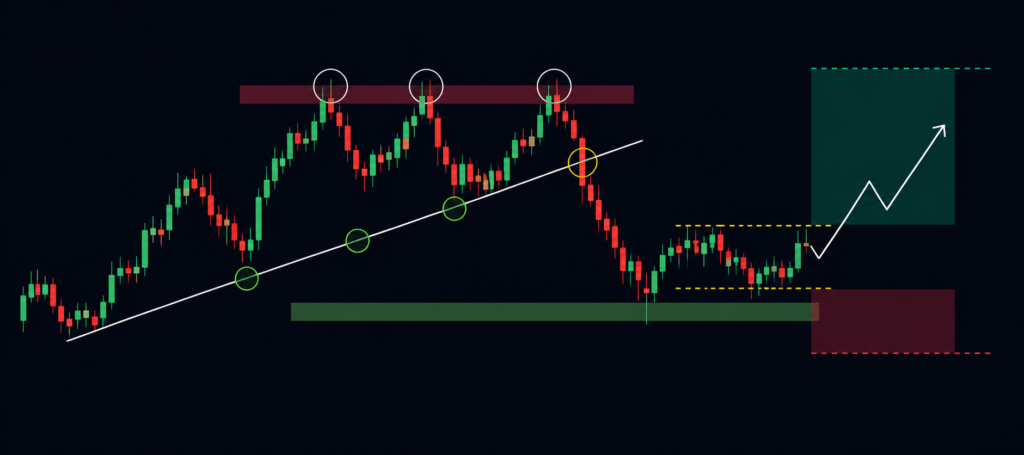
Why a Pre-Market Routine Beats Improvising
Markets reward preparation. When you sit down without a process, you react to whatever candle is moving and let emotion drive decisions. A repeatable forex pre-market analysis routine flips that script. You arrive with a thesis, a list of pairs, and predefined levels, so the session becomes about execution rather than discovery. This reduces overtrading, the single most common reason retail accounts bleed out slowly.
A routine also builds pattern recognition over time. Run the same checklist for thirty mornings and your brain starts spotting the difference between a clean trend day and a choppy, news-driven trap before you place a single order. Consistency, not cleverness, is the edge. The goal of learning how to analyze forex before trading is to make your mornings boring and your decisions mechanical. Boring is profitable.
Step One: Scan the Economic Calendar for High-Impact News
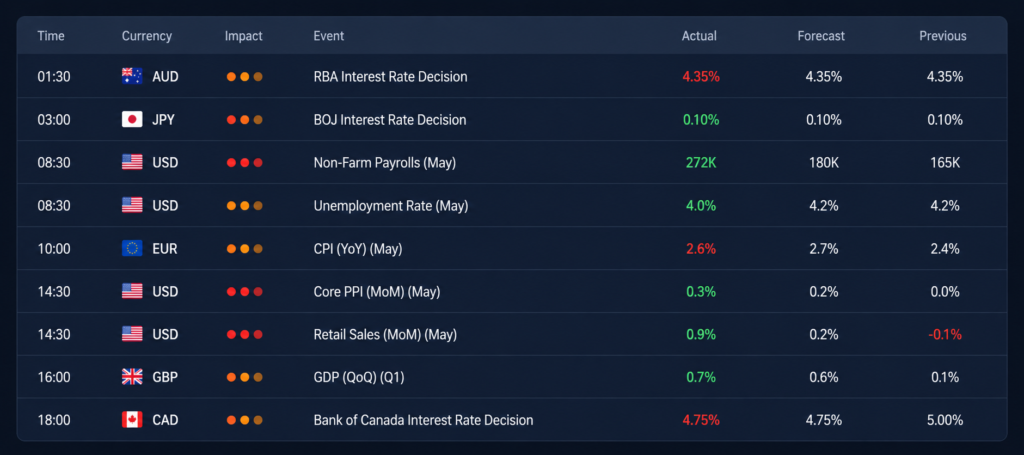
Your morning starts with the economic calendar, not the chart. Open a reputable calendar, filter for high-impact red-folder events, and set your time zone correctly. You are looking for releases like central bank rate decisions, CPI inflation prints, Non-Farm Payrolls, PMIs, and major central bank speeches. These events move price violently and can blow through your levels regardless of how clean the technical setup looks.
Note the exact release time and which currencies are affected. If USD CPI prints at 12:30 UTC, expect thin, jumpy conditions in every dollar pair around that window. Many experienced traders simply stand aside fifteen minutes before and after a red-folder release. Knowing the schedule lets you decide in advance whether today is a trading day, a wait-for-the-news day, or a sit-on-hands day. This single habit is the backbone of good forex morning analysis tips and protects you from being the liquidity that smart money feeds on.
Step Two: Review Overnight Price Action and the Asian Session
With the news mapped, study what already happened while you slept. The Asian session is typically quieter and more range-bound, which makes it useful for defining the day’s early boundaries. Note the Asian session high and low, because the London open often hunts liquidity just beyond those edges before reversing or continuing. A sweep of the Asian high followed by a sharp rejection is a classic London-session tell.
Then review the London session behavior if you are analyzing later in the day, or anticipate it if you are prepping before the open. London brings the first wave of real volume and tends to set the directional tone for European pairs. Ask simple questions. Did price trend or chop overnight? Where did it accelerate? Where did it stall? This overnight read frames everything that follows and is a core part of any complete forex pre-market analysis routine.
Step Three: Mark Key Support, Resistance, and Liquidity Levels
Now annotate your charts. On the daily and 4-hour, mark the obvious horizontal levels where price has repeatedly reacted. These are your support and resistance zones, and they matter because so many other traders watch them too. Add the prior day’s high, low, and close, plus the current week’s opening price. These reference points act as magnets and decision points throughout the session.
Pay special attention to liquidity levels, clusters of stops sitting above swing highs and below swing lows. Price is often drawn toward these pools before making its real move. Round numbers like 1.1000 or 150.00 also concentrate orders. Keep your charts clean. Three or four high-quality levels per pair beat twenty messy lines that paralyze you. The point is to know in advance where you expect reactions, so when price arrives you are ready instead of surprised.
Step Four: Run Multi-Timeframe Top-Down Analysis
This is where bias is born. Multi-timeframe top-down analysis means starting from the highest timeframe and working down, letting the bigger picture set direction and the lower timeframe refine entry. Begin on the weekly or daily to establish the dominant trend. Is structure making higher highs and higher lows, or the reverse? That answer is your macro bias.
Drop to the 4-hour to see how the current swing fits the larger trend, then to the 1-hour for intraday structure. The smaller timeframe should agree with the larger before you commit. When the daily is bullish, the 4-hour is pulling back into support, and the 1-hour shows a reversal pattern, you have alignment, and alignment is conviction. If timeframes contradict each other, that pair is messy, so skip it. Mastering this sequence is the heart of how to analyze forex before trading with structure rather than hope.
Step Five: Gauge Market Sentiment and Risk-On vs Risk-Off
Technicals tell you where; sentiment tells you why the whole board might move together. Check the broad mood. In risk-on conditions, capital flows into higher-yielding and commodity currencies like AUD and NZD, equities rise, and safe havens soften. In risk-off conditions, traders flee to the USD, JPY, and CHF, and risk currencies sell off. Knowing the regime stops you from buying a risk currency into a fearful tape.
Glance at the Dollar Index, equity futures, bond yields, and gold for a quick sentiment read. Correlations matter too: if EUR/USD and GBP/USD are both pushing higher, that is dollar weakness, not isolated euro strength. This macro context filters your watchlist. A long setup that fights the prevailing risk mood is a lower-probability trade, and recognizing that is one of the most underrated forex morning analysis tips for newer traders.
Step Six: Build Your Watchlist and Set the Daily Bias
You cannot watch every pair, and you should not try. From your analysis, select three to five pairs that show the cleanest confluence of trend, key levels, and sentiment alignment. For each, write a one-line bias: bullish above this level, bearish below that one, or neutral and waiting. This is your daily bias, and it keeps you anchored when intraday noise tempts you to flip.
A focused watchlist sharpens attention. Instead of scanning forty charts and missing everything, you monitor a handful you understand deeply. Mark your watchlist pairs with alerts at the key levels you identified, so you are notified when price reaches a decision zone rather than staring at screens all day. This step turns broad analysis into a concrete, actionable plan and is the practical payoff of the entire forex pre-market analysis routine.
A Sample Pre-Market Routine Timeline
The table below shows one way to structure your morning. Times are illustrative blocks rather than fixed clocks, since your local schedule and target session will shift them. Adjust to your own trading window.
| Time Block | Task | Purpose |
|---|---|---|
| Open + 0 min | Check economic calendar, filter high-impact | Avoid trading into red-folder news |
| Open + 10 min | Review overnight and Asian session range | Frame early highs, lows, and tone |
| Open + 20 min | Mark support, resistance, and liquidity | Define decision zones in advance |
| Open + 30 min | Top-down multi-timeframe analysis | Establish directional bias |
| Open + 40 min | Gauge sentiment and risk-on/risk-off | Filter trades by macro mood |
| Open + 50 min | Build watchlist and write bias notes | Focus on 3–5 highest-probability pairs |
| Open + 55 min | Plan entries, stops, targets, journal | Pre-commit to a mechanical plan |
For reference, the major sessions in UTC are roughly: Sydney 21:00–06:00, Tokyo 23:00–08:00, London 07:00–16:00, and New York 12:00–21:00. The London–New York overlap from 12:00–16:00 UTC carries the highest liquidity and is a favored window for many intraday traders.

Step Seven: Plan Entries, Stops, and Targets Before You Click
Analysis without a plan is just opinion. For each watchlist pair, define the three numbers that matter before the session heats up: where you enter, where you are wrong, and where you take profit. Your stop belongs at the price that invalidates your idea, typically beyond the structural level you are trading from, not at an arbitrary distance that simply feels comfortable.
Size the position from the stop, never the other way around. Decide the fixed percentage of your account you are willing to risk per trade, then calculate lot size so a stop-out costs exactly that amount. Confirm the reward justifies the risk; many traders demand at least a two-to-one target before committing. Writing these levels down removes the temptation to widen stops or move targets mid-trade when emotion spikes. This pre-commitment is the discipline backbone of a serious forex pre-market analysis routine.
Step Eight: Pre-Session Mindset and Journaling
The final step is internal. Take two minutes to check your own state. Are you rested, calm, and focused, or rushed and revenge-minded after yesterday’s loss? Your mental edge erodes fast when you trade tired or tilted. A short pre-session note recording your bias, your watchlist, and your emotional state creates accountability and a feedback loop you can review later.
Journaling is where improvement compounds. At the end of the day, compare what you planned against what you actually did. Did you follow your levels or chase? Did you respect your stops? Over weeks, these notes reveal your real edges and your recurring mistakes with brutal honesty. The traders who grow fastest are not the ones with secret indicators; they are the ones who review their own behavior. Make journaling a non-negotiable bookend to your morning analysis.
What Top Traders and Research Say
The principle of working from the big picture down is anchored in classic literature. In Technical Analysis of the Financial Markets, John Murphy argues that traders should analyze higher timeframes first to set context before drilling into entries, the exact logic behind top-down analysis. On the psychology side, Mark Douglas in Trading in the Zone stresses that consistency comes from a repeatable process executed without emotional interference, which is precisely what a pre-market routine builds.
Research supports the discipline angle. A widely cited study by Brad Barber and Terrance Odean, Trading Is Hazardous to Your Wealth, found that the most active, impulsive traders earned the worst net returns, underscoring why a structured plan that curbs overtrading matters. As trader Paul Tudor Jones put it: “The most important rule is to play great defense.” A morning routine is defense applied before the first trade.

Frequently Asked Questions (FAQs)
How long should a forex pre-market analysis routine take?
For most traders, a focused forex pre-market analysis routine takes 30 to 60 minutes. The goal is depth, not speed. Beginners may need longer while building the habit, but with practice the calendar scan, level marking, top-down read, and watchlist build become quick and automatic. Quality and consistency matter far more than rushing through every step.
What should I check first when learning how to analyze forex before trading?
Always start with the economic calendar. Knowing how to analyze forex before trading begins with identifying high-impact news that can override technicals. Once you know the risk events for the day, you can study overnight price action, mark levels, and form bias with full context. News awareness keeps you out of avoidable, low-probability conditions.
Which forex session is best for pre-market analysis?
It depends on your schedule, but the London open and the London–New York overlap (12:00–16:00 UTC) offer the most liquidity and cleaner moves. Many traders prep before the London open using the Asian session range as a guide. Align your routine with the session you actually trade for the best results.
Do I need to mark levels on every timeframe?
No. Focus on the daily and 4-hour for major support and resistance and liquidity zones, then use lower timeframes only to refine entries. Marking levels on every timeframe creates clutter and indecision. A few high-quality zones per pair give cleaner, more confident trade decisions than dozens of minor lines.
How does sentiment fit into a morning routine?
Sentiment sets the backdrop. Checking risk-on or risk-off conditions, the Dollar Index, yields, and equities tells you whether the whole market is leaning toward or away from risk. This filters your watchlist so you avoid fighting the dominant macro mood. It is one of the most valuable forex morning analysis tips for higher-probability trades.
Should beginners journal their pre-market analysis?
Absolutely. Journaling your bias, watchlist, and emotional state, then reviewing outcomes, is how beginners accelerate learning. It exposes recurring mistakes and confirms what actually works for you. Without a journal, you repeat errors blindly. With one, your forex pre-market analysis routine improves measurably week after week.
Final Thoughts
A complete forex pre-market analysis routine transforms trading from reaction into preparation. By starting with the economic calendar, reading overnight and Asian-session price action, marking clean support, resistance, and liquidity levels, running disciplined top-down analysis, gauging sentiment, building a tight watchlist, planning entries and stops, and journaling your mindset, you arrive at every session with a plan instead of a guess. None of these steps require secret indicators, just consistency. Run the same process daily and pattern recognition, discipline, and confidence compound over time. Apply these forex morning analysis tips, internalize how to analyze forex before trading with structure, and your mornings will become your edge. For more practical guides, trading routines, and market breakdowns, visit forextradingboards.com and keep sharpening your process.
This article is for educational purposes only and does not constitute financial or investment advice. Always do your own research and consult a licensed professional before trading.