Forex Spread Explained: What It Is, How It Works & Why It Matters
If you are serious about forex trading, you must understand forex spread. It directly affects your profit and loss on every single trade. Most beginners overlook it. That is a costly mistake.
This guide breaks down everything what spread in forex means, how forex slippage works, and how to protect your trading capital from unnecessary costs.
What Is Forex Spread?
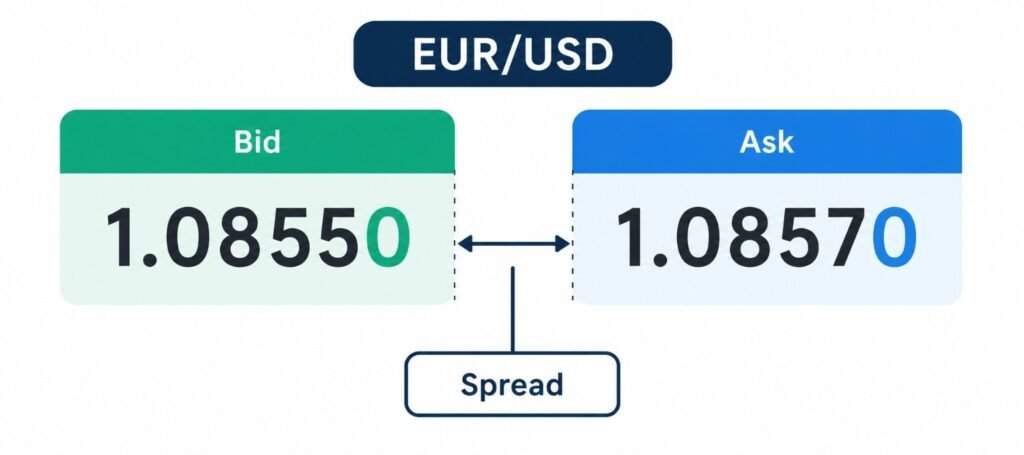
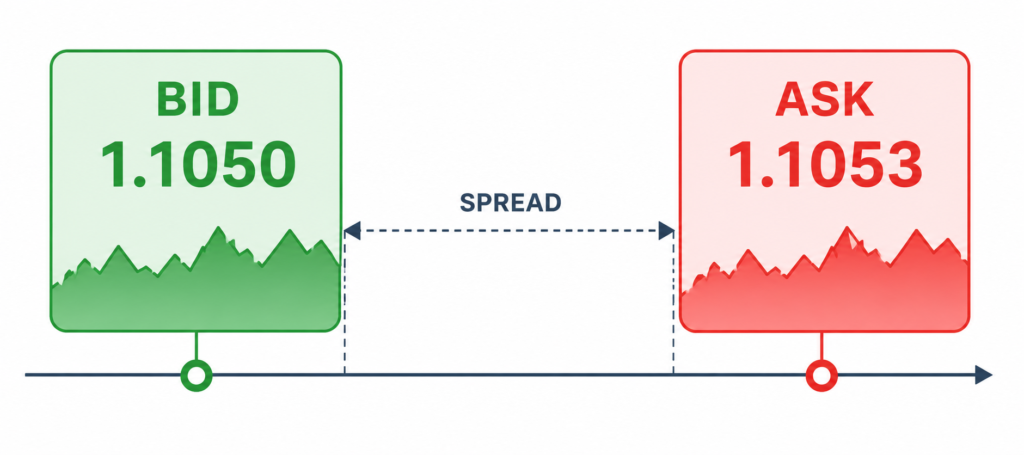
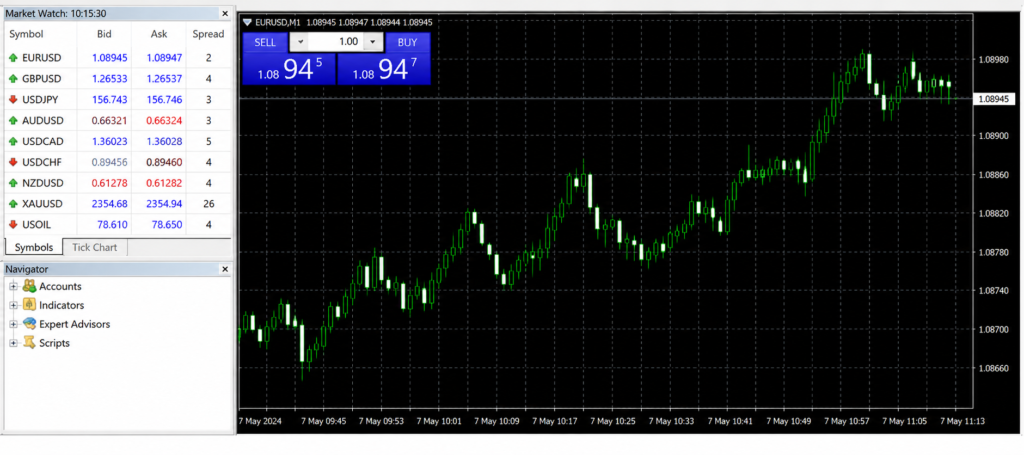
Forex spread is the difference between the buy price (ask) and the sell price (bid) of a currency pair.
Your broker does not charge a traditional commission in most cases. Instead, they earn through the spread. Every time you open a trade, you start at a small loss equal to the spread. You must overcome that gap before making any profit.
Simple Example:
- EUR/USD Bid Price: 1.10500
- EUR/USD Ask Price: 1.10503
- Spread = 0.3 pips
That 0.3-pip gap is what your broker keeps.
Why Does Forex Spread Matter So Much?
The spread in forex is your first hidden cost. It matters because:
It reduces your net profit on every winning trade.
It increases your loss on every losing trade.
It compounds over time, especially for high-frequency traders and scalpers.
It varies by broker, currency pair, and market conditions.
A trader placing 20 trades per day with a 1-pip spread pays 20 pips daily in spread costs alone. Over a month, that is 400–600 pips lost before a single market move is even calculated.
Choosing the right broker with a tight forex spread is not optional. It is essential.
Types of Forex Spread
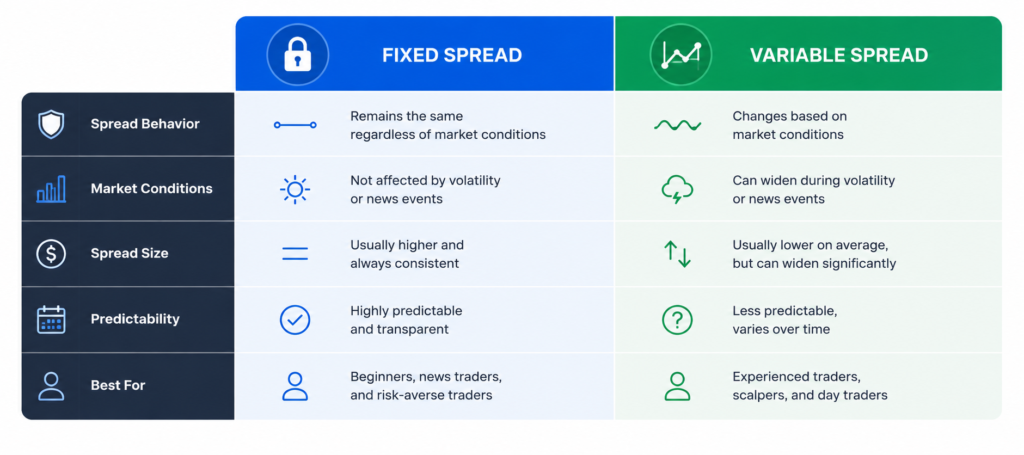
There are two main types of spread in forex:
1. Fixed Spread
Stays constant regardless of market conditions.
Good for beginners who want predictability.
Typically offered by market makers.
Slightly wider than variable spreads during calm markets.
2. Variable (Floating) Spread
Changes based on market liquidity and volatility.
Tighter during stable market hours.
Widens sharply during news events and off-hours.
Common with ECN and STP brokers.
Feature
Fixed Spread
Variable Spread
Predictability
High
Low
Cost in calm markets
Higher
Lower
Cost during news
Same
Much higher
Best for
Beginners, swing traders
Scalpers, experienced traders
It reduces your net profit on every winning trade.
It increases your loss on every losing trade.
It compounds over time, especially for high-frequency traders and scalpers.
It varies by broker, currency pair, and market conditions.
Choosing the right broker with a tight forex spread is not optional. It is essential.
Stays constant regardless of market conditions.
Good for beginners who want predictability.
Typically offered by market makers.
Slightly wider than variable spreads during calm markets.
Changes based on market liquidity and volatility.
Tighter during stable market hours.
Widens sharply during news events and off-hours.
Common with ECN and STP brokers.
Feature | Fixed Spread | Variable Spread |
Predictability | High | Low |
Cost in calm markets | Higher | Lower |
Cost during news | Same | Much higher |
Best for | Beginners, swing traders | Scalpers, experienced traders |
What Is Forex Slippage?
Forex slippage is different from the spread but equally important.
Slippage happens when your trade executes at a different price than the one you intended. This occurs during:
- High-impact news releases (NFP, FOMC, CPI)
- Low liquidity periods (late Friday, Asian session for EUR/USD)
- Fast market movements
Example of Forex Slippage:
You place a buy order at 1.10500. Due to fast price movement, your trade fills at 1.10520. That 2-pip difference is slippage.
Key Difference:
- Spread is a known, consistent cost you pay on every trade.
- Forex slippage is an unexpected cost that happens during execution.
Both eat into your profits. A good broker minimizes both.
Spread vs Slippage: A Quick Comparison
Factor
Forex Spread
Forex Slippage
Predictable?
Yes
No
Occurs every trade?
Yes
Sometimes
Cause
Broker markup
Market volatility / liquidity
How to reduce
Choose low-spread broker
Use limit orders, avoid news
Factor | Forex Spread | Forex Slippage |
Predictable? | Yes | No |
Occurs every trade? | Yes | Sometimes |
Cause | Broker markup | Market volatility / liquidity |
How to reduce | Choose low-spread broker | Use limit orders, avoid news |
How to Calculate Forex Spread Cost
Understanding the real cost of forex spread helps you make smarter decisions.
Formula:
Spread Cost = Spread (in pips) × Pip Value × Lot Size
Example:
Spread on EUR/USD: 1.2 pips
Pip value (standard lot): $10
Spread Cost per trade: 1.2 × $10 = $12
On 50 trades per month, that is $600 just in spread costs. This is why tight spreads matter for active traders.
Spread on EUR/USD: 1.2 pips
Pip value (standard lot): $10
Spread Cost per trade: 1.2 × $10 = $12
Which Currency Pairs Have the Lowest Spread?
Major currency pairs always carry the tightest forex spread:
EUR/USD: typically 0.1 to 1.5 pips
GBP/USD: typically 0.5 to 2 pips
USD/JPY: typically 0.3 to 1.5 pips
USD/CHF: typically 0.5 to 2 pips
Exotic pairs like USD/ZAR or EUR/TRY carry spreads of 20–100+ pips. Avoid them unless you have a very specific strategy.
How to Reduce Your Forex Spread Costs
Use these strategies to keep your spread costs low:
Trade major pairs: they always have the tightest spreads.
Choose an ECN or STP broker: they offer raw spreads with low commissions.
Trade during peak hours: London–New York overlap (1 PM – 5 PM GMT) has the best liquidity.
Avoid trading news events: spreads widen dramatically during high-impact releases.
Use limit orders: this also helps reduce forex slippage.
Compare brokers: always check the average spread before opening a live account.
EUR/USD: typically 0.1 to 1.5 pips
GBP/USD: typically 0.5 to 2 pips
USD/JPY: typically 0.3 to 1.5 pips
USD/CHF: typically 0.5 to 2 pips
Trade major pairs: they always have the tightest spreads.
Choose an ECN or STP broker: they offer raw spreads with low commissions.
Trade during peak hours: London–New York overlap (1 PM – 5 PM GMT) has the best liquidity.
Avoid trading news events: spreads widen dramatically during high-impact releases.
Use limit orders: this also helps reduce forex slippage.
Compare brokers: always check the average spread before opening a live account.
Choosing the Right Broker for Spread
Not all brokers are equal. When comparing brokers, look at:
Average spread on EUR/USD during normal hours
Maximum spread during volatile periods
Commission structure (some ECN brokers charge $3–$7 per lot)
Execution speed (faster execution = less slippage)
Regulation (FCA, ASIC, CySEC regulated brokers are more trustworthy)
A broker offering a 0.0-pip spread with a $6 commission is often cheaper than a "no commission" broker with a 1.5-pip spread especially for high-volume traders.
Average spread on EUR/USD during normal hours
Maximum spread during volatile periods
Commission structure (some ECN brokers charge $3–$7 per lot)
Execution speed (faster execution = less slippage)
Regulation (FCA, ASIC, CySEC regulated brokers are more trustworthy)
Frequently Asked Questions (FAQs)
What is a good forex spread for EUR/USD?
Is forex spread fixed or variable?
What causes forex slippage?
Can I avoid paying spread in forex?
Does spread affect long-term traders?
Final Thoughts
Forex spread is not just a number it is a direct cost that impacts every trade you make. Understanding spread in forex helps you calculate your real trading costs and set realistic profit targets.
Forex slippage adds another layer of cost, especially during volatile market conditions. Together, spread and slippage define your true cost of trading.
At ForexMarketTrendss.com, we are committed to giving you clear, reliable, and actionable forex education. Whether you are a beginner or an experienced trader, knowing how spread works is the foundation of profitable trading.
Choose your broker wisely. Trade smart. Protect every pip.