
Introduction
Consistency is the quiet engine behind every profitable trader, and it rarely comes from a lucky signal or a hot streak. It comes from a repeatable process you run every single day. A strong forex trading routine for consistency turns scattered, emotional decisions into calm, rule-based execution that compounds over months and years. In this guide, you will learn how to structure your pre-market preparation, your live trading window, and your post-market review so nothing important slips through the cracks. We will walk through a complete daily template, share practical morning routine tips, and show you how habits beat willpower at the chart. You will also see what respected traders and real research say about discipline. By the end, you will have a clear, actionable framework you can start using tomorrow. Let us build a routine that protects your capital and sharpens your edge.
Why a Routine Beats Raw Talent in Forex
Most new traders chase the perfect indicator or the secret strategy. The truth is far less glamorous. The market rewards traders who do ordinary things with extraordinary consistency. A forex trading routine for consistency removes the daily guesswork that quietly destroys accounts. When you follow the same process every session, you stop reacting to noise and start responding to your plan.
Talent helps, but talent without structure burns out fast. A routine acts like a guardrail. It keeps you from revenge trading after a loss and from overtrading after a win. It also reduces decision fatigue. Every choice you make at the chart drains mental energy, so the fewer decisions you leave to the moment, the sharper you stay when a real opportunity appears.
Think of your routine as your trading business operating manual. A surgeon, a pilot, and a professional athlete all rely on checklists and rehearsed habits. Traders should too. The goal is not to make trading robotic. The goal is to make good behavior automatic, so your skill shows up reliably instead of randomly.
Educational content only. This article is not financial advice. Trade only with capital you can afford to lose.
The Three Phases of a Consistent Trading Day
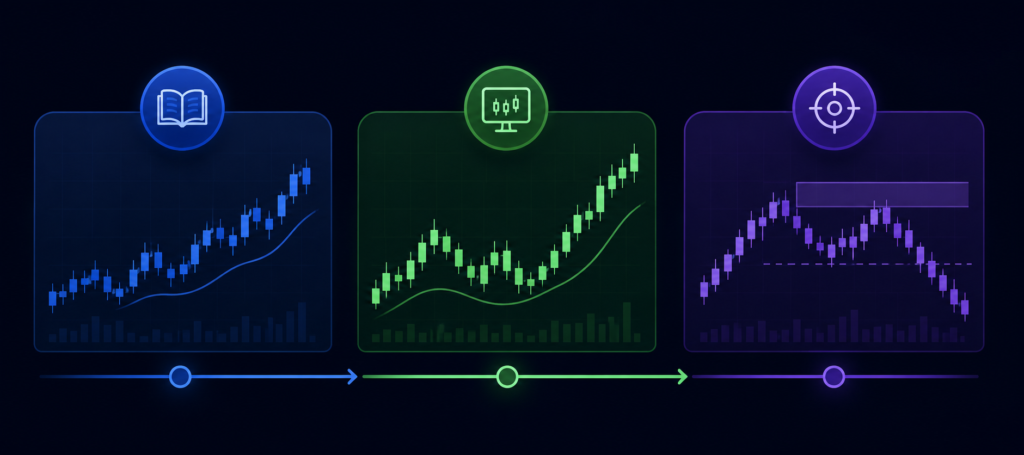
A complete day breaks into three clear phases, and each one deserves your full attention. Skipping any phase weakens the whole system. When you respect all three, your results become far more predictable.
The first phase is pre-market preparation. This is where you read the landscape before risking a cent. You scan the economic calendar, mark high-impact news, review your watchlist, and identify key support and resistance levels. Preparation is where calm, profitable trading is born. Rushed traders skip this step and pay for it later.
The second phase is live execution. This is the window when you actually place trades. Your job here is simple but hard. Follow the plan you built during preparation. Wait for your setups, size your positions correctly, and respect your stops. Execution is not the time to invent new ideas. It is the time to act on the homework you already finished.
The third phase is post-market review. After the session closes, you record what happened, score your discipline, and note lessons for tomorrow. This phase closes the feedback loop. Without review, you repeat the same mistakes for years. With it, every trade becomes a tuition payment toward mastery.
A Daily Forex Trading Routine Template You Can Copy
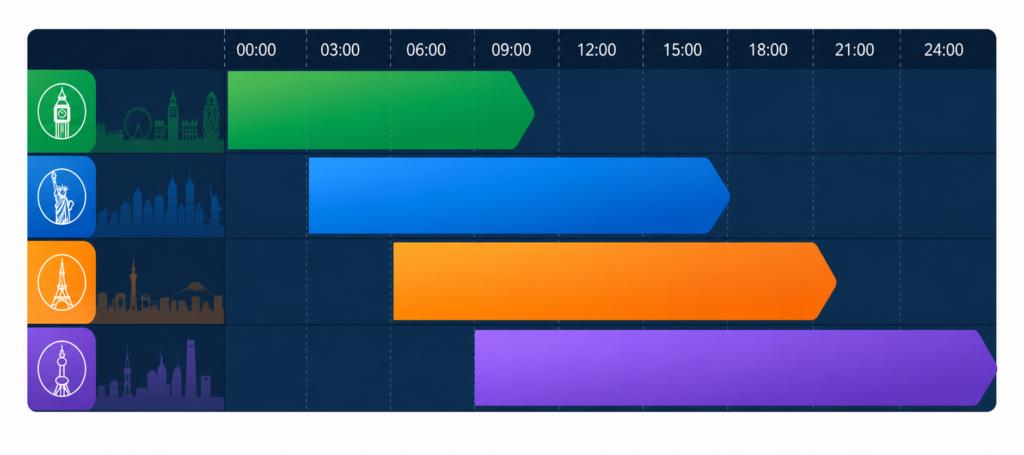
A practical daily forex trading routine template gives your day a backbone. The schedule below assumes a trader focused on the London and early New York sessions, but you can shift the clock to match your time zone and preferred pairs. The point is the structure, not the exact hour.
| Time Block | Phase | Core Activities |
|---|---|---|
| 30 to 45 min before open | Pre-market prep | Check economic calendar, mark high-impact news, review overnight price action, set key levels and alerts |
| Market open to mid-session | Live execution | Trade only A-grade setups, log entries, apply fixed risk per trade, avoid unplanned news spikes |
| Mid-session break | Reset | Step away from the screen, hydrate, reassess bias, avoid forcing trades during low-volatility chop |
| Late session | Live execution | Manage open trades, trail stops per plan, take partial profits at predefined targets |
| 20 to 30 min after close | Post-market review | Update your journal, screenshot trades, score discipline, write one lesson for tomorrow |
| Weekly, once | Strategic review | Analyze win rate, average risk-to-reward, recurring mistakes, and equity curve trend |
Notice that the template limits screen time on purpose. More hours at the chart rarely means more profit. It usually means more overtrading. A tight, intentional schedule protects both your capital and your focus.
Keep the template visible. Print it, pin it near your desk, or save it as your trading homepage. A routine you cannot see is a routine you will forget under pressure.
Forex Trader Morning Routine Tips That Set the Tone
How you start your day shapes how you trade. Strong forex trader morning routine tips begin before you ever open a chart. Your mind is your most important trading tool, so prepare it first. A few minutes of stillness, light exercise, or simply a clear head will steady your hand far more than another cup of coffee.
Once you sit down, resist the urge to jump straight into live trades. Begin with context. Read the day’s economic calendar and note when major releases hit. Surprises from central banks, inflation prints, and employment data can erase a perfect technical setup in seconds. Knowing the schedule lets you plan around the storm instead of getting caught in it.
Next, review the higher time frames before the lower ones. The daily and four-hour charts tell you the dominant trend and the levels that matter. Only after you understand the bigger picture should you drop down to your entry time frame. This top-down habit keeps you trading with the current rather than against it.
Finally, set your intentions for the session in writing. State your maximum risk, your daily loss limit, and the specific setups you will accept. Writing it down turns vague hope into a firm commitment. When the market tempts you to break a rule, that written plan becomes your anchor.
How Habits Turn Discipline Into Autopilot
Discipline feels exhausting when it depends on willpower alone. Willpower is a limited resource that drains as the day goes on. That is exactly why a forex trading routine for consistency leans on habits instead. A habit is a behavior you no longer have to argue yourself into. It simply happens.
The key is to attach trading actions to fixed cues. Open your journal the moment you close a trade. Check the calendar the moment you sit down. Run your checklist the moment you spot a setup. When each action has a trigger, you stop relying on motivation and start relying on structure. This is habit stacking, and it quietly removes friction from your entire day.
Small habits also compound. Logging one trade feels trivial. Logging every trade for a year produces a goldmine of personal data that reveals exactly where you make and lose money. Consistency is not built on grand gestures. It is built on tiny, repeated actions that you barely notice in the moment but that change everything over time.
Risk Management as the Heart of Your Routine
No routine survives without disciplined risk management. You can have a beautiful schedule and a sharp strategy, but a single oversized trade can wipe out weeks of careful work. That is why risk rules belong at the center of your daily process, not the edges.
Decide your risk per trade before the session starts, and keep it fixed. Many consistent traders risk a small, constant percentage of their account on each position. This approach means a losing streak stings but never threatens your survival. Survival is the whole game. You cannot compound an account you have blown up.
Set a daily loss limit as well. When you hit it, you stop for the day, no exceptions. This single rule has saved more accounts than any indicator ever has. It protects you from the dangerous spiral where one loss leads to a reckless attempt to win it all back. Pair the limit with predefined stop-loss and take-profit levels so emotion never decides your exits.
Position sizing ties everything together. Calculate your size from your stop distance, not from a gut feeling about how confident you are. Confidence is not a risk parameter. A mechanical approach to sizing keeps every trade aligned with your plan and keeps your equity curve smooth.
Reviewing and Refining Your Process
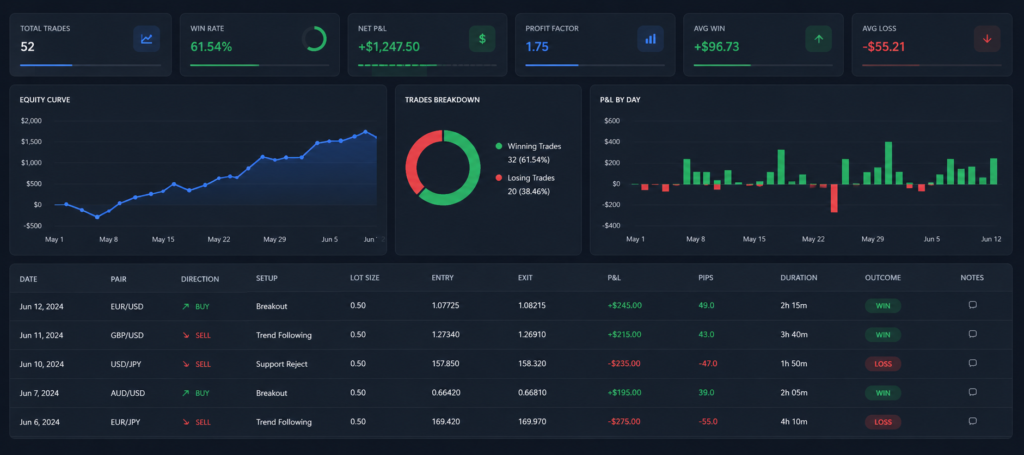
A routine is a living system, not a stone tablet. The traders who improve fastest treat review as seriously as execution. Your post-market journal is where raw experience becomes refined skill. Record not just the numbers but your state of mind, your reasons for entry, and whether you followed your rules.
Score your discipline separately from your profit and loss. This distinction matters more than it sounds. You can lose money on a perfectly executed trade and make money on a sloppy one. If you only judge yourself by the result, you will reward bad habits and punish good ones. Judging yourself by process keeps your incentives pointed in the right direction.
Once a week, zoom out. Study your win rate, your average risk-to-reward, and your recurring mistakes. Look for patterns. Maybe you lose most often during news events, or in the final hour, or after a big win. These patterns are your roadmap for improvement. Fix one weakness at a time, then test the change for several weeks before adjusting again. Steady refinement beats constant reinvention every time.

What Top Traders and Research Say
Wisdom from books, studies, and seasoned traders all points to the same conclusion. Process and discipline matter more than prediction.
In Atomic Habits, James Clear argues that you do not rise to the level of your goals but fall to the level of your systems. That idea maps perfectly onto trading. A trader without a system drifts. A trader with a routine improves automatically, because the system carries them when motivation fades.
The research agrees. In their well-known study “Trading Is Hazardous to Your Wealth,” Brad Barber and Terrance Odean analyzed thousands of retail accounts and found that the most active traders earned the worst returns. Overtrading, driven by emotion rather than process, quietly eroded their wealth. A disciplined routine that limits unnecessary activity directly counters this trap.
Seasoned traders echo the point. As Ed Seykota put it, “Win or lose, everybody gets what they want out of the market.” Consistency comes from wanting the right things: discipline, patience, and a process you trust over any single outcome.
Frequently Asked Questions
What is the best forex trading routine for consistency?
The best routine is one you can repeat every day without burning out. It should cover three phases: pre-market preparation, live execution, and post-market review. A solid daily forex trading routine template anchors each phase with fixed tasks like checking the economic calendar, trading only planned setups, and journaling afterward. Consistency comes from following the same process daily, not from chasing new strategies. Keep it simple and sustainable.
How long should my daily forex trading routine take?
For most part-time traders, a focused routine takes one to two hours, plus your live trading window. Spend around thirty to forty-five minutes on morning prep, trade only during your chosen session, and reserve twenty to thirty minutes for review. Quality matters more than hours. More screen time often leads to overtrading rather than better results, so protect your focus with clear time blocks.
What are the most important forex trader morning routine tips?
Start by clearing your mind before you open a chart. Then check the economic calendar for high-impact news, review the higher time frames first, and write down your risk limits for the day. These forex trader morning routine tips set a calm, prepared tone. Avoid jumping into live trades before you understand the day’s context. Preparation prevents the rushed, emotional decisions that hurt consistency.
How does journaling improve trading consistency?
A journal turns experience into measurable data. By recording entries, exits, reasons, and your mindset, you spot recurring mistakes you would otherwise repeat. Scoring your discipline separately from profit keeps your focus on process. Over weeks, your journal reveals exactly where you make and lose money, which lets you refine your routine with evidence instead of guesswork. It is one of the highest-value habits a trader can build.
Why do most traders struggle with consistency?
Most traders rely on willpower and emotion instead of a structured process. They overtrade, skip preparation, and chase losses. Research like Barber and Odean’s work shows that excessive, emotion-driven activity damages returns. A forex trading routine for consistency fixes this by replacing impulsive decisions with repeatable habits and firm risk rules. Without that structure, even a good strategy delivers unpredictable results.
Can beginners use a daily forex trading routine template?
Absolutely. Beginners benefit the most from structure because it builds good habits early. Start with a simple template covering preparation, execution, and review, and practice it on a demo account first. Keep your risk small and your rules strict. As you gain experience, refine the template to fit your style. A routine teaches discipline far faster than trial and error alone.
Final Thoughts
Consistency in forex is not a mystery reserved for a gifted few. It is the natural result of a process you run faithfully, day after day. A well-built forex trading routine for consistency organizes your day into preparation, execution, and review, removes the emotional decisions that drain accounts, and turns discipline into a habit you no longer have to fight for. Lean on a clear daily forex trading routine template, apply smart forex trader morning routine tips, and protect your capital with firm risk rules. Track your trades, review your process, and refine one weakness at a time. Do this long enough and your results stop depending on luck and start reflecting your skill. For more practical strategies, templates, and trading insights, keep following forextradingboards.com and start building the routine that makes your trading truly consistent.