
Quick answer: a complete forex trading strategy for beginners needs three things — a beginner-friendly setup, a fixed risk rule per trade, and demo practice before going live.
Most beginners enter the forex market with excitement — and leave with empty accounts. Not because forex is impossible, but because they start trading without a strategy, without a plan, and without the right risk management. This guide breaks down all three: beginner-friendly setups, the risk management rules that keep a small mistake from becoming a large one, and how to put it together into an actual trading plan.
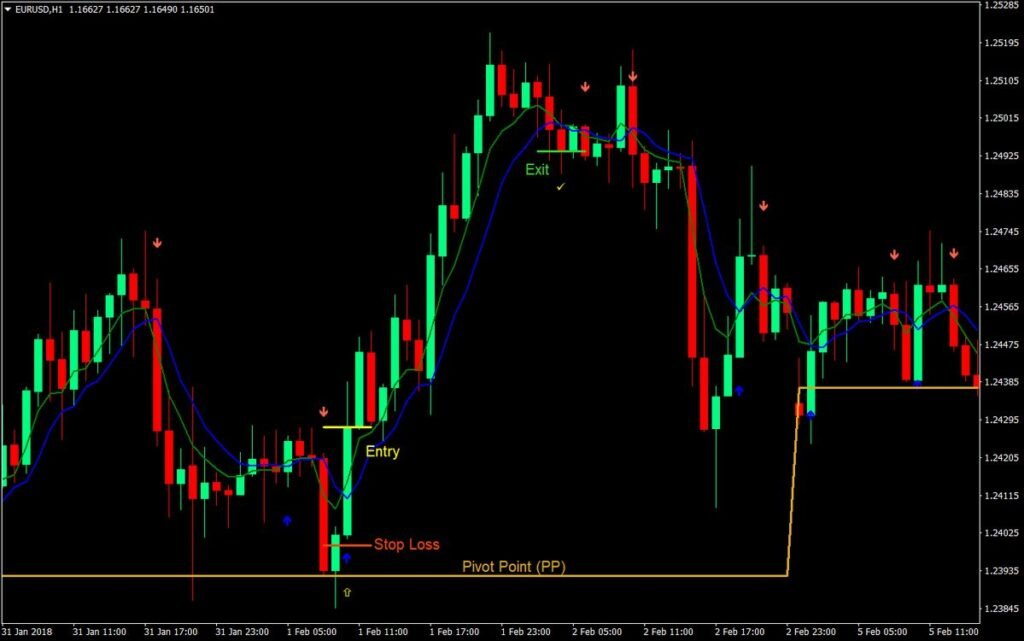
What Is a Forex Trading Strategy — And Why Do You Need One?
A forex trading strategy for beginners is a structured set of rules that tells you exactly when to enter a trade, when to exit, and how much to risk. It removes guesswork and keeps emotion out of your decisions. Without a strategy, you are not trading — you are gambling. With one, you become consistent: you know what setups to look for, you know when to sit on your hands, and over time you build the discipline that separates traders who last from those who don’t.
Step 1: Understand the Basics Before You Trade
Before you apply any forex trading strategy for beginners, you need the fundamentals. Skipping this step is one of the most common and costly mistakes new traders make.
Core concepts every beginner must know:
- Currency pairs — Forex is always traded in pairs (e.g., EUR/USD, GBP/JPY). The first currency is the base; the second is the quote.
- Pips — The smallest standard price movement in a currency pair. Understanding pips helps you measure profit and loss accurately.
- Leverage — Allows you to control a larger position with a smaller deposit. Powerful, but it magnifies losses just as much as gains without proper risk management.
- Spread — The difference between the buy and sell price, effectively the broker’s fee on every trade.
- Lots — The size of your trade. A standard lot is 100,000 units, a mini lot 10,000, and a micro lot 1,000 — micro lots are worth knowing about specifically because they let a beginner trade with meaningfully less capital at risk.
Master these basics first. Everything else builds on top of them — if you haven’t opened an account yet, our complete beginner’s guide to starting forex trading covers that groundwork.
Step 2: Choose a Forex Trading Strategy That Fits You
There is no single “best” strategy. The right one fits your personality, schedule, and risk tolerance. Here are three beginner-friendly approaches.
| Strategy | Best for | Time commitment |
|---|---|---|
| Trend Following | Riding an established directional move | Daily/4H chart checks |
| Support and Resistance | Range-bound or reversal-prone markets | Waiting for price at key levels |
| Breakout | Catching the start of a new move | Monitoring a consolidation for a decisive break |
A. Trend Following Strategy
This is the simplest and most beginner-friendly forex trading strategy for beginners. You identify the direction of the trend and trade with it, not against it.
- Use the Daily or 4H chart to find the main trend direction.
- Look for higher highs and higher lows in an uptrend.
- Look for lower highs and lower lows in a downtrend.
- Enter on pullbacks to key support or resistance levels.
- Use a moving average (like the 50 EMA) to confirm direction.
Trend following keeps you on the right side of the market the majority of the time, though it will still produce losing trades when a trend stalls or reverses without warning.
B. Support and Resistance Strategy
Price respects key levels. When price approaches a strong support zone, buyers tend to step in. When it approaches resistance, sellers tend to take control.
- Mark major swing highs and lows on the Daily chart.
- Wait for price to reach a key level before considering an entry.
- Look for a rejection candle (pin bar or engulfing candle) as confirmation.
- Place your stop loss just beyond the level, not too tight.
This strategy works on every timeframe and gets easier to apply once you train your eye to spot genuine levels versus noise.
C. Breakout Strategy
Rather than waiting for a level to hold, a breakout strategy looks for price to clear a level decisively and continue. This suits traders who’d rather catch the start of a new move than trade inside an established range.
- Identify a clear range or consolidation on the chart — price bouncing between a defined high and low.
- Wait for a candle to close beyond that range, rather than just spiking through it.
- Watch for increased volume or momentum on the breakout candle as extra confirmation.
- Place your stop back inside the range, since a break that immediately reverses is often a false signal.
Breakout trading tends to produce more false signals in quiet, low-volatility conditions, which is why confirmation (a closed candle, not just a touch) matters more here than in the other two approaches.
Step 3: Risk Management — The Part That Actually Keeps You in the Game
Picking a strategy is the easy part. Managing risk is what determines whether you’re still trading in a year. Three rules apply regardless of which of the three strategies above you choose:
- Risk a small, fixed percentage per trade — a commonly cited guideline is 2% of account balance per trade, though this is a convention rather than a rule, and your own comfort level matters too — rather than a fixed dollar amount that doesn’t scale with your account.
- Always use a stop loss. Decide where you’re wrong before you enter, not after the trade has already moved against you.
- Aim for a risk-reward ratio that makes sense. If you’re risking $1 to make $1, you need to win more than half your trades just to break even after costs. A ratio like 1:2 gives you room to be wrong more often and still come out ahead.
Step 4: Build a Trading Plan and Practice Before You Go Live
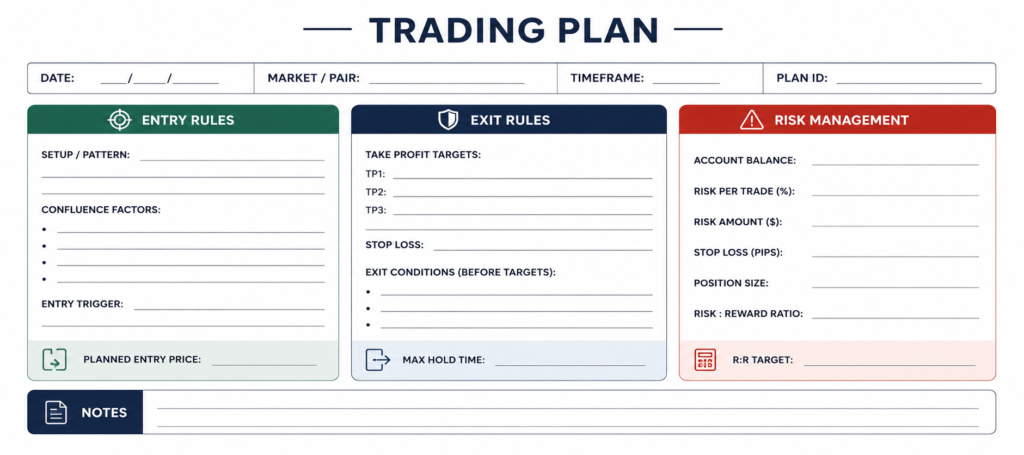
A trading plan ties the strategy and the risk rules together in writing: which setup you’re trading, your entry criteria, your stop-loss and target rules, and your maximum risk per trade and per day. Test it on a demo account first — across a few different weeks of market conditions, not just a single lucky stretch — before trading it with real money. Keep a simple journal of every trade (setup, reasoning, outcome) so you can tell whether the strategy is actually working for you.
Once you’re comfortable with the basics above, our forex swing trading strategy guide covers a longer-timeframe approach for when you’re ready to hold trades for more than a single session.
Key Takeaways
- There’s no single best forex trading strategy for beginners — trend following, support/resistance, and breakout trading are all reasonable starting points.
- Risk management (a fixed risk percentage, a stop loss on every trade, a sensible risk-reward ratio) matters more than which strategy you pick.
- Test any strategy on a demo account before trading it live, and keep a trade journal to track what’s actually working.
Frequently Asked Questions
What is the best forex trading strategy for beginners?
There isn’t one single best strategy — trend following, support and resistance, and breakout trading are all beginner-friendly starting points. The right one depends on your schedule and temperament, not a universal ranking.
How much money do I need to start forex trading as a beginner?
This depends on your broker’s minimum deposit and, more importantly, on trading only money you can afford to lose. Starting small with a micro lot while you’re still learning is safer than starting at full size.
Can I learn forex trading strategy from a demo account?
Yes, and it’s the recommended way to start. A demo account lets you practice a strategy with no financial risk before committing real capital, though it can’t fully replicate the emotional pressure of trading with real money.
How long does it take to become consistent at forex trading?
There’s no fixed timeline — it depends on the time you put in, the strategy you choose, and how disciplined you are about risk management. Treat any guaranteed timeframe you see elsewhere with skepticism.