
Introduction
If you just passed a prop firm challenge, the real test starts now. These funded trading account tips exist for one reason: keeping the account is harder than earning it. Most traders blow funded capital not because they lack skill, but because they break risk rules under pressure. The shift from a demo challenge to live-funded capital changes your psychology overnight. Suddenly drawdown limits feel personal, and every red trade stings. This guide walks you through the exact habits that protect your account, the math behind sustainable position sizing, and the mindset that separates traders who collect payouts from those who reset every month. You’ll learn how to grow funded account fast without gambling, plus daily routines, scaling logic, and the psychological traps that quietly drain accounts. Read it once, then bookmark it.
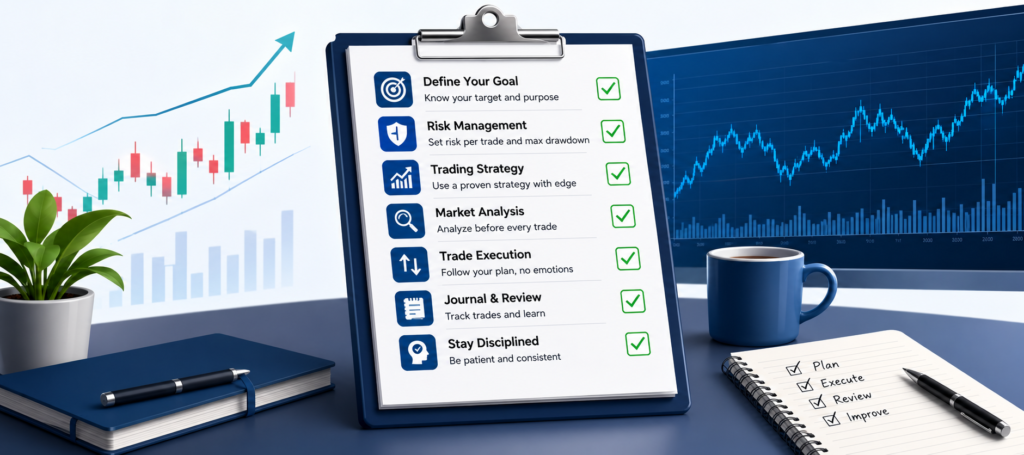
Why Keeping a Funded Account Is Harder Than Passing One
Passing the challenge is a sprint. Holding the account is a marathon. During the evaluation, you trade with a clear target and a reset button. If you fail, you pay a fee and try again. That safety net quietly encourages aggression. Once funded, the math flips. Now the firm shares profits with you, and every breach ends the relationship. The pressure shifts from “hit the target” to “do not break the rules.”
This is where most traders stumble. They carry challenge-phase aggression into a live-funded environment that punishes it. The single most useful of all funded trading account tips is to treat funded capital like a job, not a lottery ticket. Your goal is consistency, not a heroic week. Firms design their rules to filter out gamblers. A trailing drawdown that follows your equity higher will catch anyone who risks too much on a single idea. The traders who survive understand this from day one.
Think about the incentive structure. The firm makes money when you trade steadily and stay funded. You make money the same way. Your interests align around discipline, not excitement. When you internalize that, the rules stop feeling like obstacles. They become guardrails that keep you on the road long enough to collect multiple payouts. That reframe alone changes how you size positions and when you walk away from the screen.
Master the Drawdown Rules Before You Click Buy
You cannot manage a limit you do not understand. Every funded account lives or dies by two numbers: the maximum drawdown and the daily loss limit. Confuse them, and you will breach without warning. The daily loss limit caps how much you can lose in a single trading day, measured from your starting balance or equity that day. The maximum drawdown caps your total loss from the account’s high-water mark or starting balance.
The trickiest version is the trailing drawdown. It moves up as your equity grows, then locks once you reach a threshold or your starting balance plus the buffer. Many new funded traders blow accounts here. They build a small cushion, the drawdown trails up behind their gains, and then one oversized loss drops equity below the new floor. The account is gone, even though they are still net positive on paper. Mapping your exact drawdown type is non-negotiable.
Here is a practical habit. Before each session, write down three numbers: your current equity, your daily loss floor, and your maximum drawdown floor. Keep them visible. When a trade would push you near either floor, you stop. No exceptions. This single routine prevents the majority of breaches. It removes the in-the-moment math that fails under stress. Tips for trading on funded account survival almost always come back to knowing your floors cold and respecting them like a hard wall.
Risk Per Trade: The Math That Keeps You Funded
Position sizing is where funded careers are made or ended. The standard advice is to risk a small, fixed percentage per trade, and for good reason. If your account has a 10% maximum drawdown and you risk 1% per trade, you would need ten consecutive full-stop losses to breach. That gives you statistical breathing room. Risk 5% per trade, and just two bad trades put you in serious danger. The arithmetic is brutal and unforgiving.
Consider how losing streaks compound. A trader risking 1% who loses five in a row is down roughly 5%, still inside most limits and able to recover. A trader risking 4% who loses five in a row is down nearly 20%, well past most drawdown caps and out of the program. Streaks of five or six losing trades happen to everyone, even with a strong edge. Your risk per trade must assume the streak is coming, because eventually it always does.
Compounding works in your favor too, but only when you survive long enough to let it. Small, consistent gains stacked over weeks beat a single explosive day that gets followed by an explosive loss. This is the core of learning how to grow funded account fast without self-destructing: grow the account by reducing variance, not by chasing it. Lower variance means smaller, steadier position sizes and tighter risk control. Speed comes from never resetting, not from oversized bets.
| Risk Per Trade | Losses to Hit 10% Drawdown | Survivability | Recommended For |
|---|---|---|---|
| 0.5% | 20 trades | Very high | Conservative scalers, news-heavy weeks |
| 1% | 10 trades | High | Most funded traders, standard plans |
| 2% | 5 trades | Moderate | Experienced traders with proven edge |
| 3% | 3 trades | Low | High risk, only on A+ setups |
| 5%+ | 2 trades | Very low | Not recommended on funded capital |
Build a Daily Routine That Removes Emotion
Discipline is not willpower. It is structure. The traders who collect payouts month after month rely on routines that make good decisions automatic and bad decisions inconvenient. A repeatable pre-market checklist beats raw motivation every single time. Motivation fades by Wednesday. A checklist does not.
Start each day the same way. Review your floors, mark key levels, identify the sessions you will trade, and set a hard stop for total daily loss. Decide in advance how many trades you will take and what qualifies as a valid setup. When you pre-commit to these rules, you stop improvising during volatile moments. Improvisation under pressure is how accounts die. The plan exists precisely so you do not have to think clearly while your heart rate is elevated.
Equally important is the end-of-day routine. Log every trade, note your emotional state, and grade your discipline rather than your profit. A day where you followed your rules and lost a little is a good day. A day where you broke your rules and got lucky is a dangerous day, because it teaches your brain the wrong lesson. Among the most underrated funded trading account tips is journaling outcomes by process, not just by profit and loss. Over time, the journal reveals the exact habits that drain your account, and you fix them before the firm fixes them for you.

Trade With the Rules, Not Around Them
Every prop firm has a rulebook, and the fine print matters as much as the headline numbers. Read it twice before your first funded trade. Some firms ban holding positions over the weekend. Others restrict trading during high-impact news. Many enforce a consistency rule that prevents a single huge day from making up most of your profit. Violating any of these can void payouts even when you are profitable.
The consistency rule deserves special attention. It exists to stop traders from gambling their way to a target with one reckless trade. If your firm requires that no single day exceed a set percentage of total profit, you must spread gains across multiple sessions. This naturally pushes you toward steadier, lower-risk trading, which is exactly the behavior that keeps accounts alive. Fighting the rule is fighting the math that protects you.
News trading restrictions trip up many new funded traders. A position opened seconds before a major release can gap straight through your stop, blowing the daily limit in one tick. Even when a firm allows it, trading the news on funded capital is rarely worth the variance. The safer path is to stand aside during scheduled high-impact events and let the chaos pass. Respecting the rulebook is not weakness. It is how professionals stay employed by their capital provider.
Scaling: How to Grow a Funded Account Fast and Safely
Most reputable firms offer a scaling plan. Hit a profit milestone while staying inside the rules, and they increase your capital. This is the legitimate engine behind real account growth. You do not need to risk more per trade to earn more. You let the firm hand you a bigger account, then apply the same low-risk percentages to a larger base. Same discipline, bigger numbers.
Here is why scaling beats over-leveraging. Suppose you risk 1% on a 50,000 dollar account, earning steady returns. Instead of jumping to 3% risk to grow faster, you hit your scaling target and the firm bumps you to 100,000 dollars. Now your same 1% risk produces double the dollar return, with identical drawdown exposure as a percentage. You grew your income without increasing your odds of a breach. That is the difference between growth and gambling, and it is the honest answer to how to grow funded account fast.
Patience is the hidden requirement. Scaling rewards traders who can string together consistent months. The traders who try to skip the line by oversizing almost always reset before they reach the next tier. Map your firm’s scaling schedule, set realistic monthly targets, and treat each tier as a checkpoint rather than a finish line. Slow, compounding growth across multiple scaled accounts builds far more wealth than a single lucky run that ends in a breach. The market rewards the patient and punishes the rushed.
Position Sizing and Lot Calculation in Practice
Knowing you should risk 1% is useless if you cannot translate it into lot size on the fly. Every trade requires a quick calculation: account risk in dollars divided by stop distance in pips, adjusted for pip value. Get this wrong and your “1% risk” trade becomes a 3% bomb. Tools and pre-calculated tables remove the guesswork, and you should never size a position by feel.
Build a simple reference table for your most-traded pairs before the session starts. List your account size, your dollar risk per trade, common stop distances, and the matching lot sizes. When a setup appears, you read the lot size off your table instead of doing mental math under pressure. This eliminates the single most common sizing error: entering a position far larger than intended because the calculation happened in a rush.
Stop placement and sizing work together. A wider stop demands a smaller lot to keep dollar risk constant. A tighter stop allows a larger lot for the same risk. Many funded traders make the mistake of fixing their lot size and letting risk float, which means a wide-stop trade quietly doubles their exposure. Reverse that logic. Fix your dollar risk first, then let the lot size flex to fit your stop. This is one of the most practical tips for trading on funded account you can apply immediately, and it protects you on every single trade.

The Psychology That Protects Your Capital
Technical rules fail when emotions take over. Revenge trading, the urge to win back a loss immediately, has ended more funded accounts than any flawed strategy. After a loss, the disciplined trader steps away. The emotional trader doubles down, sizes up, and breaches the daily limit chasing a recovery that the market owes them nothing toward. Recognizing this impulse is half the battle.
Fear and greed sit on opposite ends of the same problem. Greed pushes you to oversize when you feel confident, just before variance humbles you. Fear pushes you to abandon a valid plan after a normal losing streak, locking in losses and missing the recovery. The antidote to both is a written plan you trust more than your in-the-moment feelings. When your rules are clear and pre-committed, you outsource the hard decisions to a calmer version of yourself.
Build psychological circuit breakers into your trading. After two consecutive losses, take a mandatory break. After hitting a daily profit goal, consider stopping to lock it in. These hard stops protect you from your own worst impulses precisely when those impulses are strongest. The best funded traders are not fearless. They are simply better at refusing to act on fear and greed. Among all funded trading account tips, mastering your own reactions delivers the highest long-term return, because no rulebook can save a trader who refuses to follow it.
What Top Traders and Research Say
The psychology of trading is well documented, and the evidence consistently points back to discipline over prediction. In Trading in the Zone, Mark Douglas argues that consistent results come from a probabilistic mindset, not from being right on any single trade. His core lesson fits funded trading perfectly: accept that any individual trade can lose, and you stop letting one outcome wreck your decisions. Funded accounts reward exactly this detachment, because survival depends on process, not on individual wins.
Academic research backs the same conclusion. In their study “Trading Is Hazardous to Your Wealth,” Brad Barber and Terrance Odean analyzed thousands of retail accounts and found that the most active traders earned the worst returns, largely because overtrading and overconfidence eroded their gains. The takeaway for funded traders is direct: more trades and more aggression usually mean worse outcomes. Trading less, but better, aligns with both the research and your firm’s rulebook.
The professionals echo this. As Paul Tudor Jones famously put it, “The most important rule is to play great defense, not great offense.” That single line captures the entire funded-account philosophy. Protect the capital first, and the profits follow.
Educational disclaimer: This article is for educational purposes only and is not financial advice. Trading carries substantial risk of loss. Funded and prop-firm arrangements vary widely, so always read your firm’s rules and consider your own circumstances before trading.
Frequently Asked Questions
How much should I risk per trade on a funded account? Most experienced funded traders risk around 0.5% to 1% per trade. This keeps you inside the drawdown limit even through a losing streak of several trades. Risking more accelerates gains but dramatically raises your odds of a breach. The goal is survival first, because a funded account you keep beats a bigger account you lose. Lower risk is the simplest of all funded trading account tips.
What is the difference between daily loss limit and maximum drawdown? The daily loss limit caps how much you can lose in one trading day, usually measured from that day’s starting balance. The maximum drawdown caps your total loss from the account’s high-water mark or starting balance. Breaching either ends the account. Always track both numbers before every session so you never cross a floor by accident.
How do I grow a funded account fast without breaking rules? The safe path to learning how to grow funded account fast is your firm’s scaling plan. Hit consistent profit milestones at low risk, and the firm increases your capital. You earn more by trading a larger account with the same small percentage risk, not by gambling. Patience and consistency, not aggression, unlock real growth.
Why do most traders lose their funded accounts? The common causes are oversizing positions, revenge trading after a loss, and ignoring drawdown rules. Many traders carry aggressive challenge-phase habits into live-funded capital that punishes them. Emotional decisions under pressure breach limits faster than any bad strategy. Strong tips for trading on funded account focus on discipline, routine, and respecting the rulebook.
Are funded trading accounts worth it? For disciplined traders, funded accounts offer leverage to real capital without risking your own savings beyond the evaluation fee. The trade-off is strict rules and a profit split with the firm. If you treat it like a job and follow a low-risk process, it can be a legitimate income path. If you treat it like a casino, the rules will quickly end the relationship.
Final Thoughts
Keeping a funded account comes down to a few unglamorous habits done consistently. Know your drawdown floors cold, risk a small fixed percentage per trade, follow a daily routine that removes emotion, and respect every line in your firm’s rulebook. Grow through the scaling plan, not through oversized bets, and let compounding do the heavy lifting over months rather than days. The traders who collect payout after payout are rarely the flashiest. They are the most disciplined. Apply these funded trading account tips with patience, journal your process, and protect your capital before you ever think about profit. Defense wins funded accounts. For more strategies, market analysis, and trading guides, visit forextradingboards.com and keep building your edge.