
Introduction
Learning how to apply for prop firm funding is the first real milestone for traders who want to scale their skills without risking their own capital. Prop firms give qualified traders access to large simulated or live accounts in exchange for a share of the profits. The catch is simple: you must prove your discipline first. That proof usually comes through a structured evaluation, often called a challenge. This guide walks you through the entire journey, from choosing a reputable firm to receiving your first payout. You will understand the prop firm application process end to end, including account sizes, fees, trading rules, and verification. By the end, you will know exactly what to prepare, what to avoid, and how to give yourself the best chance of success. Treat this as a practical roadmap, not a shortcut. Funding rewards preparation, patience, and consistency above all else.
What Prop Firm Funding Actually Means
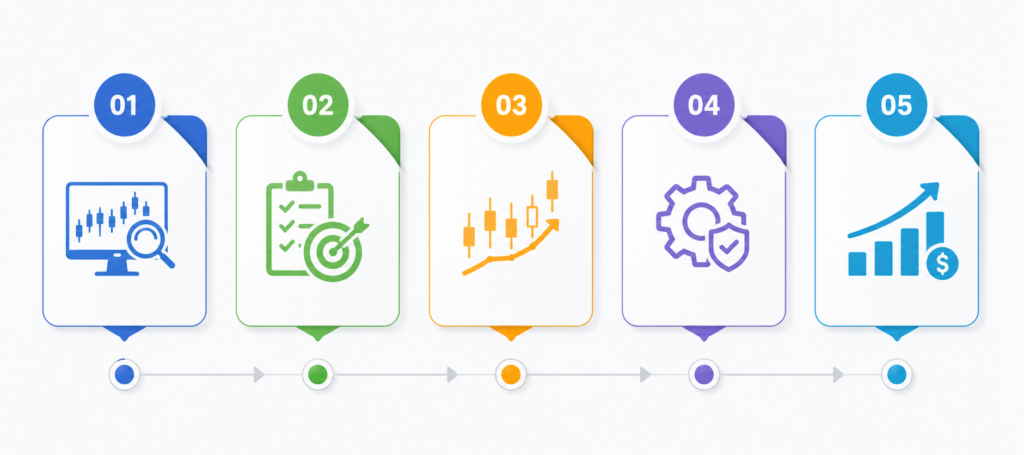
Proprietary trading firms, or prop firms, supply capital to traders who can demonstrate skill and discipline. Instead of trading your own savings, you trade the firm’s allocated balance and keep an agreed share of any profit. In return, the firm filters out reckless traders through an evaluation before handing over a funded account. This model aligns incentives. The firm wants you to succeed, because it earns from your profit split and from challenge fees. You want consistent gains, because that is what unlocks larger accounts and reliable payouts.
It helps to separate two ideas early. The challenge is a test. The funded account is the reward. Most modern firms run evaluations on simulated environments first, then either keep you on a simulated funded model or move you to live capital. Either way, the rules you follow during the challenge mirror the rules you follow once funded. Understanding this continuity is the foundation of the entire prop firm application process.
Funding is not free money, and it is not a lottery. It is a structured agreement with clear expectations. The traders who thrive treat the firm’s rules as guardrails that protect both sides. The traders who fail usually ignore risk limits chasing a fast result.
Choosing a Reputable Prop Firm Before You Apply
Your first real decision is firm selection, and it matters more than most beginners realize. A reputable firm publishes its rules clearly, pays traders on time, and maintains transparent terms. Before you spend a cent, read the rulebook in full. Look for clarity on profit targets, drawdown calculations, payout schedules, and any restricted strategies. Vague or contradictory rules are a warning sign.
Reputation is built on payouts. Search for verifiable proof that real traders have withdrawn real money. Independent reviews, trader communities, and public payout records help here, though you should weigh them critically since some feedback is biased in either direction. Pay attention to how the firm handles disputes and rule breaches, because that tells you how they will treat you on a bad day.
Consider the practical fit too. Check which platforms the firm supports, which instruments you can trade, and whether your country is eligible. A firm that ticks every box on paper but excludes your region or favorite instrument is not the right firm for you. Choosing well here prevents wasted fees and frustration later.
Selecting the Right Account Size and Challenge Type
Once you trust a firm, you choose an account size and an evaluation model. Account sizes typically range from a few thousand dollars to several hundred thousand, and the challenge fee scales with the size. Bigger accounts cost more upfront but offer larger potential payouts. Beginners often overreach here, buying a large account they are not ready to manage. Start with a size you can trade calmly, then scale up after proving consistency.
The evaluation model shapes your entire experience. Understanding the differences is central to knowing how to sign up for prop firm challenge offers that suit your style. The three common structures are the one-step challenge, the two-step challenge, and instant funding. Each balances cost, difficulty, and speed differently.
The table below summarizes typical structures. Treat these numbers as common ranges, not fixed rules, since every firm sets its own terms.
| Challenge Type | Typical Profit Target | Steps to Pass | Relative Fee | Best For |
|---|---|---|---|---|
| One-step | Often 8%–10% | 1 phase | Moderate | Traders who want speed |
| Two-step | Often 8% then 5% | 2 phases | Lower per size | Disciplined, patient traders |
| Instant funding | None to pass | 0 phases | Higher upfront | Traders who skip evaluation |
Match the model to your temperament. A patient swing trader may prefer a two-step challenge with breathing room, while an active trader confident in fast execution might accept a one-step structure or instant funding.
The Step-by-Step Prop Firm Application Process
The prop firm application process follows a predictable sequence once you commit. First, you create an account on the firm’s website, providing your name, email, and country. Next, you select your account size and challenge type from the dashboard. You then pay the evaluation fee, which is usually a one-time charge for that attempt. After payment, the firm issues your trading credentials and platform login.
From there, you trade according to the published rules until you either hit the profit target or break a limit. If you pass every required phase, the firm verifies your identity through KYC. You then sign a trader agreement, after which the firm activates your funded account. Finally, after meeting any minimum holding or trading day requirements, you request your first payout.
| Stage | What Happens | Your Goal |
|---|---|---|
| 1. Register | Create account, enter details | Accurate information |
| 2. Select | Choose size and challenge type | Realistic fit |
| 3. Pay fee | One-time evaluation payment | Confirm terms first |
| 4. Trade evaluation | Follow rules, hit target | Pass within limits |
| 5. KYC verification | Submit ID documents | Match registration name |
| 6. Sign agreement | Accept trader contract | Read carefully |
| 7. Funded account | Receive live or sim capital | Maintain discipline |
| 8. First payout | Request withdrawal | Meet holding rules |
Following this sequence calmly, without rushing any stage, dramatically improves your odds. Most failures happen during stage four, not during paperwork.
Registering and Paying the Evaluation Fee
Sign-up itself is straightforward, but accuracy matters more than speed. Use your legal name exactly as it appears on your identity documents, because any mismatch can delay KYC later. Use a reliable email address, since the firm sends credentials, payout updates, and important notices there. Some firms ask for a country of residence at this stage to confirm eligibility, so answer honestly.
The evaluation fee is the price of entry to the challenge. It is typically a single upfront payment tied to your chosen account size. Many firms refund this fee with your first payout once you pass and trade successfully, though refund policies vary, so confirm the exact terms before you buy. Knowing how to sign up for prop firm challenge offers responsibly means treating the fee as a calculated cost, not an impulse purchase.
Keep your payment confirmation and any receipts. If a dispute arises, clear records protect you. Once payment clears, your dashboard unlocks the challenge and your platform login arrives, usually within minutes to a few hours.
Understanding the Trading Rules That Decide Your Outcome
The rules are where most applications are won or lost. A profit target is the gain you must reach to pass a phase, often somewhere between five and ten percent. A daily loss limit caps how much you can lose in a single day, protecting the firm from sudden blowups. A maximum drawdown sets the floor your account balance or equity may never breach across the whole evaluation. Breaking either loss rule usually ends the attempt instantly, regardless of your profit.
Many firms also require a minimum number of trading days, which prevents traders from gambling everything on one lucky position. Some add a consistency rule, limiting how much of your total profit can come from a single trade or day. These rules reward steady performance over hero trades. Read each one and write it down before you place a single order.
Other restrictions can apply too. Some firms limit trading around high-impact news, restrict holding positions over the weekend, or cap your effective leverage. None of these are traps if you read them in advance. They become traps only for traders who skip the rulebook.
Passing the Challenge: Preparation and Mindset
Passing is less about a perfect strategy and more about repeatable discipline. Before you apply, practice your system on a demo account under the same rules you will face. Simulate the daily loss limit and drawdown, so the constraints feel familiar. This rehearsal removes surprises and builds the muscle memory that protects your account when emotions run high.
Risk small per trade. If you risk a tiny fraction of the account on each position, a losing streak cannot breach your drawdown. Steady, modest gains compound toward the target without forcing you near any limit. Aim to pass slowly and safely rather than quickly and recklessly.
Protect your mindset as carefully as your capital. Avoid revenge trading after a loss, and step away when frustration rises. Keep a simple journal of every trade and the rule context around it. Discipline practiced during the challenge is the same discipline that keeps a funded account alive.
KYC Verification, the Trader Agreement, and Your First Payout
Once you pass, the administrative phase begins. KYC, short for Know Your Customer, is a verification step where you submit a government ID and sometimes proof of address. This protects against fraud and ensures payouts go to the right person. Submit clear documents that match your registration details exactly, and verification usually completes quickly.
Next comes the trader agreement, the contract that governs your funded account. Read it carefully. It defines your profit split, payout schedule, ongoing rules, and the conditions under which the firm may close your account. Common profit splits favor the trader, often ranging from a substantial majority to nearly all of the profit, sometimes increasing as you scale.
After activation, you trade the funded account under the same disciplined rules. When you meet any minimum holding period, you request your first payout through the dashboard. The firm processes it according to its schedule, and many firms refund your original evaluation fee alongside this first withdrawal. From there, consistent performance can unlock scaling plans and larger capital over time.

What Top Traders and Research Say
Education sharpens execution, and a few credible sources reinforce why discipline matters so much in funded trading. In the book Trading in the Zone, Mark Douglas argues that consistent results come from a probabilistic mindset and rigorous rule-following rather than from predicting every market move. That message maps directly onto prop firm evaluations, where respecting risk limits beats chasing perfect entries.
Academic research supports the same caution. The well-known study by Barber and Odean, Trading Is Hazardous to Your Wealth, found that the most active retail traders tended to underperform precisely because they overtraded. For a challenge with a consistency rule and a drawdown limit, that finding is a direct warning against overtrading your way out of funding.
A short, attributed reminder ties it together. As Paul Tudor Jones famously said, “The most important rule of trading is to play great defense, not great offense.” In the context of how to apply for prop firm funding, defense means protecting your drawdown first and letting profit follow.
Suggested Images
Frequently Asked Questions (FAQs)
How do I apply for prop firm funding as a beginner?
Start by learning how to apply for prop firm funding from a reputable firm with transparent rules. Create an account, choose a small account size you can manage calmly, and select an evaluation model that suits your style. Pay the one-time fee, then trade the challenge within the published limits. Beginners succeed by prioritizing risk control over fast profit.
How much does it cost to sign up for a prop firm challenge?
The cost depends on account size and challenge type. Smaller accounts carry lower fees, while larger accounts cost more upfront. The fee is usually a single payment per attempt, and many firms refund it with your first payout. Confirm the refund policy before you buy, since terms differ between firms.
What is the difference between a one-step and two-step challenge?
A one-step challenge has a single profit target to pass, offering speed. A two-step challenge splits the evaluation into two phases with separate targets, which rewards patience and consistency. Understanding both helps you decide how to sign up for prop firm challenge offers that match your temperament and trading pace.
What rules can fail my prop firm application?
The most common failures come from breaching the daily loss limit or the maximum drawdown. Some firms also enforce minimum trading days, consistency rules, news restrictions, and weekend holding limits. Reading the full rulebook before you trade is the single best protection during the prop firm application process.
How long does it take to get a funded account and first payout?
Timing varies by firm and challenge model. After you pass, KYC verification and the trader agreement usually take a short period. Once funded, you typically trade for a minimum holding period before requesting your first payout. Payout processing then follows the firm’s published schedule.
Is instant funding better than passing a challenge?
Instant funding skips the evaluation but usually costs more upfront and may carry stricter ongoing rules. A challenge model is cheaper per account size and proves your discipline before you trade real stakes. The better choice depends on your confidence, budget, and trading style.
Final Thoughts
Applying for prop firm funding is a structured journey, not a gamble. You begin by choosing a reputable firm, then select an account size and evaluation model that fit your skill and budget. You register, pay the fee, and trade the challenge under clear rules covering profit targets, daily loss, and maximum drawdown. Pass the evaluation, complete KYC, sign the trader agreement, and your funded account activates. Disciplined, patient trading then leads to your first payout and, over time, to scaling larger capital. The traders who win treat risk management as the priority and the rules as guardrails. Prepare thoroughly, trade calmly, and let consistency do the heavy lifting. For more practical, trader-focused guides on funding, strategy, and market analysis, keep learning with forextradingboards.com.
This article is for educational purposes only and does not constitute financial, investment, or trading advice. Trading carries significant risk; always do your own research and consider professional guidance before making financial decisions.