
Introduction
The ict turtle soup setup is one of the most reliable liquidity-grab reversal patterns in modern price-action trading. It works because price rarely respects obvious levels the way retail traders expect. Instead, the market pushes just beyond a prior swing high or low, triggers a wave of stop orders resting there, and then snaps back inside the range. That false breakout is the trap. In this guide, you will learn exactly what is turtle soup in trading, why the pattern originated with the legendary Turtle traders, and how ICT adapted it using liquidity, market structure shifts, and fair value gaps. We break down the precise entry, stop, and target logic, the best sessions and pairs, and the confluence that separates a clean signal from noise. By the end, you will know how to fade breakouts with confidence and discipline.
What Is Turtle Soup in Trading?
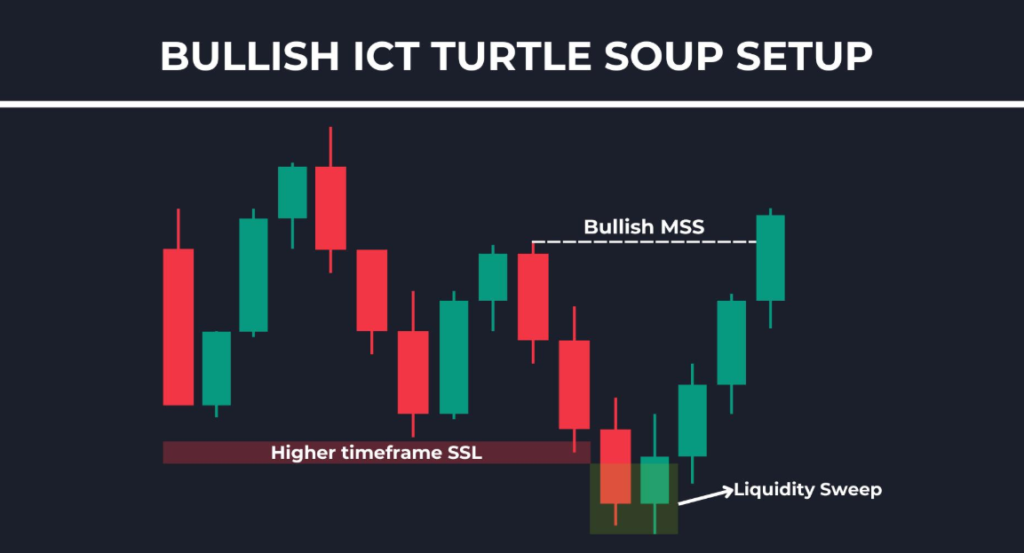
To understand what is turtle soup in trading, start with the trap it exploits. A turtle soup trade is a fade of a failed breakout. Price breaks beyond a recent swing high or low, then reverses back into the range within a few candles. The breakout looks strong. Momentum traders pile in. Breakout traders place stops just beyond the level. Then the move fails. Price reverses hard, and everyone who chased the breakout is caught on the wrong side.
The name has real history. In the 1980s, a group known as the Turtles traded a famous trend-following system built on 20-day and 55-day breakouts. Buy new highs, sell new lows, ride the trend. It worked well in trending markets. But many breakouts failed. Linda Raschke and Laurence Connors noticed this and designed a countertrend pattern to fade those failed 20-day breakouts. They called it Turtle Soup, a playful jab at eating the Turtles’ losing signals for lunch.
The ict turtle soup version keeps the same core idea but reframes it through liquidity. Instead of talking about failed breakouts alone, ICT explains why they fail. Stops rest above old highs and below old lows. Large players need that liquidity to fill big orders. Price is drawn to those pools, sweeps them, and reverses once the orders are filled. The breakout was never real. It was a liquidity grab.
Why the Turtle Soup Pattern Works
Every reversal setup needs a reason to work, and the turtle soup trading strategy rests on a simple truth about order flow. Markets move toward liquidity. Resting orders cluster in predictable places: above swing highs, below swing lows, and around equal highs and equal lows. Traders place stop-loss orders there. Breakout traders place entry orders there. That concentration of orders is fuel.
When price sweeps a prior high, it triggers the buy stops of short sellers and the buy entries of breakout traders. This gives large sellers the volume they need to enter short positions without slipping the price against themselves. Once filled, they no longer need higher prices. Price reverses. The same logic applies in reverse below a swing low, where a sweep triggers sell stops and hands large buyers their liquidity.
This is why the pattern is often called a stop hunt. It is not manipulation in a conspiratorial sense. It is the natural result of how large orders interact with clustered liquidity. The turtle soup setup simply reads that behavior and positions against the crowd. You are not guessing a top or bottom. You are waiting for proof that the breakout failed, then trading the reversion.
How to Identify an ICT Turtle Soup Setup
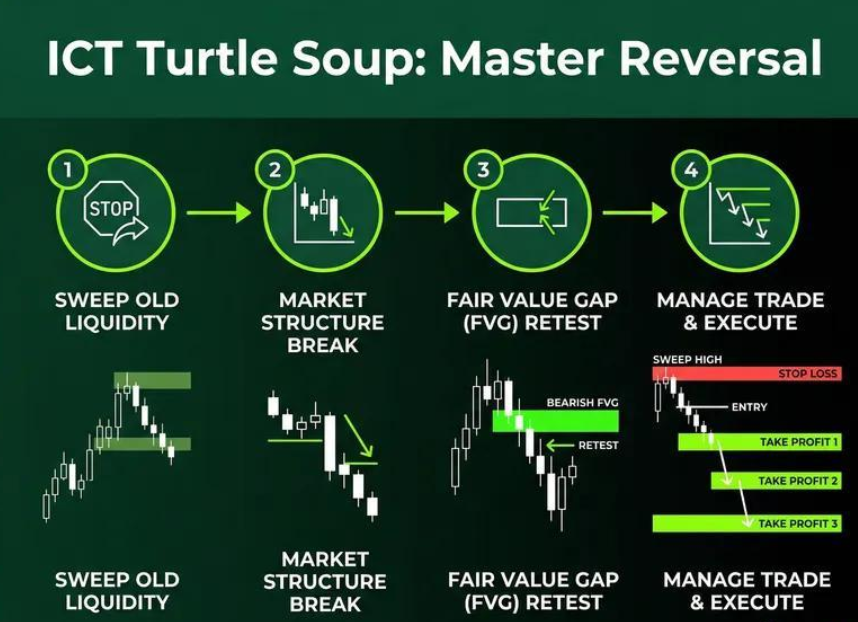
Identifying a clean ict turtle soup requires patience and a clear checklist. First, mark a significant prior swing high or swing low on your chart. The best levels are obvious ones: recent session highs and lows, previous day highs and lows, and areas of equal highs or equal lows where liquidity is heavily stacked. These are the targets price is likely to hunt.
Next, wait for price to sweep that level. A sweep means price trades beyond the old high or low, often with a sharp wick, and then closes back inside the range. The rejection wick is a strong tell. It shows that price probed the liquidity, found no follow-through, and got rejected.
Then look for the reversal signal. In ICT terms, this is a market structure shift, sometimes called a change of character. After the sweep, price should break a recent short-term structure point in the opposite direction. If price swept a high and then breaks below the last minor low, that is your confirmation. A displacement candle, meaning a strong impulsive move that leaves a fair value gap, adds conviction. The gap becomes a high-quality entry zone on the pullback.
Here is a compact checklist of the core signal, kept to one short list for clarity:
- A clear prior swing high or low with resting liquidity
- A sweep that trades beyond the level and closes back inside
- A market structure shift confirming reversal
- Ideally a displacement move leaving a fair value gap to enter on
Buy-Side vs Sell-Side Turtle Soup: Setup Comparison
The turtle soup pattern is symmetrical, but the labels confuse many traders. In ICT language, liquidity is named by where the stops sit, not by the direction you trade. Buy-side liquidity sits above old highs. Sell-side liquidity sits below old lows. When price grabs buy-side liquidity above a high, you look to sell. When it grabs sell-side liquidity below a low, you look to buy. The table below makes the two mirror setups clear.
| Element | Sell Setup (Buy-Side Sweep) | Buy Setup (Sell-Side Sweep) |
|---|---|---|
| Liquidity targeted | Buy-side, above a prior swing high | Sell-side, below a prior swing low |
| Price action | Sweeps above the old high, then closes back below | Sweeps below the old low, then closes back above |
| Confirmation | Break of structure to the downside | Break of structure to the upside |
| Trade direction | Short / sell | Long / buy |
| Entry zone | Fair value gap or order block above entry | Fair value gap or order block below entry |
| Stop placement | Above the sweep high (the wick) | Below the sweep low (the wick) |
| First target | Nearest opposing liquidity below | Nearest opposing liquidity above |
Reading the table, notice the symmetry. Both setups hunt clustered stops, both require a structure shift, and both place the stop just beyond the extreme of the sweep. Master one side and you understand the other.
Exact Entry, Stop, and Target Rules
Precision is what turns a concept into a tradable turtle soup trading strategy. Start with the entry. The cleanest entry comes after the market structure shift, not during the sweep itself. Chasing the sweep is a common way to get stopped out on a deeper probe. Instead, wait for the structure break, then enter on the retracement into the fair value gap or order block left behind by the displacement move. This gives you a tighter stop and a better price.
Your stop-loss goes just beyond the extreme of the sweep. If you sold a buy-side sweep above a high, your stop sits a few pips above the sweep wick. If price trades back above that high, the setup has failed and you want to be out. Keeping the stop beyond the wick, not at the old level, protects you from a slightly deeper hunt.
For targets, let liquidity guide you. The first logical target is the opposing liquidity pool, typically the swing low or high on the other side of the range. Many traders scale out there and trail the remainder toward the next higher-time-frame draw on liquidity. Because the stop is tight and the target reaches across the range, a well-timed turtle soup often offers a reward-to-risk ratio of three to one or better. Never widen your stop to stay in a losing trade. The tight stop is the edge.
Position sizing matters as much as the setup. Risk a fixed small percentage of your account per trade, commonly one percent or less. Even a high-probability pattern loses regularly. Consistent sizing keeps a normal string of losses survivable and lets the edge play out over many trades.
Best Times and Pairs for Turtle Soup
Timing sharpens the ict turtle soup edge. Liquidity sweeps happen most cleanly when volume and volatility rise, which points to the major session opens. The London open and the New York open, often called kill zones in ICT material, are prime windows. A frequent sequence unfolds when the Asian session builds a tight range, London sweeps one side of that range to grab liquidity, and then reverses. This Asian-range sweep is a textbook turtle soup on the 5-minute and 15-minute charts.
Previous day highs and lows are also magnet levels. Price often runs the prior day’s extreme early in a new session, then reverses. Watching those levels around the London and New York opens produces some of the highest-quality setups.
Pair selection favors liquid instruments with clean structure. Major forex pairs such as EUR/USD, GBP/USD, and USD/JPY respect these levels well because they carry deep liquidity and tight spreads. Indices like the Nasdaq and S and P also show textbook sweeps during the New York session. Avoid thin, exotic pairs where erratic spikes muddy the pattern and stops get run for no clean reason.
Confluence That Strengthens the Setup
A sweep alone is a starting point, not a signal. The strongest turtle soup trading strategy trades stack confluence. The first and most important layer is higher-time-frame bias. Establish direction on the 1-hour or 4-hour chart, then take turtle soup entries only in that direction on the lower time frames. Fading a sweep in line with the higher-time-frame trend has a far better hit rate than fighting it.
Draw on liquidity is the second layer. Ask where price is likely headed next. If a clear opposing liquidity pool sits across the range, the reversal has a logical destination and a clean target. Fair value gaps and order blocks provide the third layer, offering precise entry zones with defined risk. When a sweep reverses into a fresh fair value gap that aligns with your bias, conviction rises.
Time confluence ties it together. A sweep during the London or New York kill zone, aligned with the higher-time-frame trend, targeting obvious opposing liquidity, and entering on a fair value gap, is about as high-probability as short-term trading gets. The more of these boxes you tick, the more confident and the more selective you should be.
Common Mistakes to Avoid
Even a strong pattern punishes sloppy execution. The most common mistake is entering on the sweep itself rather than waiting for the market structure shift. Price can wick deeper than expected, and early entries get stopped before the real reversal begins. Discipline to wait for confirmation is the difference between a hunter and prey.
A second mistake is trading against the higher-time-frame trend without cause. Not every sweep reverses. In a strong trend, a sweep is often just liquidity fueling continuation, not a turnaround. Trading every sweep as a reversal is a fast way to bleed an account. Filter with bias.
Widening stops is the third killer. The tight stop beyond the sweep wick is the entire edge of the setup. Moving it to avoid a loss destroys your reward-to-risk and turns small losses into large ones. Take the stop and move on. Finally, avoid low-liquidity levels and dead sessions. Sweeps of insignificant intraday wiggles produce weak signals. Trade the obvious, heavily stacked levels during active hours, and let the marginal setups pass.
What Top Traders and Research Say
The original pattern is documented in a genuine, respected source. Linda Bradford Raschke and Laurence A. Connors introduced Turtle Soup in their 1995 book Street Smarts: High Probability Short-Term Trading Strategies. They designed it explicitly as a fade of the Turtle traders’ 20-day breakout, and the book lays out the rules for taking failed breakouts as reversal signals. The ict turtle soup framework builds directly on that foundation, adding the language of liquidity and market structure. Mark Douglas, in Trading in the Zone, reinforces the psychological discipline these trades demand, arguing that consistent execution of an edge matters more than any single outcome.
On the research side, academic work supports the idea that technical patterns carry information. Lo, Mamaysky, and Wang, in their 2000 Journal of Finance study “Foundations of Technical Analysis,” used statistical methods to show that certain chart patterns provide incremental value beyond random price movement. Their findings lend credibility to structured price-action approaches like turtle soup, which read repeatable behavior rather than guess.
Raschke summed up the mindset behind fading failed moves with a line worth remembering: “The market can do anything at any time.” The point is humility. Trade the setup, respect the stop, and let probability work across many trades.
Frequently Asked Questions
What is turtle soup in trading? Turtle soup is a reversal setup that fades a failed breakout. Price breaks beyond a prior swing high or low, sweeps the liquidity resting there, then quickly reverses back into the range. It was created to fade the Turtle traders’ 20-day breakout signals, and the ICT version explains the failure through liquidity and stop hunts.
Is ict turtle soup the same as the original Raschke pattern? They share the same core logic. The original Turtle Soup by Raschke and Connors fades failed 20-day breakouts. The ict turtle soup version reframes it with liquidity, market structure shifts, and fair value gaps, giving more precise entry and confirmation rules while keeping the same fade-the-breakout idea.
Where do I place my stop loss on a turtle soup trade? Place your stop just beyond the extreme of the sweep, a few pips above the sweep high on a short or below the sweep low on a long. If price returns past that wick, the setup has failed. This tight stop is the main source of the strategy’s strong reward-to-risk.
What time frames work best for the turtle soup trading strategy? Higher time frames like the 1-hour or 4-hour set your bias, while entries are taken on the 5-minute and 15-minute charts. Sweeps during the London and New York kill zones, especially of the Asian range or previous day highs and lows, produce the cleanest signals.
Which pairs suit this setup best? Liquid majors such as EUR/USD, GBP/USD, and USD/JPY respect these levels well, along with indices like the Nasdaq during the New York session. Avoid thin, exotic pairs where erratic spikes create false sweeps and unreliable stops.
How reliable is turtle soup? No pattern wins every time. With higher-time-frame bias, clean liquidity, and a confirmed structure shift, turtle soup can be highly effective, but it still loses regularly. Consistent risk management and patience for confirmation matter more than any single trade.
Final Thoughts
The ict turtle soup setup rewards traders who understand why breakouts fail rather than those who simply chase them. When you learn to spot a liquidity sweep, wait for the market structure shift, and enter with a tight stop beyond the wick, you position yourself against the trapped crowd with a clear, logical edge. Layer in higher-time-frame bias, kill-zone timing, and fair value gap entries, and the strategy becomes a repeatable process rather than a guess. Like every edge, it works over many trades, not one, so protect your capital, respect your stops, and stay selective. For more in-depth price-action guides, trading strategies, and market breakdowns, keep learning with us at forextradingboards.com and sharpen your edge one setup at a time.