
Introduction
The new week opening gap ICT concept is one of the most practical tools in the Inner Circle Trader toolkit, yet many traders still misread it. Each weekend, price closes on Friday and reopens on Sunday at a different level. That empty space is the New Week Opening Gap, and ICT treats it as a permanent reference for support, resistance, and fair value. In this guide, you will learn exactly what a NWOG is, how to mark it correctly, and why its midpoint matters so much. We will cover consequent encroachment, weekly bias, target selection, and confluence with other liquidity draws. By the end, you will know how to plot the gap, read how price reacts to it, and fold it into a repeatable weekly routine. This is a complete, practical breakdown built for real chart application.
What Is a New Week Opening Gap?
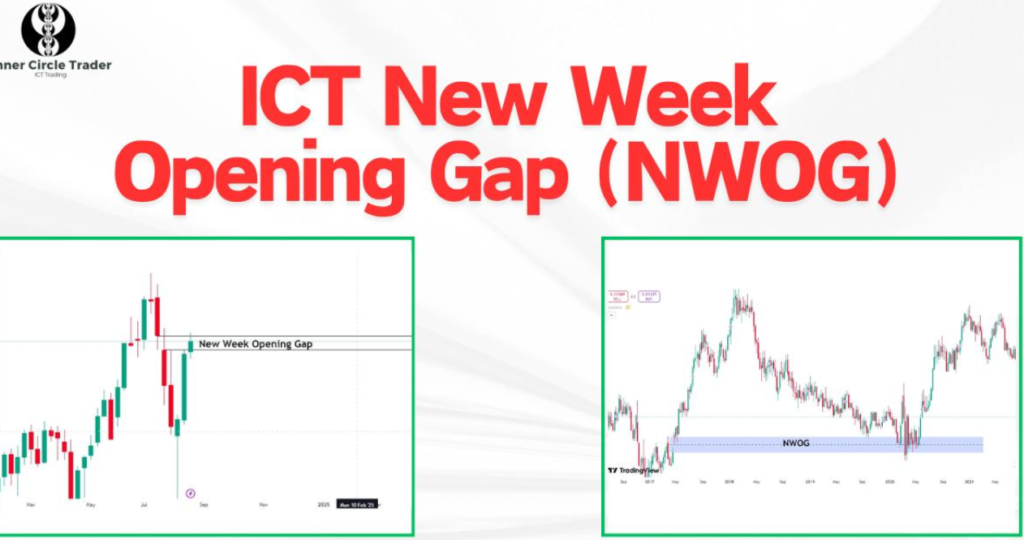
A New Week Opening Gap is the price difference between Friday’s session close and Sunday’s session reopen. The forex market pauses on Friday and returns on Sunday evening. During that pause, the world keeps moving. News breaks, sentiment shifts, and orders queue up. When trading resumes, price rarely opens at the exact level where it stopped. That empty vertical space on the chart is the gap.
So what is nwog in trading? It is a mapped reference zone, not a single line. ICT defines it using two prices. The first is the Friday close, typically the 16:59 New York time price on many index and forex feeds. The second is the Sunday open, usually 17:00 or 18:00 New York time depending on the instrument and broker. You draw a box or two horizontal lines connecting those two prices. That box is your NWOG.
The gap matters because the algorithm that delivers price respects these institutional reference points. ICT teaches that price is not random. It moves between engineered levels of liquidity and fair value. The weekend gap is one of those engineered levels. It represents an area of thin or absent trading, a small void the market may revisit later to rebalance.
Unlike a fair value gap that forms inside a single trading session, the NWOG is tied to the calendar. It resets every week. This makes it a clean, objective marker. Two traders looking at the same feed should draw nearly the same gap. That objectivity is exactly why nwog trading appeals to structured, rule-based traders who dislike guesswork.
How to Mark the NWOG on Your Chart
Marking the gap is simple, but precision matters. First, confirm your chart is set to New York time or Eastern Time. ICT concepts assume this reference. If your platform uses broker server time or GMT, your Friday close and Sunday open candles will sit in the wrong place, and your gap will be wrong.
Next, find the last Friday candle before the weekend pause. Note its closing price. Then find the first Sunday candle when the market reopens. Note its opening price. Draw a rectangle from the Friday close to the Sunday open, extended to the right across the new week. You now have your NWOG box.
The table below shows the two anchor prices you need and what they represent.
| Element | Price used | Typical time (NY) | Role |
|---|---|---|---|
| Upper or lower bound | Friday session close | 16:59 ET | End of prior week delivery |
| Opposite bound | Sunday session reopen | 17:00 / 18:00 ET | Start of new week delivery |
| Consequent encroachment | Midpoint of the two | midpoint | Fair value / mean threshold |
| Extension | Box projected right | Full week | Reference for the week ahead |
A short checklist keeps your marking consistent:
- Use New York time, confirm the Friday close and Sunday open candles, draw the box, mark the midpoint, and extend it across the week.
Keep older gaps on your chart too. Many ICT traders keep the last three to five NWOGs visible. Price often reaches back several weeks to tag an unfilled gap. If you delete last week’s gap, you lose a level the market may still target. A faded or thin box for older gaps and a bold box for the current one keeps the chart readable.
Consequent Encroachment: The Midpoint That Matters
The single most important line inside the gap is its midpoint. ICT calls this consequent encroachment, often shortened to CE. It is simply the 50 percent level between the Friday close and the Sunday open. You calculate it by averaging the two prices.
Why does the midpoint matter more than the edges? ICT teaches that price delivery gravitates toward fair value, and the CE represents the fair value of the gap. When price trades into a NWOG, it frequently reacts precisely at consequent encroachment rather than at the outer boundary. Traders who watch only the top and bottom of the gap often miss the cleanest reaction, which happens at the center.
Consequent encroachment acts as a two-way level. In an uptrend, price may dip into the gap, tag the CE, and continue higher. The midpoint offers support. In a downtrend, price may rally into the gap, reject at the CE, and roll over. The midpoint offers resistance. This dual behavior makes the CE a genuine decision point rather than a passive marker.
The concept works because it mirrors how the algorithm treats other fair value structures. A fair value gap has a consequent encroachment. A swing has an equilibrium at 50 percent. The weekend gap is no different. Learning to respect the midpoint is what separates a trader who understands new week opening gap ict from one who just draws boxes.
How Price Interacts With the Gap
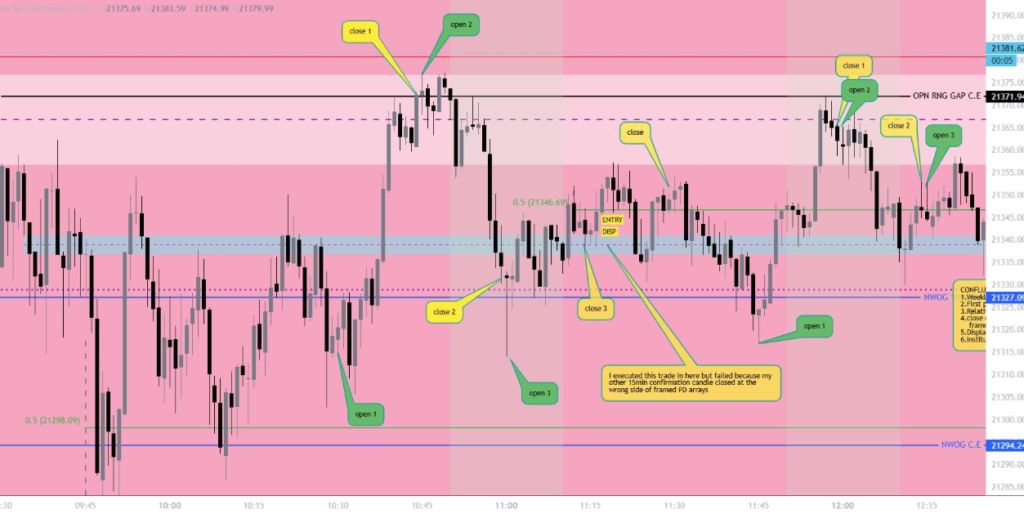
Price interacts with a NWOG in a few recognizable ways, and reading these interactions is where the edge lives. The first behavior is respect. Price approaches the gap, reacts at the edge or the midpoint, and reverses. This tells you the level is active and the market is defending fair value.
The second behavior is fill. Price trades fully through the gap, closing the void. A filled gap is not a failure. It is information. Once a gap fills, the level often flips from a magnet into a launchpad. Price may use the filled zone as a base for the next expansion.
The third behavior is overlap and confluence. When a NWOG sits on top of a prior fair value gap, an old high, or a key session level, the zone becomes far more reliable. Multiple reasons to react at the same price create a stronger reaction. Isolated levels are weaker than clustered ones.
The fourth behavior is the draw. ICT frames unfilled gaps as a draw on liquidity. If a large NWOG sits above current price and remains unfilled, the market may be drawn upward to rebalance it. The gap becomes a target the algorithm wants to reach. This forward-looking read is what turns a static level into a directional forecast.
Watch how the first touch behaves. A clean, sharp rejection at the CE signals strong intent. A slow, grinding overlap that eventually pushes through signals weakness. The quality of the reaction, not just its presence, guides your confidence.
Using the NWOG for Weekly Bias
The gap is a powerful anchor for weekly bias, which is one of the hardest parts of trading to get right. At the Sunday open, ask a simple question. Where is price relative to the gap and its midpoint?
If price opens and holds above the NWOG and its consequent encroachment, the bias leans bullish. The market is trading in premium relative to the gap but defending it as support. Pullbacks into the CE that hold become buying opportunities aligned with the week’s likely direction.
If price opens and stays below the gap and CE, the bias leans bearish. Rallies into the gap that reject become selling opportunities. The midpoint acts as the ceiling the market respects.
If price opens inside the gap, the bias is neutral until price picks a side. Wait for a decisive close above or below the CE before committing. Trading inside an unresolved gap is choppy and low probability. Patience here protects your account from midweek noise.
This framework gives nwog trading a structured starting point every single week. Instead of guessing direction from a blank chart, you begin with a reference and a question. That structure reduces emotional, reactive decisions and builds a repeatable process you can journal and refine.
NWOG vs New Day Opening Gap
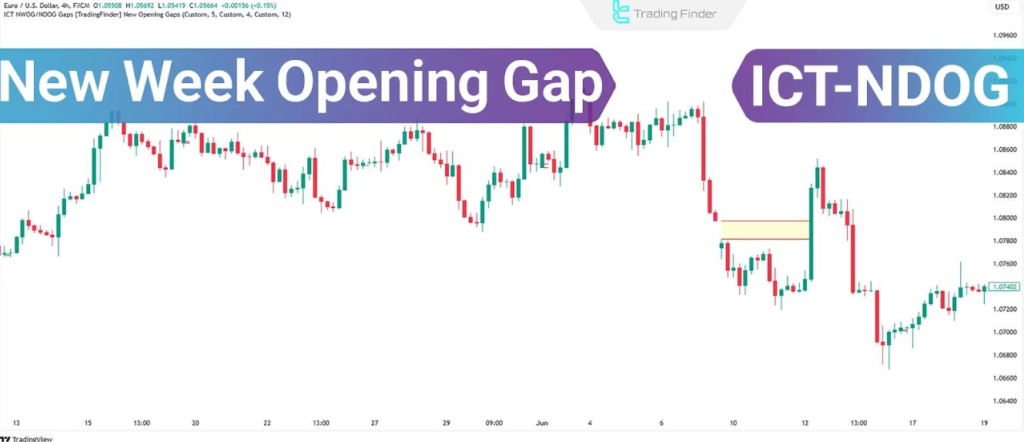
Traders often confuse the New Week Opening Gap with the New Day Opening Gap, or NDOG. Both are ICT gap concepts, but they operate on different timeframes and carry different weight. The comparison table below clarifies the distinction.
| Feature | New Week Opening Gap (NWOG) | New Day Opening Gap (NDOG) |
|---|---|---|
| Formed between | Friday close and Sunday open | Prior day close and next day open |
| Frequency | Once per week | Once per trading day |
| Typical strength | Stronger, wider reference | Shorter-term reference |
| Best use | Weekly bias and swing targets | Intraday reactions and scalps |
| Persistence on chart | Kept for several weeks | Often cleared within days |
| Midpoint name | Consequent encroachment | Consequent encroachment |
The core mechanic is identical. Both mark the space created when the market pauses and reopens. Both use consequent encroachment as the key internal level. The difference is scale. The NWOG spans a full weekend and reflects two days of accumulated sentiment, so it tends to be wider and more influential. The NDOG forms overnight and suits intraday traders looking for shorter reactions.
Most swing and position traders favor the NWOG because it aligns with the weekly narrative. Intraday scalpers lean on the NDOG for session-level reactions. Many skilled traders track both, using the daily gap for entries and the weekly gap for direction. Combining them layers your reference levels and sharpens your read of where price is likely drawn next.
Combining the Gap With Other Liquidity Draws
The NWOG rarely works best in isolation. Its real power appears when you stack it with other ICT draws on liquidity. Think of the gap as one voice in a chorus. When several levels agree, the signal is loud.
Start with liquidity pools. Old highs and lows hold resting orders, stops from trapped traders. If a NWOG midpoint sits just beyond a cluster of old highs, price may sweep that liquidity and then react at the CE. The sweep provides the fuel, and the gap provides the destination. That pairing is a classic ICT setup.
Next, layer fair value gaps. When a NWOG overlaps a fair value gap from a strong displacement move, the combined zone becomes a high-probability reaction area. The two imbalances reinforce each other. Add session timing, and the picture sharpens further. Reactions that occur during the New York or London killzone carry more weight than reactions in quiet, low-volume hours.
Also watch premium and discount. If the NWOG sits in the discount half of the weekly dealing range and price is bullish, buying the gap aligns with the larger structure. If the gap sits in premium during a bearish week, selling into it makes sense. Alignment across concepts is the goal.
The lesson is simple. One level is a hint. Three aligned levels are a plan. The new week opening gap ict concept becomes far more reliable when it confirms, and is confirmed by, the rest of your analysis rather than standing alone.
Practical Application and a Weekly Routine
Turning theory into results requires routine. Build a repeatable Sunday and midweek process around the gap so nothing depends on mood or memory.
On Sunday evening, before the week begins, mark the fresh NWOG. Note the Friday close, the Sunday open, and the consequent encroachment. Check whether price opened above, below, or inside the gap, and write down your resulting bias in one sentence. Then scan the chart for confluence. Are there old NWOGs still unfilled? Fair value gaps nearby? Liquidity pools above or below? Note the most likely draw for the week.
During the week, let price come to your levels. Do not chase. When price reaches the gap, watch the reaction at the CE. If it aligns with your bias and confluence, look for a lower-timeframe confirmation such as a shift in structure or a small fair value gap forming in your direction. That confirmation is your entry trigger. Place your stop beyond the gap boundary, not at the midpoint, so a shallow overshoot does not knock you out.
For targets, use the next opposing draw. If you buy at a NWOG in discount, an unfilled gap or old high above becomes a logical target. The gap that started your trade points toward the gap that ends it. This keeps entries and exits inside one coherent framework.
Review every week. Journal how price treated each gap. Over time you will notice which conditions produce clean reactions and which produce messy fills. That feedback loop, more than any single setup, is what makes nwog trading a durable skill rather than a lucky streak.
What Top Traders and Research Say
Serious study of gaps and levels is not unique to ICT. It sits within a long tradition of technical analysis. In Technical Analysis of the Financial Markets, John J. Murphy explains how gaps mark areas of imbalance between supply and demand, and how the market often returns to fill them. That classic principle underpins why a weekend gap acts as a reference and a magnet, giving the modern NWOG concept a solid analytical foundation.
Academic research supports the broader idea that technical patterns carry information. In their 2000 Journal of Finance study, “Foundations of Technical Analysis,” Andrew W. Lo, Harry Mamaysky, and Jiang Wang used automated pattern recognition across decades of data and concluded that several technical indicators provided incremental information. Their work lends credibility to the view that structured levels, including gaps, are not pure noise.
The trader’s mindset matters as much as the level. As Paul Tudor Jones put it, “The secret to being successful is to have an intense, unwavering focus.” A gap is only useful if you apply it with discipline and consistency, week after week.
Frequently Asked Questions
What is NWOG in trading? NWOG stands for New Week Opening Gap. It is the price space between Friday’s session close and Sunday’s session reopen. ICT traders mark it as a reference zone for support, resistance, and fair value. The gap and its midpoint act as levels the market may revisit. Answering what is nwog in trading simply, it is a mapped weekend gap used to guide weekly bias and targets.
How do I calculate the consequent encroachment? Consequent encroachment is the midpoint of the gap. Add the Friday close and the Sunday open, then divide by two. That average is the CE. Price often reacts most cleanly at this level rather than at the gap’s outer edges, so many traders treat it as the key decision point inside the NWOG.
Does the new week opening gap ICT concept work on all instruments? It works best on instruments with a clear weekend pause, such as forex pairs and index futures. The new week opening gap ict framework needs a genuine Friday close and Sunday open. Markets that trade continuously, like some crypto, do not form a true weekend gap, so the concept applies differently or not at all there.
How long should I keep a NWOG on my chart? Keep the last three to five gaps visible. Price frequently reaches back several weeks to fill an old, unfilled gap. If you erase prior gaps, you lose levels the market may still target. Use faded boxes for older gaps and a bold box for the current week to keep your chart clean and readable.
Is nwog trading suitable for beginners? Yes, with practice. The mechanics are objective and easy to mark, which makes nwog trading approachable. Beginners should start on a demo account, journal every reaction, and combine the gap with basic bias and confluence before risking capital. Master the reference first, then add entries and risk management gradually.
Final Thoughts
The new week opening gap ict concept gives you something most traders lack: a clean, objective starting point every single week. By marking the Friday close and Sunday open, respecting the consequent encroachment midpoint, and reading how price interacts with the gap, you convert the weekend void into a genuine edge. Layer it with liquidity pools, fair value gaps, and premium-discount context, and the NWOG stops being a lone line and becomes part of a complete framework for bias and targets. Discipline and journaling turn the concept into a durable skill. For more ICT breakdowns, forex strategy guides, and market analysis, visit forextradingboards.com and keep sharpening your edge one week at a time.
Related guides:
This article is for educational purposes only and does not constitute financial advice. Trade at your own risk.