
Comparing options? See our independent Blue Guardian prop firm review alongside these picks.
Are Forex Prop Firms Regulated? The Complete Truth for Traders in 2025
The forex prop trading industry has exploded in recent years. Thousands of traders now use prop firms to access large capital without risking their own money. But one question keeps coming up are forex prop firms regulated?
This is not just a technical question. It directly affects your money, your safety, and your future as a trader. Let’s break it down clearly.

What Is a Forex Prop Firm?
A prop firm, or proprietary trading firm, provides traders with funded accounts. Traders pass an evaluation challenge, follow specific risk rules, and then trade with the firm’s capital. Profits are split between the trader and the firm.
It sounds simple. But the regulatory side is anything but.
Are Forex Prop Firms Regulated? The Honest Answer
Here is the short answer: most forex prop firms are not regulated in the traditional sense.
Unlike retail forex brokers, prop firms do not hold client funds. They do not execute trades on behalf of clients. Because of this, they fall outside the standard regulatory framework used for brokers.
Most prop firms operate under a business model where traders use simulated or demo accounts during the challenge phase. Only a handful of firms use live capital from the start.
This means regulators like the FCA (UK), ASIC (Australia), or the FSCA (South Africa) do not have direct authority over most prop firms.
So Are Prop Firms Legit?
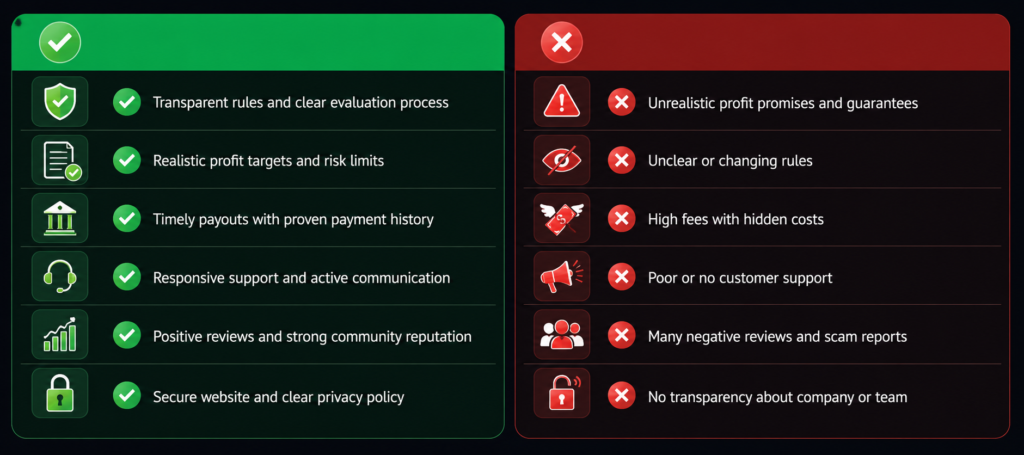
Yes many regulated prop firms and well-established prop companies are completely legitimate. Being unregulated does not automatically mean a firm is a scam. However, it does mean you must do your homework.
Legitimate prop firms typically:
- Have clear, published terms and conditions
- Offer transparent profit splits (usually 70%–90%)
- Provide verifiable payout records and trader testimonials
- Use reputable platforms like MetaTrader 4/5 or cTrader
- Have responsive customer support and dispute resolution channels
- Have been operating for multiple years with a solid reputation
Red flags to watch out for:
- No published company address or registration details
- Vague or constantly changing rules
- Refusal to process payouts without clear reason
- Overwhelmingly negative reviews on Trustpilot or Forex Peace Army
- No social media presence or community engagement
Which Prop Firms Have Some Form of Regulation?
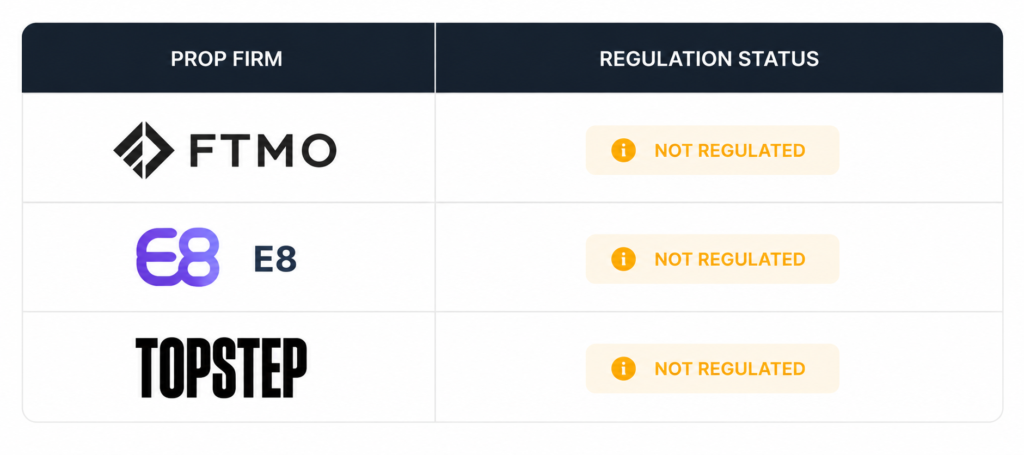
A small number of prop firms have taken steps toward regulatory compliance. Here is a quick comparison of notable firms:
| Prop Firm | Regulated? | Regulation Body | Account Type |
| FTMO | Partially | Czech Trade Inspection Authority | Simulated |
| The Funded Trader | No formal regulation | None listed | Simulated |
| MyForexFunds (MFF) | Was under scrutiny | CFTC/NFA (US) action | Simulated |
| Funder Trading | Registered business | Local business license | Simulated |
| True Forex Funds | No | None listed | Simulated |
Key takeaway: Even the most popular firms in the industry operate primarily through simulated accounts and remain outside traditional forex regulation.
Why Are Most Prop Firms Unregulated?
The business model makes regulation difficult to apply. Here is why:
- Traders are not clients in the legal sense they are independent contractors
- No real client money is held or managed
- The firm profits from challenge fees, not from trader losses on live markets
- International operations make jurisdiction complex
This regulatory grey area is not illegal. But it does place the responsibility on the trader to vet each firm carefully.
How to Choose a Safe and Legit Prop Firm
Even without strict regulation, you can still find trustworthy regulated prop firms or highly reputable unregulated ones. Follow these steps:
- Research the firm’s history: How long have they been operating? Are there public payout proofs?
- Read the rules carefully: Daily drawdown, maximum loss limits, and news trading restrictions vary widely.
- Check reviews: Use Trustpilot, Reddit (r/Forex), and Forex Peace Army for unfiltered trader feedback.
- Understand the fee structure: Challenge fees range from $50 to $1,000+. Know what you are paying for.
- Test customer support: Email or chat before you sign up. Slow or vague responses are a warning sign.
- Start small: Begin with a smaller account size to verify the payout process before scaling.
What Regulators Are Doing About Prop Firms
Regulators are taking notice. In 2023, the US Commodity Futures Trading Commission (CFTC) and the National Futures Association (NFA) took action against MyForexFunds, one of the largest prop firms at the time. This sent a clear message to the industry.
Regulators in the UK, EU, and South Africa are also reviewing the prop trading space. More oversight is likely coming in 2025 and beyond.
This is actually good news for traders. Greater regulation means greater protection.

Frequently Asked Questions (FAQs)
Are prop firms regulated by the FCA?
Most prop firms are not regulated by the FCA. The FCA regulates retail brokers that manage client funds. Most prop firms use simulated accounts and fall outside this scope.
Is it safe to trade with an unregulated prop firm?
It depends on the firm. Many unregulated prop firms are legitimate businesses with strong reputations. Always research thoroughly before committing any challenge fees.
Can I lose more than my challenge fee?
No. In most prop firm models, your maximum loss is the challenge fee you paid upfront. The firm absorbs trading losses on the simulated account.
Which prop firm is most trusted in 2025?
MO, Topstep, and E8 Funding are among the most trusted and longest-running firms. Always check the latest reviews as the industry changes quickly.
Are prop firms worth it for beginner traders?
Prop firms can be valuable for skilled traders. However, beginners should focus on education and demo trading first. Failing multiple challenges wastes both money and time.
Final Thoughts
o, are forex prop firms regulated? The honest answer is mostly no, but many are still trustworthy and legitimate.
The prop trading industry is growing fast. Regulation is coming, but it has not fully arrived yet. As a trader, your best protection is knowledge. Understand the business model. Read the terms. Verify payouts. Start small.
Regulated prop firms are rare, but reputable ones exist. Choose wisely, trade responsibly, and always put your capital safety first.